

EasyJet is the first airline in the world that signed a contract with aerospace giant Airbus for its carbon removal initiative that will offset flight emissions with its Direct Air Capture (DAC) technology.
With Airbus’ Carbon Capture Offer, via its Direct Air Carbon Capture and Storage (DACCS), EasyJet can use the carbon removal credits to advance its climate goals, and aviation’s decarbonization targets.
The deal makes the British low-fare airline the first partner of the Airbus carbon removal efforts.
Building a Sustainable Aviation Ecosystem
The aviation industry is responsible for emitting about 3% of global energy-related carbon emissions, per data from last year. And as the world was recovering from the pandemic, aviation’s emissions started to climb again to >1 billion tonnes.
The hard-to-abate industry aimed to reach net zero emissions by 2050, primarily through sustainable aviation fuel (SAF) and carbon capture. DAC is one of the widely available and scalable carbon capture technologies today.
DAC traps and removes carbon directly from the air, often through high powered giant fans. The captured CO2 is then stored safely in underground reservoirs. Or better yet, the gas can be used to make sustainable aviation fuel, further helping the industry cut its footprint.
While carbon emitted during aircraft operations can’t be directly rid of at the source, DAC can extract the same amount from the atmosphere.
EasyJet’s Group Markets Director Thomas Haagensen said that the airline considers carbon removal essential in helping them achieve their net zero goal. That entails investing into relevant projects like DAC to “accelerate the development of zero carbon emission aircraft technology.”
EasyJet Net Zero Roadmap
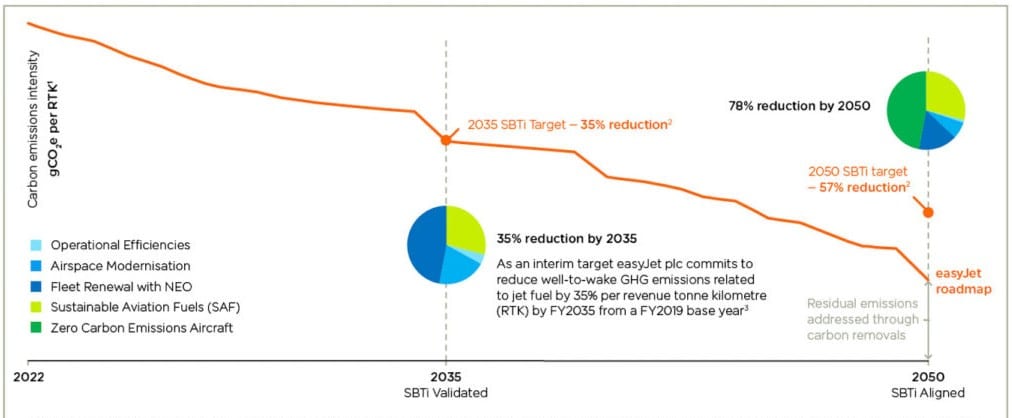 The Swiss airline plans to hit net zero emissions flying by 2050 as outlined in its roadmap published in 2022. The roadmap also says that EasyJet seeks to reduce carbon footprint per passenger by 78% by 2050.
The reduction will be through switching to fuel-efficient aircraft and greener fuels like SAF. The remaining 22% will be through carbon capture technologies.
EasyJet was one of the first major airlines to offset all of its emissions, amounting to 8.7 million tonnes. It’s also one of the first in the aviation to negotiate with Airbus to possibly pre-purchase durable carbon removal credits.
An executive from Airbus commented on their partnership noting that their deal shows EasyJet’s willingness to extend its environmental commitment. He further added that:
“Initiatives such as this one underline Airbus’ commitment to decarbonization solutions for our industry and to, bringing together airlines and industry players from all sectors in order to build a sustainable aviation ecosystem.”
Airbus’ Commitment in Decarbonizing Aerospace
Airbus’ carbon removal credits at 400,000 metric tons will be issued by its partner DAC company 1PointFive. The carbon credits will be effective between 2026 – 2029.
1PointFive is a subsidiary of oil major Occidental (Oxy) focusing on carbon capture. The company is currently developing what it says will be the biggest DAC plant in the world – Stratos. The facility is in the Texas Permian Basin aiming to capture 500,000 tonnes of CO2 per year.
Airbus has been at the forefront of the aerospace sector’s decarbonization efforts. It has been consistently refining its products and services to better tackle climate change. The company is an active proponent of various global decarbonization initiatives to help curb the industry’s carbon footprint.
For instance, it’s spearheading innovations in aircraft and aerodynamic design and architecture to reduce the industry’s environmental footprint. Currently, all their units can fly with a SAF blend of 50% maximum, aiming to make it 100% by 2030.
While EasyJet is Airbus’ first partner, there are other operators that inked letters of intent for 1PointFive’s carbon removal initiative. These include the Virgin Atlantic, Air Canada, Air France-KLM, Lufthansa Group, IAG, and LATAM Airlines Group.
Airbus’ carbon removal credits initiative for the airlines is part of its broader decarbonization strategies.
EasyJet’s partnership with Airbus marks a huge stride toward achieving sustainable aviation and reducing carbon emissions in the industry. Through carbon removal credits with DAC technology, they aim to offset flight emissions and accelerate the development of zero-carbon aircraft technology, contributing to aviation’s net zero aspiration.