

The U.S. battery storage market achieved unprecedented growth in 2024, fueled by the need for renewable energy integration and improved grid stability. The year surpassed previous records, highlighting the sector’s rapid expansion and future potential.
Power Surge: How Battery Storage Is Transforming the U.S. Grid
Large-scale lithium-ion battery storage installations in the U.S. reached new heights in 2024, surpassing the previous year’s record.
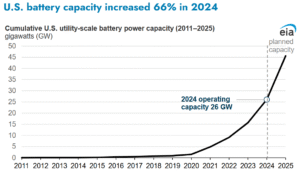
By November, developers had added over 9 GW of new capacity, setting a new benchmark for the industry. This remarkable growth pushed the nation’s cumulative battery storage capacity to exceed 26 GW by the end of 2024, per the U.S. Energy Information Administration.
Most installed battery systems are designed for 1 to 4 hours of discharge, with many directly connected to solar farms. These hybrid setups provide dual benefits:
- Renewable energy generation, and
- Storage for use during peak demand periods or when solar production wanes.
Among the major projects completed in 2024, Quinbrook Infrastructure Partners’ Gemini Solar Plus Storage Project in Nevada stands out. This massive facility, which became fully operational in July, combines a 690-MW solar farm with a 380-MW/1,416-MWh battery system. It delivers power under a 25-year agreement with NV Energy, supporting grid reliability and renewable energy adoption.
Charging the Future with Expanding Battery Projects Pipeline
The pipeline for future battery storage projects in the U.S. remains robust, reflecting sustained confidence in the sector. By the third quarter, developers had begun construction on 14.2 GW of new battery power capacity, with an additional 2 GW in advanced development.
Looking further ahead, the U.S. battery storage market has a planned pipeline of 143 GW of non-hydro energy storage projects through 2030. This includes ambitious goals for the next few years, including:
- 43.6 GW in 2025,
- 37.3 GW in 2026, and
- 33.8 GW in 2027.
These figures highlight the industry’s rapid evolution and its critical role in the energy transition.
Battery Storage Key to 60% Carbon Reduction
Battery storage is emerging as a critical driver of the energy transition, with costs falling and adoption accelerating. Major companies are expanding their offerings to meet surging demand fueled by the rise of AI and data centers. Both of these will significantly increase energy consumption, driving substantial growth in the global battery storage market.
Electric vehicles (EVs) alone will replace millions of barrels of oil daily by 2030, intensifying the need for large-scale energy storage in the power sector.
According to the International Energy Agency (IEA), achieving net-zero emissions requires energy storage capacity to grow six-fold by 2030. This means reaching 1,500 GW by that period.
- Batteries are expected to drive 90% of this expansion, increasing 14-fold to 1,200 GW, while other technologies like pumped storage and compressed air provide support.
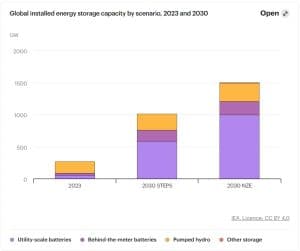
This rapid growth calls for annual battery deployment to rise by 25%. Batteries could account for 60% of carbon reductions by 2030, both directly through EVs and solar PV systems and indirectly via electrification and renewable energy integration.
As battery storage scales up, it remains essential to decarbonizing the energy sector and ensuring electricity security worldwide. In the U.S., certain states are leading the charge in battery storage development and planning.
Who is Leading the Battery Charge?
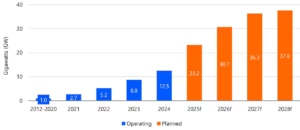
California maintains its dominance with 12.5 GW of installed capacity in 2024. Most of this operates within the California Independent System Operator’s (CAISO) service area.
Cumulative operating and planned battery storage capacity in CAISO, 2020-2028
Texas follows with a little over 8 GW of installed capacity, supported by its vast renewable energy resources and deregulated energy market. Arizona and Nevada also feature prominently, while no other state has surpassed the 1 GW threshold.
When it comes to planned projects, Texas leads with around 60 GW of battery storage in development, far outpacing California’s 35 GW. Nevada ranks third, followed by Arizona and Oregon.
This geographical distribution highlights the growing regional diversity in battery storage investments, driven by varying energy demands, renewable energy policies, and state-level incentives.
Toward a Clean Energy Future with Solar + Storage
The 2024 additions reflect a healthy mix of hybrid and standalone systems, showcasing the versatility of battery storage solutions. Of the nearly 9.2 GW added this year, around 6 GW were standalone projects, while 3.2 GW were hybrid systems, mostly colocated with solar farms.
These hybrid setups are particularly valuable for enhancing the efficiency of renewable energy projects. By combining solar generation with battery storage, hybrid facilities can store excess solar power during the day and discharge it during periods of high demand or low solar output.
This ability to smooth energy supply and demand makes hybrid systems a critical component of the grid’s transition to cleaner energy sources.
The Atrisco Solar Plus Storage Project in New Mexico is another noteworthy example of hybrid development. This facility includes a 360-MW solar farm paired with a 300-MW/1,200-MWh battery system.
The project delivers power under a 20-year agreement with the Public Service Company of New Mexico, underscoring the long-term viability and economic benefits of such projects.
The rapid growth of the U.S. battery storage market in 2024 reflects broader efforts to decarbonize the energy system. By enabling the integration of renewable energy and improving grid reliability, battery storage is becoming an indispensable tool for achieving national and state-level clean energy goals.