


Companies and governments worldwide are transitioning to a low-carbon economy and corporations are under increasing pressure to reduce their carbon footprints. Tech giants, such as Meta, Apple, and Netflix, have committed to achieving net-zero emissions by 2030, while mining and energy giants like Barrick, Newmont, and ExxonMobil are following suit. For investors, this evolving trend presents a unique opportunity to invest in carbon stocks and support innovative companies focused on carbon reduction and capture.
Why Carbon Stocks Are Gaining Traction in 2025
Carbon stocks are becoming increasingly popular as people and organizations alike strive to meet climate goals. These stocks represent companies that focus on reducing or offsetting carbon emissions. They are drawing attention not only for their environmental benefits but also for their potential financial returns.
With governments and corporations prioritizing carbon reduction technologies and emissions offsets, the market for carbon-related solutions is poised for rapid growth.
In 2025, here are the top five carbon stocks worth keeping on your radar.
1. Brookfield Renewable Partners (BEP): A Leader in Clean Energy
Brookfield Renewable Partners (BEP) is one of the world’s largest publicly traded renewable energy companies. With a clear focus on clean, renewable energy, BEP distinguishes itself from many of its competitors by operating as a pure-play renewable energy company. This means that its portfolio consists exclusively of renewable sources of power generation, unlike other companies that often combine renewable energy with fossil fuel assets.
Global Portfolio and Capacity
As of 2024, BEP’s diversified portfolio encompasses over 35,000 megawatts of operating capacity across various renewable energy sources:
- Hydroelectric Plants: 229 facilities
- Wind Farms: 105 installations
- Solar Power Plants: 88 sites
- Energy Storage Facilities: 700 megawatts of capacity
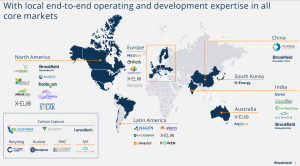
This extensive array of assets spans multiple regions, including North America, South America, Europe, and Asia, underscoring BEP’s commitment to global renewable energy development.
Financial Performance, Growth, and Expansion Plans
In the third quarter of 2024, BEP reported Funds From Operations (FFO) of $278 million, equating to $0.42 per unit. This represents an 11% increase compared to the same period in the prior year, highlighting the company’s robust financial health and operational efficiency.
Over the past 5 years, BEP has maintained an average dividend yield of around 5%. Since its inception over two decades ago, it has reached over $109 billion in assets under management globally.
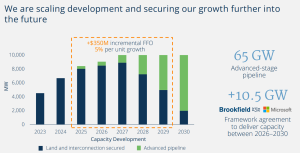
The company is actively pursuing an ambitious growth strategy, with a development pipeline poised to add 11,000 megawatts of capacity. This expansion represents a 46% increase over the current operating capacity, with plans to execute these developments over the next 3 years.
Successful realization of this pipeline could enable the renewable energy company to significantly scale its power generation capabilities. Here’s what BEP’s development and growth plans look like, highlighting its 10.5 GW partnership with Microsoft:
Positioning in the Transition to Clean Energy
As corporations worldwide strive to achieve net-zero carbon emissions, the demand for renewable energy sources is escalating. BEP’s exclusive focus on carbon-free energy positions it as a preferred partner for companies seeking to reduce their carbon footprints.
For investors seeking exposure to the renewable energy sector with a preference for established companies demonstrating stable growth and reliable returns, Brookfield Renewable Partners represents a compelling option.
2. Aker Carbon Capture ASA (AKCCF): Pioneering Carbon Capture Solutions
Aker Carbon Capture (AKCCF) is a Norwegian company specializing in carbon capture technology. Leveraging its expertise from the Aker Group, a global leader in offshore engineering, Aker Carbon Capture has developed modular carbon capture systems that are both cost-effective and scalable.
One of the company’s standout innovations is the “Just Catch” modular carbon capture plant. It is designed to meet the needs of mid-sized industries like cement, biomass, and waste-to-energy. This plant reduces the time and cost typically associated with custom-built carbon capture facilities.
Aker has also developed a proprietary amine solvent, a technology that efficiently captures CO₂ from industrial emissions. This solvent is highly stable, has low degradation rates, and minimizes energy consumption, making it a cost-effective solution for industries looking to reduce their carbon footprint.
The technology has been successfully deployed in real-world projects, such as the CO₂ capture pilot at the Norcem cement plant in Brevik, Norway.
Aker Carbon Capture is also undergoing a joint venture with SLB to form SLB Capturi, which will further accelerate the development of large-scale carbon capture technologies. The carbon capture company partnered with Microsoft last year to capture and store carbon at pulp and paper mills.
Financial Performance, Key Projects, and Outlook
As of the third quarter of 2024, ACC ASA reported a net loss of NOK 47 million. The company maintained a robust financial position with NOK 4.5 billion in cash and an equity standing at NOK 5.5 billion.
ACC ASA is involved in several significant carbon capture projects including:
- Heidelberg Materials Brevik CCS Project (Norway): Captures 400,000 tonnes of CO₂ annually.
- Ørsted’s BECCS Project (Denmark): Deploying five Just Catch units to capture up to 500,000 tonnes of CO₂.
- Twence Project (Netherlands): Captures 100,000 tonnes of CO₂ annually for use in local agriculture.
With a solid financial foundation and strategic partnerships, ACC ASA is well-positioned to expand its carbon capture solutions globally. The aim is to contribute significantly to the reduction of industrial CO₂ emissions and support the transition to a low-carbon economy.
3. LanzaTech Global, Inc. (LNZA): Turning Emissions into Valuable Products
LanzaTech Global, Inc. (LNZA) is a pioneering carbon recycling company that transforms waste carbon emissions into sustainable fuels and chemicals through innovative biotechnology using gas fermentation. Through this process, industrial emissions—rich in carbon monoxide and carbon dioxide—are converted into ethanol and other chemicals.
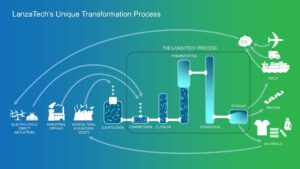
The company uses proprietary microbes engineered to thrive in industrial gas streams, such as those found in steel mills and refineries. These microbes consume waste gases, turning them into useful products.
The ethanol produced can serve as a building block for various products, including jet fuel, plastics, and synthetic fibers.
Financial Performance and Strategic Development
In the third quarter of 2024, LanzaTech reported revenue of $9.9 million, a decrease from $17.4 million in the second quarter and $19.6 million in the third quarter of 2023. This decline was primarily due to a timing delay in a LanzaJet sublicensing event, which was expected to generate about $8.0 million in licensing revenue.
LanzaTech has been actively expanding its technological capabilities and market reach:
- CirculAir Initiative: In June 2024, LanzaTech and its subsidiary LanzaJet introduced CirculAir, a commercially viable solution designed to convert waste carbon and renewable power into sustainable aviation fuel (SAF).
- Project Drake: LanzaTech advanced Project Drake, a 30-million-gallon sustainable aviation fuel project, furthering its commitment to large-scale SAF production.
Key Projects and Partnerships
The carbon recycling company has engaged in several significant projects and collaborations, including:
- Technip Energies Collaboration: Received U.S. Department of Energy funding to commercialize CO₂-to-ethylene technology.
- Eramet Partnership: Developing a Carbon Capture, Utilization, and Storage (CCUS) project in Norway.
- LanzaJet Initiative: Introducing CirculAir, a technology to produce sustainable aviation fuel (SAF).
Additionally, LanzaTech is developing a novel biocatalyst to directly convert CO₂ to ethanol at 100% carbon efficiency, leveraging affordable, renewable hydrogen. This transformative technology aims to produce biofuels and feedstocks for valuable products using carbon-free renewable energy, water, and CO₂.
With a solid financial foundation bolstered by recent capital raises and strategic partnerships, LanzaTech is well-positioned to expand its carbon recycling solutions globally, creating sustainable products from waste carbon.
4. Occidental Petroleum Corporation (OXY): Carbon Capture with Enhanced Oil Recovery
Occidental Petroleum (OXY) is a major player in the oil and gas industry. However, in recent years, the company has been transforming itself into a leader in carbon management solutions.
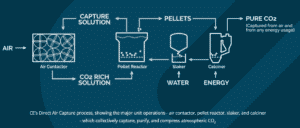
Occidental has embraced Direct Air Capture (DAC) technology, which removes CO₂ directly from the atmosphere. In partnership with Carbon Engineering, Occidental is constructing the world’s largest DAC facility in Texas, a groundbreaking project that will play a significant role in achieving global emission reduction targets.
Financial Performance
In the third quarter of 2024, Occidental reported net income attributable to common stockholders of $964 million, or $0.98 per diluted share. The company has scheduled the announcement of its fourth-quarter 2024 financial results for February 18, 2025.
Carbon Capture Initiatives
Occidental is actively investing in DAC technology through its subsidiary, 1PointFive. The company’s flagship DAC facility, named STRATOS, is under construction in the Permian Basin.
STRATOS is designed to extract 500,000 metric tons of atmospheric CO₂ annually, laying the foundation for commercial-scale DAC deployment. The facility will begin operations in the summer of 2025, with live power anticipated to come online in December 2024.
Occidental plans to integrate the captured CO₂ into enhanced oil recovery (EOR) processes, injecting the CO₂ into aging oil fields to extract additional oil while effectively sequestering the CO₂ underground.
This approach creates a closed-loop system that both boosts oil production and reduces atmospheric carbon.
Additionally, Occidental is developing a project to transport and store CO₂ captured from Velocys’ planned Bayou Fuels biomass-to-fuels project in Natchez, Mississippi, in secure geologic formations.
The Bayou Fuels project converts waste woody biomass into transportation fuels, and applying CO₂ capture and storage can make the facility a net-negative carbon dioxide emitter.
Occidental’s approach is an example of how traditional energy companies are evolving to embrace sustainability. By combining its existing expertise in oil extraction with innovative carbon capture methods, Occidental is paving the way for a future where fossil fuel extraction can coexist with carbon reduction technologies.
5. Equinor ASA (EQNR): Leading the Way in Carbon Storage and Capture
Equinor, formerly known as Statoil, is a Norwegian energy giant that has diversified its portfolio to include renewable energy sources like wind power. It has also been at the forefront of carbon capture, utilization, and storage (CCUS) technologies for over 25 years.
Their extensive experience includes operating the world’s first dedicated CO₂ storage site at the Sleipner field since 1996 and the Snøhvit field since 2008. The image from the company’s presentation below shows its overall performance in the latest report.
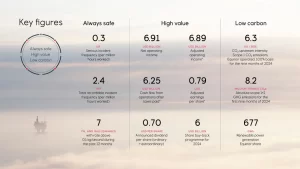
Moreover, Equinor is a key player in the Northern Lights project, a pioneering initiative in Norway aimed at developing a large-scale CCS infrastructure.
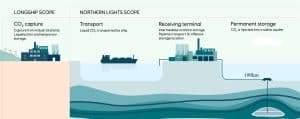
The Northern Lights project focuses on capturing CO₂ from industrial sources, transporting it via ships, and securely storing it beneath the North Sea seabed. This project is a crucial step in addressing the complexities of CCS, and Equinor is positioning itself as a facilitator of this transformative technology.
What makes the Northern Lights project particularly noteworthy is its open-source infrastructure. It allows other companies to use the storage facilities. This collaborative model could accelerate the widespread adoption of CCS technology across Europe and beyond.
Financial Performance
Other Key Projects and Developments
- Bayou Bend CCS Project: Equinor has acquired a 25% interest in Bayou Bend CCS LLC, positioning it to be one of the largest carbon capture and storage projects in the United States.
- UK Carbon Storage Initiatives: Equinor, in collaboration with BP and TotalEnergies, has secured investment into Britain’s carbon capture projects, directly supporting 2,000 jobs in the northeast of England.
Strategic Partnerships, Technological Innovations, and Outlook
Equinor has signed an agreement with French gas grid operator GRTgaz to develop a CO₂ transport system that will carry captured CO₂ from French industrial emitters to offshore storage sites in Norway.
The Norwegian energy giant operates the Technology Centre Mongstad, the world’s largest and most flexible plant for testing and improving CO₂ capture technologies. This facility plays a crucial role in advancing CCUS solutions to decarbonize industries and the energy system.
In December 2024, Equinor secured over $3 billion in financing for its Empire Wind 1 offshore project in the U.S. Scheduled to become fully operational by 2027, the project will deliver clean energy to 500,000 New York homes, advancing the company’s renewable energy ambitions.
- READ MORE: Equinor’s $3B Financing Deal for Empire Wind 1 Project: A Turning Point for U.S. Offshore Wind?
Equinor has decades of experience in offshore oil and gas exploration. Its deep-rooted knowledge of energy infrastructure is key to its success in developing large-scale CCS solutions. With the potential to store the equivalent of 1,000 years of Norwegian CO₂ emissions beneath the seabed, Equinor’s initiatives are pivotal in supporting global climate goals.
Conclusion: The Future of Carbon Stocks
As more companies declare their commitment to net-zero goals and seek innovative solutions to reduce carbon emissions, carbon stocks are becoming attractive to investors. The top carbon stocks or companies mentioned in this article—Brookfield Renewable Partners, Aker Carbon Capture, LanzaTech, Occidental Petroleum, and Equinor—are leading the charge in decarbonizing industries and creating sustainable solutions for a carbon-constrained world.
By investing in these carbon stocks, investors support the transition to a cleaner, more sustainable future and also position themselves to benefit from the growth of the green economy.
As we move closer to 2030 and beyond, carbon stocks will become an increasingly important part of investment portfolios aiming to align financial returns with environmental impact.