

Vale and Sweden’s GreenIron have teamed up to reduce emissions in the mining and metals supply chain. The MOU focuses on key initiatives in Brazil and Sweden, including a feasibility study for a direct reduction facility in Brazil operated by GreenIron. Additionally, Vale will also supply iron ore to GreenIron’s commercial operations in Sandviken, Sweden.
Rogério Nogueira, EVP of Commercial and New Business at Vale noted,
“This agreement brings together Vale’s superior product portfolio, Brazil’s competitive advantage on green hydrogen and GreenIron’s expertise on sustainable iron production to provide low-carbon solutions for the mining and metals industry”, “We are focused on helping our clients achieve their decarbonization targets and also fostering Brazil’s new industrialization.
Vale and GreenIron’s Collaborative Vision for Metal Recycling
Moving on, their feasibility study will identify the best site and assess renewable energy and resource options for a direct reduction facility in Brazil. Most importantly, it will explore green hydrogen and innovative technologies to reduce the environmental impact of the industries.
GreenIron has conducted rigorous trials to commercialize its hydrogen-based, fossil-free, and energy-efficient technology. The press release revealed that in the last two years, Vale and GreenIron have tested Vale’s iron ore pellets at GreenIron’s Swedish facilities.
- The new MoU includes plans to test Vale’s iron ore briquettes, which produce lower CO2 emissions than pellets.
Additionally, GreenIron’s technology offers exceptional adaptability. It can handle various feedstocks and customize capacity to meet specific client requirements. It is also cost-effective and compatible with green hydrogen use.
GreenIron’s Sandviken Facility
The company plans to bring the Sandviken Industrial Park, located 160 kilometers north of Stockholm into full-scale production by the end of this year. This is crucial for the company’s goal of becoming a leader in CO2-free metals and mining while advancing to a circular economy.
- Each GreenIron furnace is expected to cut CO2 emissions by at least 56,000 tonnes annually, paving the way for a greener future.
Edward Murray, CEO of GreenIron said,
“This MOU with Vale marks a significant milestone for GreenIron. It represents a clear commitment to pursue collaborative opportunities that align with our vision for a sustainable mining and metals industry, and to drastically reduce the sector’s climate footprint. By pooling our expertise and resources, we aim to innovate and develop projects that not only benefit both companies but also positively impact the environment and the communities in which we operate.”
- READ MORE: Vale Base Metals Boosts Nickel: Completes Underground Mining of Voisey’s Bay Project in Canada
Vale Iron Ore: Sustainably Sourced from Brazil
Vale is one of the largest iron ore producers in the world. Iron ore, the key raw material for steelmaking, is found in rocks mixed with other elements. It is refined through advanced industrial processes and then sold to the steel industry.
Vale’s iron ore from Carajás is among the best globally, with a 67% iron content. In Northern Brazil, the company’s mines occupy just 3% of the Carajás National Forest. The remaining 97% is protected in collaboration with environmental institutes. Vale operates in Brazil, China, and Oman to suffice global supply of this crucial resource.
Here’s Vale’s 3Q24 production and sales report for Iron ore, pellets, copper, and nickel.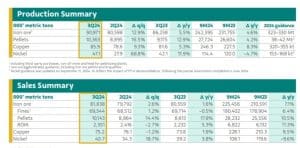
Source: Vale
By 2025, the company plans to transition entirely to renewable energy in Brazil and 100% renewable energy by 2030 globally. Additionally, Vale aims to enhance its global energy efficiency by 5% by 2030, using 2017 levels as the baseline
DOE Partnership
In November, Vale completed negotiations with the U.S. Department of Energy’s Office of Clean Energy Demonstrations. The company will start Phase 1 of a project to develop an industrial-scale briquette plant in Louisiana. It will use over $3.8 million in DOE funds to support engineering studies and community engagement in 2025.
- FURTHER READING: Alaska Energy Metals Pioneers A Model of Carbon-Neutral Mining