


China claims it’s “homegrown,” and more than 90 percent of the equipment is sourced from China.
In reality, the technology was purchased from Germany when they abandoned nuclear a decade ago.
Still, China hopes to use it to demonstrate mastery over Fourth-Generation nuclear—and its evolution from nuclear amateur to pioneer on the world stage.
The reactor is a high-temperature gas-cooled reactor (HTGR), which means it doesn’t need to be built near water or the coast.
And since there’s no need for a containment dome, it’s far more cheaper to build HTGR than ERPs.
In other words, it’s the ideal reactor for exporting globally.
But it’s not the only nuclear reactor China has developed.
China is now the proud owner of four advanced nuclear power plant designs that can be built at scale—all “obtained” from other countries: the EPR (France), the CAP1000 (U.S.), the HTR-PM (Germany), and the VVER-1000 (Russia).
So why is China building every model of reactor it can get its hands on? That’s been proven to be the least cost-efficient and time-efficient way to build nuclear.
It’s because China doesn’t care if these nuclear reactors are over time or over budget. They only want to see what works. They’ll replicate the best, and throw out the rest.
They also want to slowly iterate away from other countries’ intellectual property, ensuring everything is “Made in China”.
- China has already integrated everything it’s learned [stolen] from other countries into its own advanced design, the Hualong One.
The Hualong One, which has been called China’s nuclear “calling card,” is fully owned by China—so they can sell it freely around the world.
It’s already built two of the reactors in China, two in Pakistan… signed a contract to build one in Argentina… and is seeking approval to build one in the UK.
Of the reactors under construction in China, fully 50 percent are Hualong Ones.
The average construction time is just six years, and construction is $2,600 per kilowatt—less than half of the time and price of France’s EPRs.
China’s “Go Out” Nuclear Strategy
China recently announced an upgraded, simplified version, the Hualong Two. The first one is expected to begin construction in 2024.
Costs are around $2,000 per kilowatt, and the construction time to be an unprecedented four years.
After thirty years of “development”—squirreling intellectual property from other countries— nuclear in China is finally ready to face the world.
“‘Going out’ with nuclear power has already become a state strategy.”
– Former CNNC chairman Wang Shoujun
China plans to exert the full weight of its economic and diplomatic influence to go global with nuclear, bringing carbon-free energy to the world.
And their offer will be irresistible.
State-backed banks are loaning about 70 percent of the cost of Chinese reactors—at far lower rates than are available to other nations.
“With nuclear, China is stepping up to the plate with financing.”
– BloombergNEF analyst Chris Gadomski
Other developed countries, like the United States and France, will be unable to compete with ultra-cheap, state-backed funding.
Additionally, the policy of China’s National Development and Reform Commission (NDRC) is to export nuclear technology backed by full fuel cycle capability: China will provide the uranium, and they’ll take the waste.
So buyers won’t even have to worry about the biggest problem with nuclear.
Customers are lining up. The CNNC says that it has already sold reactors to seven countries, and is working on deals with forty more.
China already has a stranglehold on the international nuclear export market.
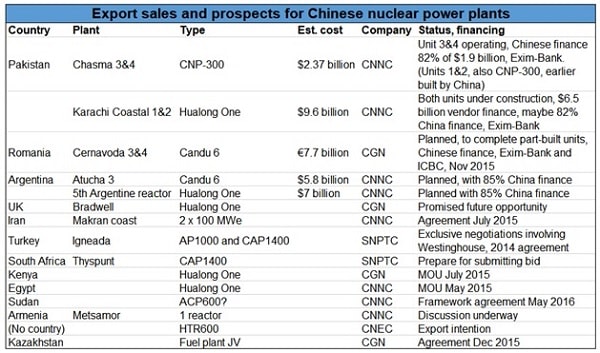
In 2019, the former chairman of China National Nuclear Corporation told a meeting of China’s political advisory body that China could build thirty overseas reactors that would earn Chinese firms $145 billion by 2030.
“Our goal is for China to lead the global nuclear energy industry by the middle of this century.”
– CNNC President Gu Jun
That’s just a small taste of what’s to come… except suddenly, the other large nuclear powers are realizing China’s master plan.
And they’re not happy.
The Power in Nuclear Power
China General Nuclear Power (CGNP) has been on a U.S. government blacklist for three years for attempting to steal nuclear technology.
CGNP is also a partner with EDF, the world’s largest operator of nuclear power stations. But it’s quickly becoming its fiercest rival.
EDF once had plans to build a Hualong One in eastern England—not any more.
And British finance minister George Osborne said that China could build and own a nuclear power plant in Britain—also no longer an option.
The UK has begun to look for ways to squeeze CGNP entirely out of its reactor development.
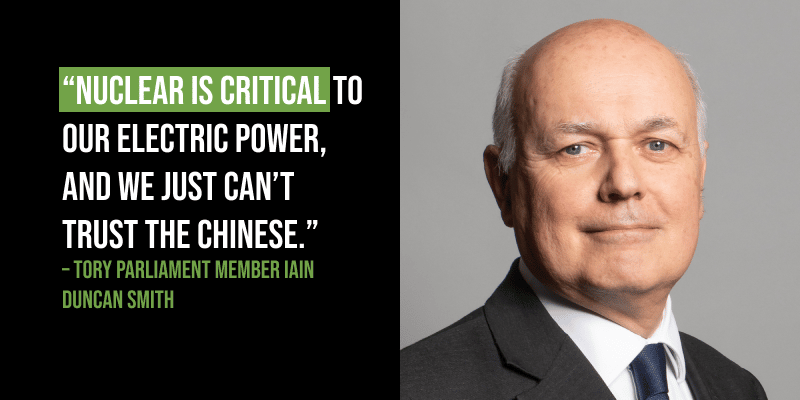
Even Romania cancelled an order for two CGNP reactors—opting to work with the U.S. instead.
But there’s a much bigger concern for the United States and other developed countries than stolen state secrets.
It’s called “the hundred-year marriage.”
Nuclear energy deals create nearly unbreakable ties between the seller and the host—ties that must last as long as the nuclear plant does.
- From first discussions to first operations: ten years.
- Unit operation: sixty years.
- Decommissioning: thirty years.
That’s a century, start to finish, of strategic operations between countries.
The license for that marriage has been signed once the plant begins operations.
All the fuel, maintenance, waste disposal, training, and even staff are provided by China. So breaking relations with them is to lose power for your country—both political and electrical.
And since China’s providing financing, they’ll have extreme leverage even if countries want to get out.
They’ve already used that kind of debt trap to coerce African nations into giving up strategic properties.
And now, China is intent on using nuclear reactor exports to “marry” United States allies.
- In other words, China’s nuclear reactor exports will lead to a guaranteed century of Chinese global dominance.
That’s why other nations are scrambling to boost their own domestic nuclear programs…
… starting with the United States of America.