

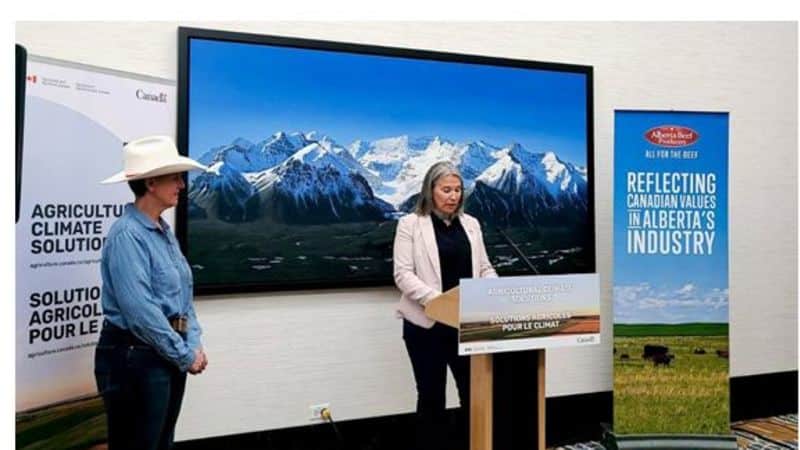
A new Canadian agriculture program committed $16 million to “living labs” that can allow producers to get agricultural carbon credits.
The Canadian government will fund 9 new living labs across the country. Two of them are in Alberta while one is in Northern Alberta and British Columbia.
Living labs are a concept used in the context of open innovation and collaborative networks to address societal needs. They are designed to include users (producers) in the early stage of the innovation process.
In the case of the agricultural sector, living labs are a… “novel way to speed up the development of sustainable agricultural practices and technologies.”
The Living Laboratories Initiative in Alberta
Agriculture and Agri-Food Minister Marie-Claude Bibeau announced the funding program for Living Laboratories. Bibeau said that the living labs will help the country to reduce emissions. Plus, they’ll be beneficial for a collaboration between various stakeholders.
She added that:
“By working together, they [living labs] are creating innovative research-based solutions that can be applied to real-world challenges on the farm.”
The Living Laboratories Initiative brings together farmers, scientists, and other groups to develop and test innovative practices and technologies to tackle agri-environmental issues.
The federal government has begun a network of living labs between 2019 and 2021. They’re found in PEI, Manitoba, Quebec and Ontario.
In Alberta, the federal government partners with the Alberta Beef Producers and the Food and Water Wellness Foundation. Both organizations seek to improve the beef, forage and cropping sectors.
- The $16 million is a second installment for living labs announced last year. It’s part of the $185 million funding support from the Agriculture Climate Solutions. It’s a 10-year program for developing and implementing better environmental practices.
In particular, the program supports efforts for carbon sequestration and reducing carbon emissions.
The announcement is also a part of Canada’s emissions reductions plan launched in March this year. The Canadian government pledged ~$1 billion to help the agricultural sector cut emissions.
With the funding, the living labs can directly work with farmers, researchers, and other interested groups to develop best agricultural practices that boost soil carbon capture. As such, Alberta producers and growers can also earn more agricultural carbon credits.
As Bibeau further noted:
“Here in Alberta, and across Canada, our farmers are adopting approaches and technologies such as precision agriculture, zero tillage, efficient grazing, environmental farm plans… and our cattle producers are playing a vital role in preserving our grasslands. They are storing carbon…and so are on the frontline of climate change”
Alberta Agricultural Carbon Credits System
Alberta was the first to enact a carbon trading system in North America in 2007. Regulated emitters (emitting ~100,000 tonnes of carbon) buy carbon offsets from agricultural producers who take part in approved protocols.
Alberta is one of the three Prairie provinces in which most of Canada’s crop farming happens. Though Alberta’s carbon credit system covers many sectors, most credits are from projects in the agricultural sector.
Agriculture is part of the voluntary, non-regulated sectors of Alberta’s economy. The voluntary reduction of emissions must meet the standards of an Alberta-approved offset protocol.
The province has 19 offset protocols, of which 4 are agriculture specific with 3 active today. Other protocols offer other industries the opportunity to create carbon offset credits.
Agricultural Protocols for Generating Carbon Credits
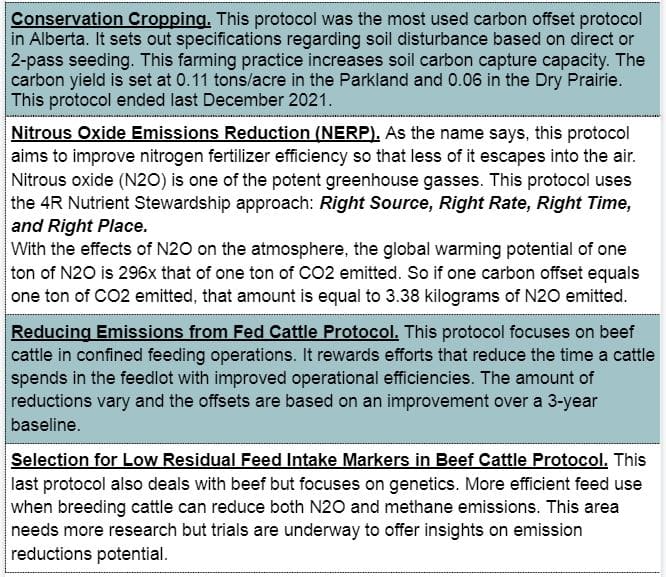
Each of the protocols have detailed guidelines for crop and beef producers to follow to claim offset credits accordingly.
But emission reductions associated with improved agricultural practices (reduced nitrogen use or cattle days on feed) must be clear. Once verified, the reductions are given corresponding carbon offsets. They’re then tracked via the Alberta Emissions Offset Registry.
Producers can sell those offsets as carbon credits to regulated emitters or in the voluntary carbon market.
But carbon offset credits are available mostly for crop growers not beef producers in Alberta. This is where the current agricultural program supporting living labs can help.
As the director of the Food and Water Wellness Foundation said:
“One issue the project intends to address is the lack of proper models to calculate how much carbon is being captured by pasture land and ranching operations… This is a very important project for that reason, to help build out the data to actually make good carbon credit offsets a viable approach.”
Bibeau said she is working with Environment and Climate Change Minister Steven Guilbault on developing a carbon offset credit system for beef producers.