


The internet didn’t exist back then.
Even computer screens had barely been invented.
The instant you began arguing, Netflix’s massive multi-billion market cap would laugh you out of the room.
Yet that’s precisely the situation today for nuclear.
When a researcher at The Breakthrough Institute started investigating arguments against nuclear based on price, she discovered something interesting.
The majority of the research was based on nuclear construction… from the ‘70s.
So she decided to do her own study—and unsurprisingly found that construction costs are extremely different now.
Same goes for safety and waste figures. The numbers used to argue against nuclear are all from the ‘70s—with predictably inaccurate results.
Here’s the problem: a grand total of zero nuclear reactors currently operating in the U.S. started construction after 1978.
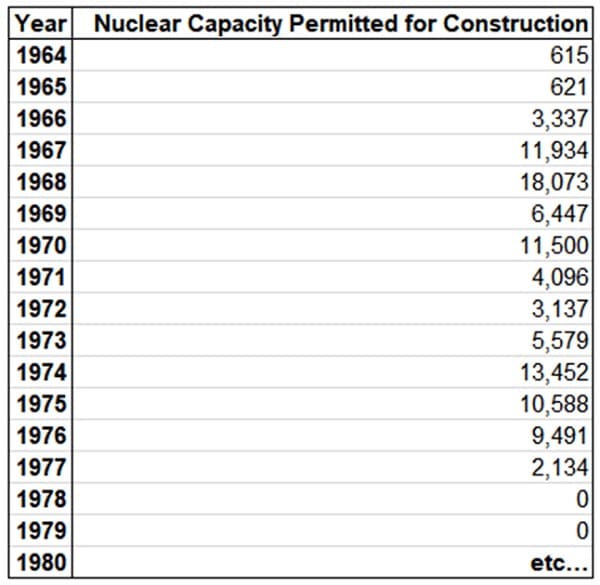
Meanwhile, nuclear has evolved just as much as computers have in the past fifty years.
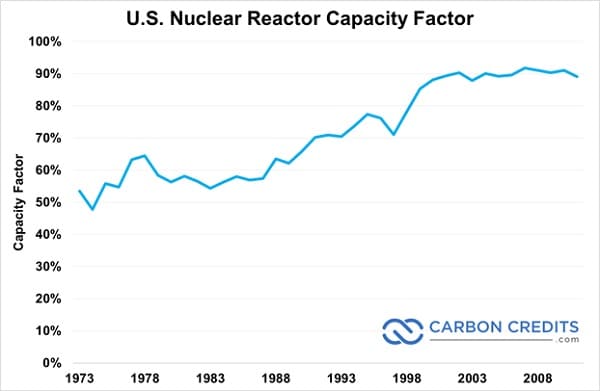
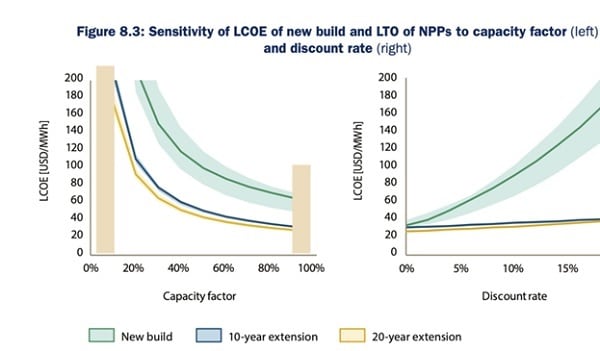
Take something called “capacity factor,” for example. It measures uptime for energy sources.
A capacity factor of 100 percent means a nuclear plant is generating energy 24/7.
In the ‘70s, nuclear was just starting up. Operational difficulties that caused unplanned outages were common.
The capacity factor was about 50 percent—so that’s the number often used to compare nuclear to energy sources like wind and solar.
Guess what it is now…
-
In 2021, U.S. nuclear capacity factor was 93 percent.
… nearly double what it was thirty years ago.
In fact, the capacity factor has increased so much over the past thirty years, that even though fifteen nuclear reactors have shut down in the U.S….
The total power produced annually by nuclear has increased by nearly 25 percent.
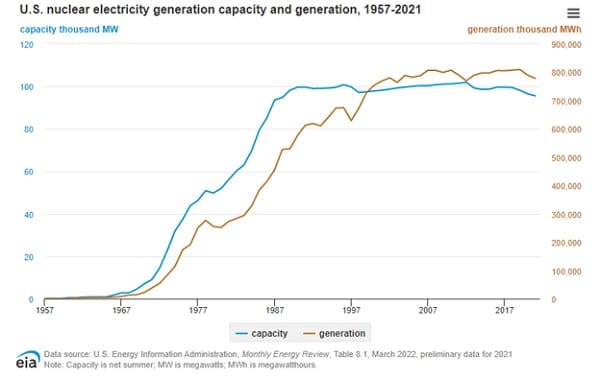
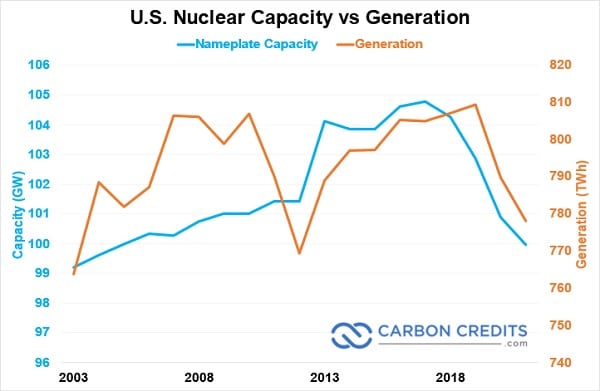
The other contributor to total power generated from nuclear is “uprating”—adding additional capacity to existing reactors.
Here’s how powerful that can be:
- Two reactors in Finland started in 1978 and 1980 at 660 MWe.
- Thirty years later, they were rated at 880 MWe—a 30 percent increase.
- The operator, TVO, is planning to uprate them again, this time to 1,000 MWe.
In fact, TVO uses uprating to always have forty years of remaining lifetime on their plants.
And that’s another major evolution of nuclear power no one saw coming…
Rise of the Planet of the Octogenarians
When nuclear reactors were just getting traction in the ‘60s, they needed investors. And investors needed to know how long these plants would be pumping out energy.
So for amortization purposes, they chose… say, forty years.
Around the turn of the century, nuclear plants started to hit their fortieth birthdays.
And in March 2000, the Calvert Cliffs plant received the first twenty-year license extension.
Since then, 96 percent of the fleet in the U.S. has been granted extensions to operate sixty years.
Now they’re hitting the sixty-year mark… and they aren’t slowing down.
So in 2021, the Nuclear Regulatory Commission (NRC) approved a second twenty-year extension for the Surry plant in Virginia built in 1972.
It will now be able to operate until 2052—a lifetime of eighty years.
Fifteen more reactors have applied for extensions, with more expected.
- Extremely long-term nuclear plant operations are not the exception. They’re the norm.
There’s no limit to the number of times a license can be extended, provided the NRC decides the reactor is safe to continue operations.
And the NRC is now preparing to authorize nuclear plants for up to 100 years.
Why are license extensions so important? It’s because nuclear is compared to other forms of energy using a levelized cost of energy (LCOE).
- Since the costs of nuclear power are front-loaded, a mere twenty-year extension means the LCOE of nuclear drops 50 percent.
Add in capacity factor increases…
And the LCOE drop is more like 65 percent.
The past ten years have brought another 35 percent drop in nuclear LCOE for a twenty-year extension:
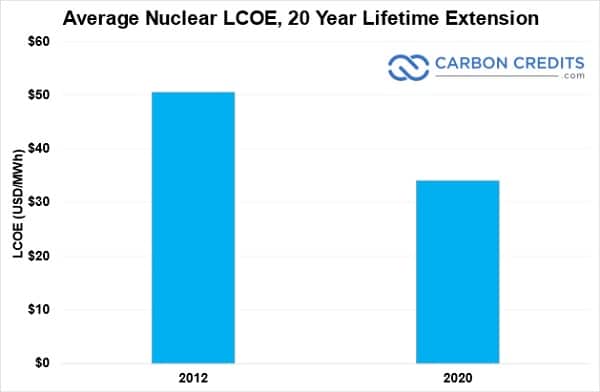
That brings the LCOE down to near $30/MWh.
- In other words, nuclear operations in the U.S. are 30 percent cheaper than wind is now.
Here’s the thing:
The increased capacity, the increased output, and the increased longevity is all on Generation II reactors.
And those aren’t the ones being built today.
The Gen III Max Plus
In the late ‘90s, Japan built the first Generation III reactor, beginning a new era for nuclear.
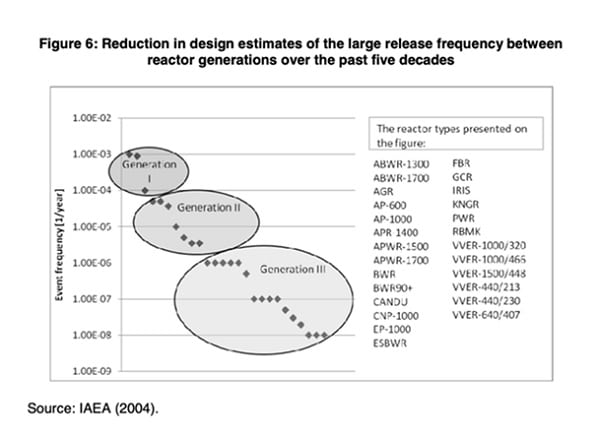
Gen III reactors carefully incorporate lessons from Fukushima, Three Mile Island, and Chernobyl. That makes them safer, stronger, cleaner, less expensive, and easier to build than Gen II reactors.
For example, if a station completely blacks out, “passive nuclear safety” takes over, ensuring the fuel remains cooled.
These improvements make Gen IIIs 1,600 times less likely to experience a severe accident than previous reactors.
Another technology turns potentially explosive gases into water without using electricity—which helps keep radioactivity in the reactor in case of a meltdown.
So even if there is core damage, the probability of a severe radioactivity release is 10 times less than it used to be…
- Studies have found that Gen III nuclear reactors are so strong that they could withstand being rammed into by a fully fueled Boeing 767.
European manufacturers have now created a reactor design called the EPR—or Evolutionary Power Reactor.
It’s one of the first Generation III+ designs, and it’s built to be indestructible.
It has:
- F that can provide cooling for up to three years after shutdown.
- A “core catcher” that traps and cools the hot core if it escapes the reactor.
- Two layers of concrete walls that are a total of eight feet thick.
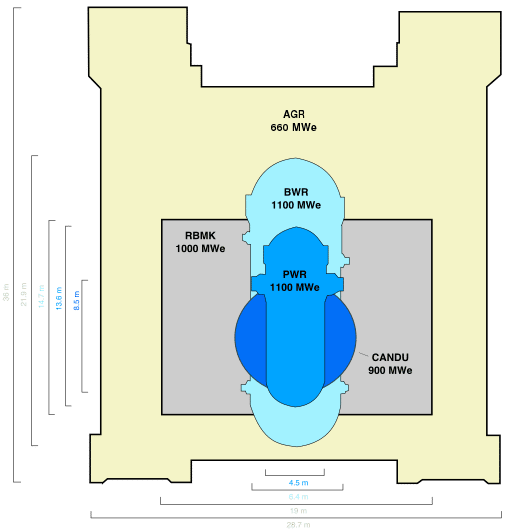
EPRs are huge—output is up to 1,650 MWe, or 70 percent more than most U.S. reactors.
Oh, and they use nearly 20 percent less uranium per MW than older reactors.
The first Gen III+ started up operations in 2017, followed in rapid succession by reactors in China, Finland, France, and the UK.
From Evolution to Revolution
A group of fourteen countries around the world are already developing advanced Gen IV reactors.
If Gen III+ reactors are evolutionary, Gen IV reactors are nothing short of revolutionary.
For example, American companies are working on “walk away” safety: nuclear reactors that need zero backup power or external cooling in case of an accident.
And Gen IV isn’t a pipe dream.
China’s already started up the first Gen IV reactor—a model that can’t melt down.
More than a dozen other large reactor designs are being developed.
More importantly, more than seventy reactor designs are under development for SMRs—Small Modular Reactors.
“Modular” means that the components can be built in a factory, instead of on-site.
- SMR production is easily scalable, and costs plummet as production rises.
In the future, SMRs could be produced at the same scale as airplanes.
The reactor is small enough to be brought to the nuclear plant on a truck.
They produce about ¼ as much power as a regular reactor, and some are designed to operate for thirty years before refueling.
-
A 300 MWe SMR plant can be built in under four years.
Once built, it can follow electricity demand, cutting from 100 percent power to 40 percent in just twenty minutes.
SMRs are currently being licensed or constructed in five of the six top nuclear-producing countries in the world.
TerraPower, a company founded by Bill Gates, is installing its first SMR in a small Wyoming coal town.
Why there?
Because it can use the existing infrastructure and workforce of the coal plant that’s retiring in 2025. The same land, the same connections, the same office buildings—saving up to 35 percent of the cost.
- In just a couple years, that single SMR is set to provide enough carbon-free energy to power 345 small towns.
Today’s nuclear is worlds apart from the nuclear of fifty years ago.
Old plants have improved. New designs have been built. New moonshot approaches are actually working.
Waste is dropping, reactors are becoming safer, and the price is going down.
Around the world, rapid learning is taking place that will enable nuclear to radically expand.
All the industry needs to blow up is a catalyst.
And that catalyst…
It’s here.