

Australian uranium mining giant Paladin Energy Ltd. has announced a C$1.14 billion ($833 million) all-stock offer to acquire Canadian mining firm Fission Uranium Corp. Using uranium in nuclear power significantly contributes to achieving climate goals by providing reliable energy that reduces the global carbon footprint. Thus, this deal can bring a paradigm shift in uranium mining.
According the Paladin’s press release, the Transaction is targeted to close in the September 2024 quarter on meeting all the conditions under the Agreement. Paladin CEO Ian Purdy, is highly optimistic, noting,
“The rationale is very compelling. We see this as a fantastic asset. Regardless of where the uranium cycle is or how the industry’s doing, the combination of these two companies just makes fundamental sense.”
He further added that Fission is a natural fit for Paladin’s portfolio with the shallow high-grade Patterson Lake South (PLS) project located in Canada’s Athabasca Basin. The addition of PLS creates a leading Canadian development hub alongside Paladin’s Michelin project, with exploration upside across all Canadian properties.
 source: Bloomberg
Paladin and Fission Merger Advantages
The merger of Paladin and Fission will establish a leading clean energy company, providing these benefits to shareholders of both companies:
- Enhanced project development pipeline.
- Multi-asset production projected by 2029.
- Diversified presence across top uranium mining regions in Canada, Namibia, and Australia.
- Increased exposure to favorable long-term uranium market fundamentals.
- Expanded scale and global profile for Paladin with a TSX listing.
Furthermore, Fission shareholders are poised to benefit directly from the JV. They will get an attractive 30% premium to Fission’s 20-Day Volume-weighted average price (VWAP) and the opportunity to participate in Paladin’s future expansion plans.
Uranium Powerhouse- Paladin’s Path to Global Leadership
Paladin, an ASX 200-listed premier uranium company based in Perth, Western Australia, holds a 75% stake in the Langer Heinrich Mine (LHM) in Namibia. This mine has generated over 43 Mlbs of U3O8 and is poised for a robust return to production. The initial volumes are scheduled to be processed on 30 March 2024. After the Transaction closes, Fission shareholders will hold a 24.0% stake in Paladin. It is expected to have a market value of around US$3.5 billion.
The company boasts a diversified, high-quality uranium exploration and development portfolio in top mining regions, including Canada and Australia.
Paladin is dedicated to reducing carbon emissions and adopting nuclear energy. It supports strong nuclear safeguards for the peaceful use of nuclear materials to generate zero-emissions electricity.
As the Langer Heinrich Mine (LHM) resumes production, it will measure, track and report its emissions. Paladin strongly emphasizes sustainability managing their Scope 1 and Scope 2 carbon emissions.
Notably, Paladin does not face the Scope 3 emissions challenge, as nuclear power plants produce no greenhouse gas emissions during operation. They also predict that LHM’s uranium production will prevent approximately 1.3 BT of CO2 emissions, compared to equivalent coal-fired electricity generation.
Ian Purdy has significantly highlighted that the price of uranium has spiked <3x in the past five years. It surged further following the Russia-Ukraine war, highlighting the urgent need for alternative reactor fuel sources. Thus, he anticipates more uranium deals ahead.
Fission’s Athabasca Basin, a Geographical Bounty
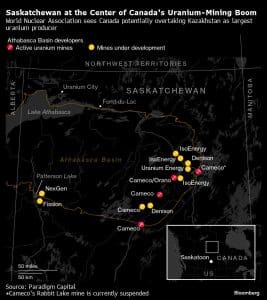
Fission is among several junior mining companies, such as NexGen Energy Ltd. and Denison Mines Corp., developing projects in the Athabasca Basin. This area has become a mining hotspot due to rising supply concerns and increasing global interest in nuclear power as a sustainable alternative to fossil.
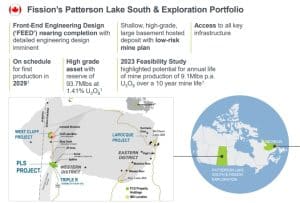
Located in Saskatchewan’s Athabasca Basin, PLS is home to the Triple R deposit. It is recognized as the region’s largest high-grade uranium reserve close to the surface. We discovered from the company’s Feasibility Study that Triple R has the potential to become one of the lowest-cost uranium mines globally. It also unveils its unique strategic position along all-weather Highway 955. It traverses the UEX-AREVA Shea Creek deposits and leads to the historical Cluff Lake uranium mine. These advantages make it one of the world’s most productive uranium mining regions.
 Source: Paladin
Due to its shallow nature, the PLS project offers flexibility for development through underground mining, open pit mining, or a hybrid approach. Considering sustainability, , Fission has chosen to pursue an underground-only mining strategy after deep consultation with local communities. This approach allows the company to fully extract the deposit while benefiting from reduced CAPEX and a minimized environmental impact.
Fission CEO Ross McElroy said that while the region holds high concentrations of uranium. Only a few companies have the expertise to explore and develop such projects. Undoubtedly, Paladin is one of them.
He further commented,
“Having worked the majority of my geology career in the Athabasca Basin, I can tell you that it takes a great deal of expertise to properly explore and make discoveries like this one.”