

After the success of its Rhino bond, the World Bank revamped it with a $50 million Emission Reduction-Linked Bond that will channel up-front financing to low-carbon development projects generating carbon credits like the water purification project in Vietnam.
As with any other sustainable development bond issued by the International Bank for Reconstruction and Development (IBRD), proceeds from the deal will be diverted to World Bank projects.
But the coupon payments that would have been paid to investors will be used to fund the manufacture of water purification devices in Vietnam. Then bond investors will earn a return linked to the issuance of carbon credits from Vietnam’s water purifier projects.
World Bank’s Sustainable Development Bonds
IBRD, the world’s largest development bank, is the original member of the World Bank Group. It supports the mission and strategy of the WBG by issuing bonds to finance sustainable development projects.
- The sustainable development bonds finance green and social projects aimed at having positive social and environmental outcomes.
Social projects include health care, education, employment creation, and food security. Green projects, on the other hand, involve pollution and climate change as well as sustainable resource use.
The end goal is to align the projects’ results with the UN Sustainable Development Goals (SDGs). The World Bank then works closely with governments to assess progress toward the SDGs and identify areas where it can provide support. And in the case of Vietnam, it’s in improving access to clean water for 2 million children.
The $50M Bond Deal
The World Bank priced a 5-year $50 million bond that will support a water purification project in Vietnam. The project aims to make and distribute 300,000 water purifiers to schools and other institutions.
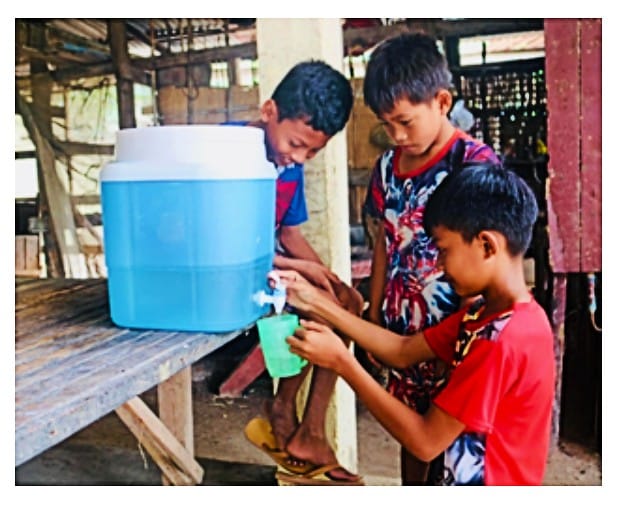
The water purifiers will bring several benefits:
- help cut carbon emissions,
- improve air quality, and
- lower fuel costs.
The bond is an outcome-based financial instrument attracting private capital to drive positive climate and development results. It’s 100% principal protected, and with investors willing to finance the project up-front. They will receive semi-annual coupon payments linked to the issuance of carbon credits that the water purification project generates.
WBG’s CFO and Managing Director, Anshula Kant remarked:
“This outcomes based bond builds on our experience from the Wildlife Conservation Bond, channeling private capital to support the financing of development outcomes, with investors benefiting when projects achieve positive results. In the Emission Reduction-Linked Bond, outcomes are measured by the issuance of carbon credits while in the Wildlife Conservation Bond [a.k.a Rhino bond] it is the growth in rhino populations.”
This deal is the bank’s second outing, with the previous Rhino bond seen as a success giving investors good returns. It’s only a third of the size of the Rhino bond deal which raised $150 million.
However, the current deal in Vietnam would see rising interest rates. That means there’s a chance to earn a higher return than conventional IBRD bonds. The Bank says the potential uplift would be at around 100 basis points.
The Water Purifier Project and Carbon Credits
The purifiers will make access to clean water possible while also addressing emissions by preventing the burning of wood to purify water. Project beneficiaries will receive the purification devices for free.
All because the Emission Reduction-Linked Bond structure is enough to cover the local manufacturing and distribution costs.
- The project can potentially reduce about 6 million tonnes of CO2. In context, that’s like shutting down 2 coal-fired power plants for a year.
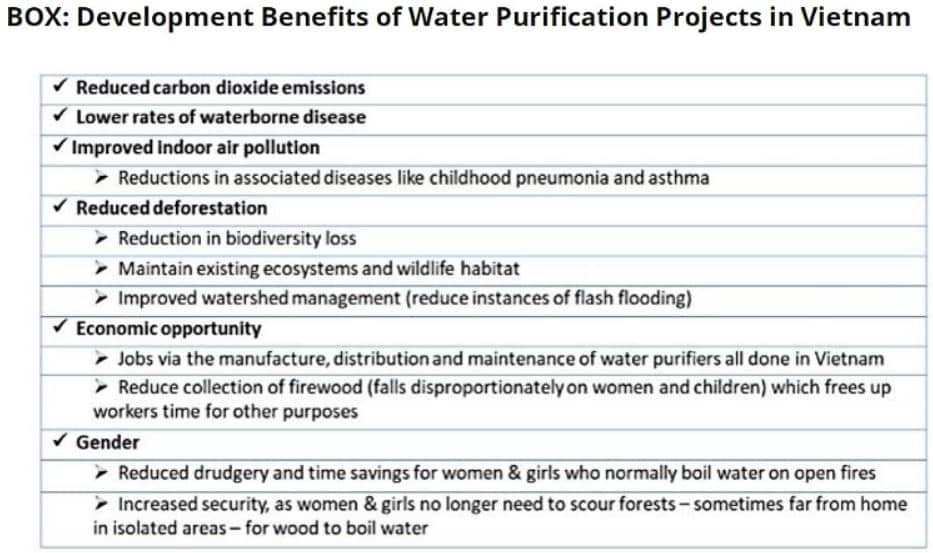
It will further bring about a lot of development benefits as the following:
The World Bank didn’t develop nor will it implement the Vietnamese project. The Sustainability Investment Promotion and Development Joint Stock Company (SIPCO) will implement it.
SIPCO is a private company in Vietnam specializing in developing climate-friendly projects and it manufactures water purifiers. Its Chairman, Hoang Anh Dung said:
“SIPCO is proud to be associated with this innovative structure. It gives project developers like us access to finance in anticipation of future carbon revenues. That helps us move faster and expand programs that will positively impact thousands of kids across Vietnam.”
The reduced emissions from using purifiers will become carbon credits issued by Verra. These credits, also called Verified Carbon Units (VCUs), will then be sold to fund a coupon payment for investors.
Coupon payments to bond investors will be based on carbon credits sales revenue from the proceeds. Proceeds from the first 1.8 million tonnes of carbon credits sold are earmarked for bondholders.
What Investors Have to Say?
The three major investors on the $50 million bond deal are Impax Asset Management, Velliv Pension, and Nuveen.
Impax portfolio manager commented that the return opportunity in this new bond is more attractive than normal World Bank bonds. They’re satisfied with what they’ve examined in the carbon credit side of the deal.
Meanwhile, Velliv’s CIO said that the new deal is exceptional for its strong social profile and “significant green carbon credit”. While the head of ESG at Nuveen remarked that the bond provides additionality and has an attractive valuation.
What they’re all trying to say is that investors are willing to bet in these kinds of projects. More importantly, this carbon credits-linked bond and other initiatives of the World Bank can help buildup carbon credit markets.
In October last year, the World Bank launched a new trust fund designed to pool public funds to provide grants for carbon emissions reduction projects. This facility, known as “Scaling Climate Action by Lowering Emissions” or SCALE, is atrust fund for the WB’s climate finance projects.
As the World Bank President David Malpass said, the bond structure linked with carbon credits “can be replicated and scaled to channel more private capital to development and climate activities”.