


A number of large corporations decided to fund their own projects that generate carbon credits despite criticisms against offsets.
GSK, Volkswagen and Total are just some of the corporate firms that continue to lean on carbon credits to offset carbon emissions.
Corporate Carbon Offsetting
One of the world’s leading pharma companies, GSK Plc, believes that carbon offsets are a crucial tool that moves capital needed for health, nature, and climate. As per the company’s director of sustainability partnerships and strategy, Adele Cheli:
“Just because it’s [carbon offsetting] not perfect doesn’t mean we’re going to step out. We’re going to lean in and make it better.”
Corporate carbon offsetting means a polluting company buys a carbon credit to make up for the carbon it emits. Existing carbon offsetting schemes are under pressure due to the poor quality of some offset projects.
Moreover, carbon offsets are exploited in developing countries where most projects operate. This puts large companies’ offsetting schemes under scrutiny by environmentalists and investors.
Some groups think that heavy reliance on carbon offsets led to corporate greenwashing. Others believe that it can discourage companies from directly cutting their carbon footprint.
Overall, there’s a consensus in the sector to ensure that corporate offsets don’t replace or delay urgent actions to decarbonize.
Large firms such as GSK and Volkswagen admitted that they’re aware of the need to prioritize emission reductions over offsetting. Many big corporations also agree like Total, Shell, Barclays, Chevron, Bayer AG, among others.
If done right, corporate carbon offsetting can rapidly professionalize the voluntary carbon market and further drive its growth.
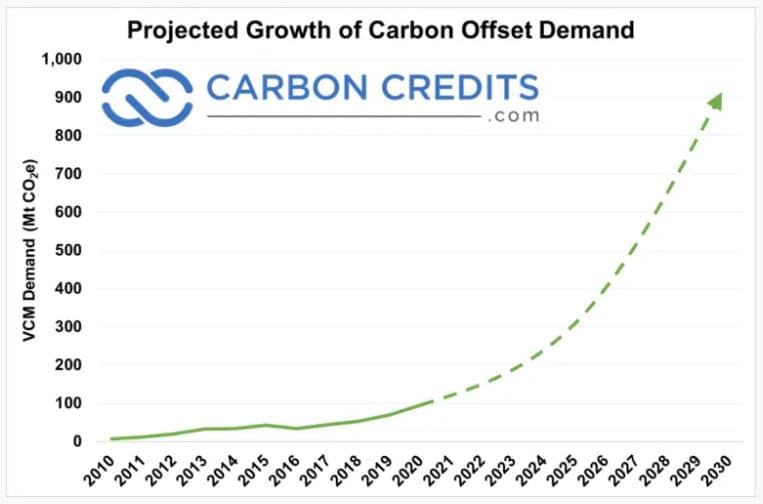
The Taskforce for Scaling Voluntary Carbon Markets (TSVCM) survey indicated that market size in 2030 can grow into ~$50 billion at the high end of estimates. That means about 200x growth for the carbon offset market within a decade as the chart shows.
An industry expert once said that companies with their own offsetting projects can manage the impact and quality of their offsets better than buying from carbon credit brokers.
In-house Carbon Credit Generation
Pharmaceutical: GSK
The London-based pharma thinks that homegrown carbon credits can offset any emissions it can’t get rid of. GSK aims to be carbon neutral by 2030 while planning to use offsets until at least 2045.
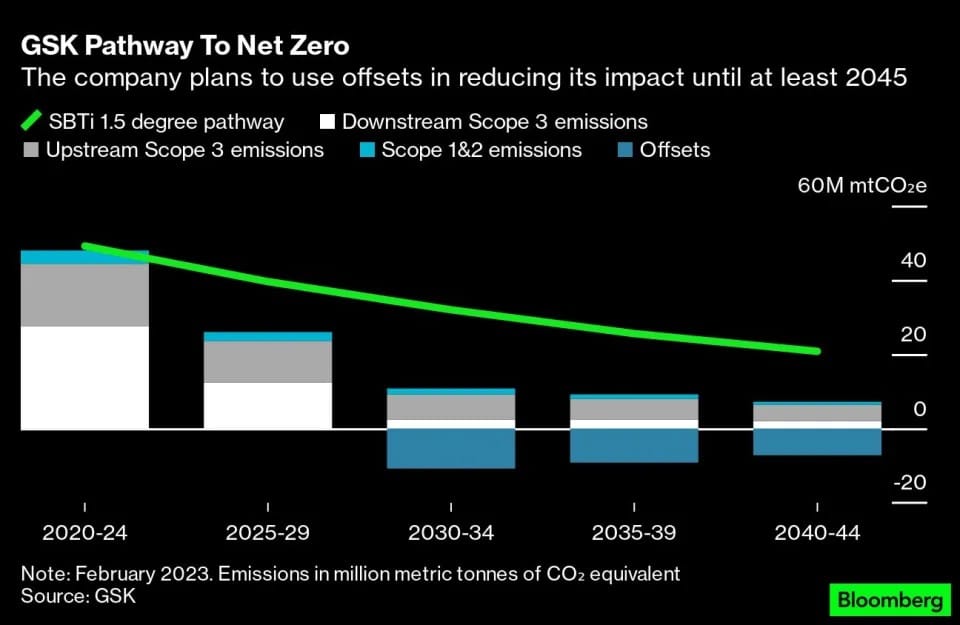
- About 50% of its carbon emissions is from the firm’s asthma inhaler products.
The drug maker plans to directly reduce 80% of its own carbon footprint by the end of the decade. This includes emissions from its supply chain and customers. The remaining 20% will be abated through carbon offsets, specifically by investing in mangroves.
GSK has been leaning on the carbon capture power of mangroves in the coastal areas of Indonesia. The company is supporting the mangrove project in exchange for the carbon the coastal trees are capturing.
Mangroves are known to sequester up to 50x more carbon than tropical forest trees. Unfortunately, this natural carbon sink is under threat to disappear. In Asia, Indonesia is one of the countries that is hardly hit and GSK is offering financial help.
The pharma company partners with First Climate, a carbon project developer in its mangrove project in Java seeking to restore mangroves in 2,500+ hectares. In exchange for its funding support, GSK expects to generate up to 140,000 carbon credits every year from the project.
The company even plans to produce as much as 2 million carbon credits each year for its own offsetting purposes. It has more upcoming projects to get all the credits it requires beyond this decade.
The company then seeks to opt for carbon removal credits for its 2030 climate goals while preferring it for its 2045 targets.
Automotive: Volkswagen
The German carmaker, Volkswagen, has an even more ambitious goal than GSK – generate 40 million credits each year by 2030. That’s understandable though because the automaker emits around 30x more carbon than the drug maker.
That goal makes up about 25% of the amount of offsets that global companies bought and retired last year. Bloomberg reported it to be at 155 million.
Volkswagen AG seeks to reach net zero emissions by 2050. It partnered with a local carbon project developer to develop its own carbon credit generating venture “Volkswagen ClimatePartner GmbH”.
The goal of the program is to offset emissions from the carmaker’s electric vehicle production supply chains in Europe. It has 8 projects underway which includes forests and savanna protection. The venture’s director said that they expect to generate the first carbon credits by 2025.
Oil and Gas: TotalEnergies
A representative from the big oil and gas industry, TotalEnergies, can’t agree more with the German automaker. The energy firm’s former executive of nature-based climate solutions said that investing in offset projects now is a good start. It can produce good credits in 5 years time.
Total SE aims to support nature-based projects with $100 million each year. It is meant to have its own natural carbon sinks that can suck in a total of 5 to 10 million tons of carbon each year starting in 2030.
The oil giant is investing in projects that protect forests, regenerative agriculture, and wetlands. Also part of its 2050 net zero targets, Total will reduce its petroleum products and increase natural gas and renewable electricity.
BP Plc has a majority stake in Total and helps ramp up its carbon credit generation efforts.
Other corporates are also turning their attention and money to carbon credit projects that can offset their huge carbon footprint. Shell, Chevron, Barclays, and Bayer AG are some examples. They are investing millions of dollars in nature-based climate solutions such as reforestation, mangrove restoration, and regenerative agriculture.