

Resonant Technology Group recently announced that its patented product, SOP® Lagoon, can significantly reduce greenhouse gas emissions of the dairy industries – 80% for methane and 75% for carbon dioxide.
US-based Resonant is an affiliate of SOP (Save Our Planet), an Italian tech company run by biologists, agronomists, chemists, engineers, animal nutritionists, and veterinarians. SOP’s proprietary technology is for application to crops, animals, soils and vineyards.
Resonant is developing innovative ways of applying SOP® Inside technology aimed at mitigating GHG emissions. The company enables adaptation of SOP products in agriculture, food industries, and their supply chains.
A Breakthrough Solution to Cut Methane Emissions
Methane is a more powerful gas than CO2 in heating up the planet. It accounts for about 50% of the increase in global temperatures while remaining in the atmosphere in a shorter period. Thus, cutting methane emissions could be the fastest way to prevent temperatures from going up.
Dairy cows are the major source of emitting around 8% of global methane pollution. And about 80% of the total GHG emissions of milk production comes from the farm level.
This is where Resonant’s SOP® Lagoon offers an unrivaled solution in reducing methane emissions at the dairy farm level.
SOP® Lagoon is a mineral 0.07 oz (2g)/head additive that is applied once a week into the lagoon. Lagoon dairy waste emissions account for up to 57% of total dairy methane emissions.
The SOP proprietary product can be used alongside other products that are scientifically proven to reduce enteric and soil emissions. It has been used by farmers for animals, crops, soils and vineyards in Europe and North America.
A joint study from the University of Milan and University of California Davis scientifically showed that the SOP® Lagoon product’s application in dairy lagoons significantly reduced GHG emissions, targeting these pollutants:
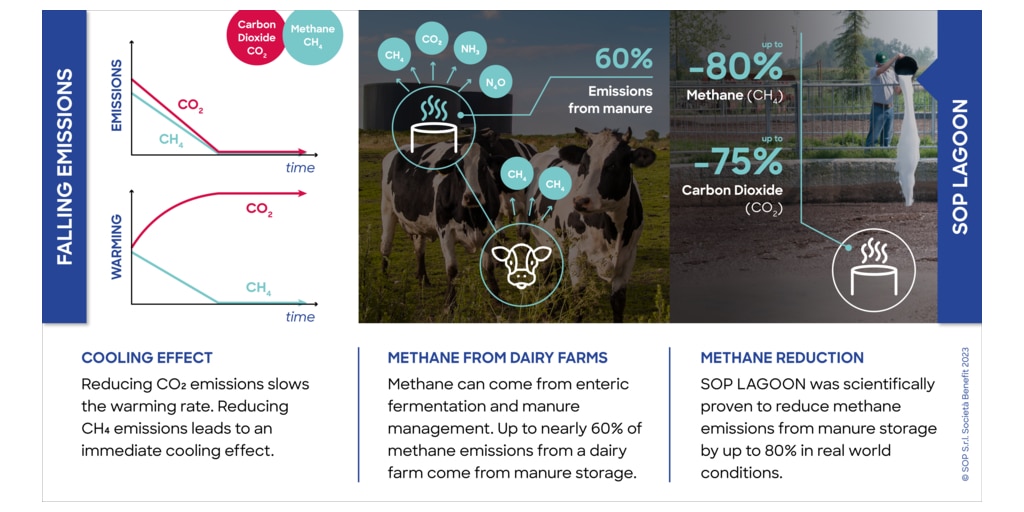
- Methane – 80% emission reductions
- Carbon dioxide – 75% emission reductions
The researchers did a three-and-a-half month in-field study at a 520-head commercial dairy farm in Northern Italy. Their findings show the additive’s GHG reduction potential identified above.
Other Ways to Lower Dairy Methane Emissions
The additive is also capable of reducing emissions from other sources, enteric (digestive) and soil. Overall reduction potential is more than 50% of total emissions from dairy farming operations.
Other 4 separate studies have also confirmed SOP® Lagoon’s ability to offer an immediate and meaningful solution in cutting the methane emissions of the dairy and livestock industries in general.
Other initiatives to reduce livestock emissions include improving reproductive efficiency in dairy cattle, which can cut methane emissions by 24%.
Another solution is to lower emissions from enteric fermentation by changing the livestock’s diet such as including seaweed or barley. Also, scraping manure and transporting it to another storage facility for cattle production systems may cut methane emissions by 55%.
Enteric and manure emissions make up as much as 40% of the total GHG emissions from dairy operations. The other 60% comes from effluents and manure flowing from dairy lagoons or barns.
Addressing those sources on a large-scale basis can potentially reduce methane emissions in millions of tonnes of CO2 equivalent (CO2e). And each tonne of emission reduction generates one carbon credit.
Earning Extra by Cutting Methane
Carbon credits, also known as carbon offsets in voluntary markets, provide extra income for entities that reduce GHG emissions.
While most credits are issued for activities reducing CO2 emissions, methane reduction through manure management such as applying the additive is also eligible to earn credits. The world’s largest certifier of carbon credits, Verra, had issued credits for cow methane reduction.
And considering that methane can be 85x more potent than CO2, reducing more of it means more carbon credits generation.
But the price for each carbon credit for methane reduction varies widely. Several factors affect the price, including location, market dynamics, and the certification standard.
On average, the price for a carbon credit ranges from less than $1/tonne of CO2e to $15/tonne or more. Assuming that a 500-head dairy farm applies Resonant’s SOP® Lagoon and reduces about 2,000 tons of CO2e yearly (methane emissions), the owner can earn up to $30,000 a year.
The additive can also reduce ammonia, which is being considered to be added to the target list of GHG emissions.