


The U.S. stock market saw its biggest weekly gain in a year just one week following Donald Trump’s re-election. However, clean energy stocks tumbled as investors worried Biden’s pro-renewables agenda would be replaced by Trump’s “drill, baby, drill” policies. And recently, Vivek Ramaswamy, known for his strong opposition to environmental, social, and governance (ESG) investing, was appointed to co-lead Trump’s government efficiency group.
A biotech entrepreneur Ramaswamy has long criticized ESG standards, arguing they hurt economic growth. His new position could mean major changes to environmental regulations and corporate climate reporting.
His role is to help cut regulations, reduce government waste, and overhaul federal agencies. This appointment signals a shift in U.S. climate and investment policies.
ESG Under Fire: What It Means for Corporate Climate Disclosure
The drop in clean energy stocks highlights the challenges for sustainable finance. Over the past two years, Republicans have pushed back against ESG investing, leading several states to boycott ESG-focused asset managers.
A Bloomberg Intelligence report highlights Trump’s potential efforts to restrict shareholders from filing ESG-related proposals. This follows more lenient SEC rules that have driven a 47% increase in ESG proposals since 2021.
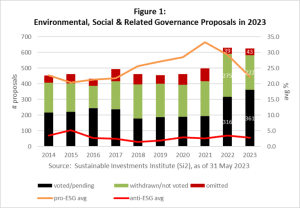
Referring to the chart above, two major trends stand out for 2023. First, climate change proposals continue to rise. Second, there’s a surge in resolutions on reproductive health following the U.S. Supreme Court’s Dobbs decision, which has led to widespread restrictions.
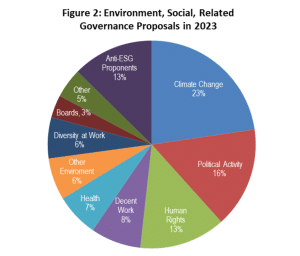
Meanwhile, anti-ESG proposals are growing (13% in 2023), though they lack support and primarily aim to block ESG efforts without offering solutions. But with a second Trump administration will likely make big changes.
According to Rob Du Boff, a senior analyst at Bloomberg Intelligence, a Trump presidency could restrict ESG-related shareholder proposals. He particularly noted that:
“The bottom line is the Trump administration is anxious to undermine these ESG-related initiatives.”.
While the SEC’s climate risk disclosure rule faces an uncertain future under Trump’s presidency, U.S. companies still need to prepare for reporting requirements in California and Europe. These regulations demand transparency about emissions and climate risks, regardless of federal policy shifts.
California’s laws require businesses with over $1 billion in revenue, roughly around 5,344 companies, to disclose Scope 1, 2, and 3 emissions starting in 2026. They must also have these emissions verified by third-party organizations.
Additionally, companies with revenue exceeding $500 million, over 10,000 of them, must submit climate risk reports explaining how extreme weather, supply chain issues, and regulations could affect their operations.
These rules apply to thousands of businesses, forcing them to enhance their climate reporting efforts.
Legal Battles and Compliance
Despite legal challenges, California’s climate laws remain on track. Business groups, including the U.S. Chamber of Commerce, sued the state to block these mandates, arguing they place an undue burden on companies.
However, a federal judge recently allowed the case to proceed to trial, delaying any immediate relief for opponents.
Michael Littenberg, a legal expert on ESG, advises companies to prepare now. “Businesses are at different stages of readiness,” he said, “but those operating in California must ensure compliance.”
Global Trends in Climate Reporting
Globally, climate disclosure rules are expanding. The European Union has already implemented strict regulations, and 29 other countries are in various stages of adopting similar policies. Together, these jurisdictions represent 55% of global GDP.
Steven Rothstein from the Ceres Accelerator for Sustainable Capital Markets notes that U.S. companies with international operations are already aligning with global standards. Rothstein also explained that Canada, Australia, and Brazil have their disclosure requirements, too.
Consistency in reporting frameworks is essential for corporate leaders planning decades ahead. This global momentum ensures climate data remains crucial, regardless of U.S. political changes.
What’s Next for ESG and Climate Policy?
The ESG standard faces an uncertain future in the U.S. Many Republican-led states have passed laws banning ESG considerations in public investments, arguing they politicize financial decisions. However, these laws have sparked legal challenges from business groups.
Experts believe the term “ESG” might eventually be replaced. It’s a politically charged term but while alternative terms exist, none have gained widespread acceptance.
Despite political opposition, sustainability data will continue to guide investments. Julie Anderson, formerly of BlackRock, emphasized the importance of climate information. She said that investors seek any data that can impact financial performance and if ESG factors affect profits, they will influence decisions.
The Trump administration is expected to weaken ESG-related policies, including revising a 2022 rule that allows retirement fund managers to consider ESG risks. However, experts believe the push for sustainability will persist in the private sector.
More notably, certain areas of climate policy like carbon removal, nuclear energy, and critical minerals may still see progress due to bipartisan support.
Bipartisan Climate Wins: Carbon, Nuclear, and Critical Minerals
Carbon removal technologies, such as direct air capture and enhanced carbon storage, are critical to reducing greenhouse gas emissions. Bipartisan bills like the CREST Act and the CREATE Act aim to advance research and development in this space, benefiting both the economy and the environment.
Nuclear energy is another area with widespread bipartisan backing. With its potential to provide large-scale, low-carbon power, nuclear energy is seen as a key component of the clean energy transition. Recent legislative efforts, such as the ADVANCE Act, focus on modernizing reactor technologies and increasing domestic nuclear capacity.
The critical minerals sector is another focal point due to its importance for renewable energy technologies like wind turbines, solar panels, and electric vehicle batteries.
Legislation such as the Critical Minerals Security Act and the Critical Mineral Access Act seeks to enhance mining and processing capabilities while supporting global projects that align with U.S. national security interests. These efforts reflect a shared commitment to ensuring the availability of materials crucial for the clean energy transition.
Even with political shifts, the importance of ESG and climate data isn’t going away. Investors and corporations alike are recognizing that sustainability plays a crucial role in long-term success and U.S. businesses must adapt to stay competitive as the world moves toward greater climate accountability.