

Disseminated on behalf of Sierra Madre Gold & Silver Ltd.
Silver is no longer being driven by one industrial story. Solar remains one of the metal’s biggest applications, but a broader technology shift is reshaping demand.
Artificial intelligence, data centers, electric vehicles, electronics, and power-grid investment are creating new uses for silver across the global economy.
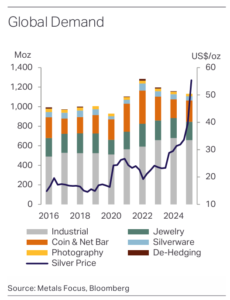
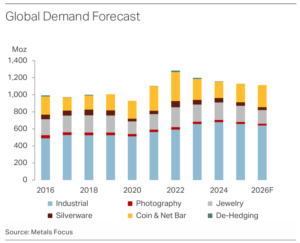
Industrial demand hit 657.4 million ounces in 2025. This made up over half of total global silver demand, as noted in the Silver Institute’s World Silver Survey 2026.
Although industrial demand declined 3% last year because of weaker photovoltaic consumption, the underlying mix is changing. Structural growth in AI infrastructure, automotive applications, and electricity networks helped offset part of the decline in solar.
That shift matters for silver producers because the next demand cycle may be less dependent on any single end market.
Silver Is Becoming a Technology Metal
Silver’s value in industrial applications comes largely from one property: electrical conductivity.
The metal is used in electrical contacts, circuit boards, switches, and power electronics. It’s vital for parts that need reliable conductivity. That makes silver increasingly relevant as the global economy becomes more electrified and more digitally connected.
The Silver Institute estimates a 2% drop in electrical and electronics demand for 2025. However, gains from grid infrastructure, automotive applications, and AI-driven electronics still support the sector.
Those gains were not enough to offset falling photovoltaic demand, where manufacturers have accelerated efforts to reduce silver loadings through thrifting and substitution.
The result is an important distinction: silver demand can remain structurally tied to technology even when total industrial demand temporarily declines. That makes the composition of demand increasingly important.
AI Is Creating a New Silver Demand Channel
The growth of artificial intelligence is adding another layer to silver demand.
AI models need a lot of computing resources. This includes servers, processors, networking gear, power systems, and data centers. Silver is used throughout electrical and electronic equipment because of its conductivity and reliability.
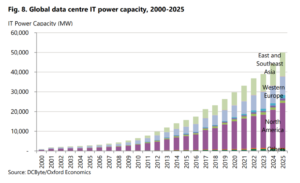
The Silver Institute’s 2025 tech report shows that global IT power capacity rose from 0.93 gigawatts in 2000 to almost 50 GW in 2025. That’s about a 53-fold increase. The organization expects data centers and AI-related technologies to remain important drivers of industrial silver consumption through 2030.
The connection is broader than AI chips themselves.
More computing requires more data center capacity. More data centers require more electricity. More electricity requires additional transmission, distribution, and power-management infrastructure. That creates multiple potential pathways for silver demand.
As AI adoption grows, the metal faces new demands. It is now needed for semiconductor production and the infrastructure for power-hungry computing systems.
EVs Add Another Layer of Electrical Demand
Transportation is undergoing a similar transformation.
Electric vehicles have more electrical parts than traditional internal-combustion vehicles. This opens up more uses for silver. It’s now found in electrical contacts, power electronics, battery management systems, and charging infrastructure.
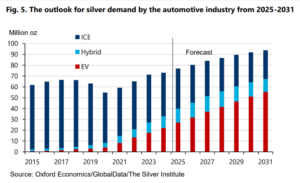
A Silver Institute report from Oxford Economics shows that battery-electric vehicles use 67% to 79% more silver than internal combustion vehicles. Each EV has about 25 to 50 grams of silver. It forecasts automotive silver demand to grow at a 3.4% compound annual growth rate between 2025 and 2031.
The change is not limited to the vehicle itself. A larger EV fleet requires a larger charging network. That means additional electrical equipment, connections, and power infrastructure.
Oxford Economics predicts that by 2027, EVs will lead automotive silver demand. They expect EVs to make up 59% of this demand by 2031.
These figures show why electrification may be a long-term source of silver use. This is true even as manufacturers try to use less material.
Power Grids Could Become an Overlooked Silver Driver
The growth of AI and EVs ultimately leads back to electricity.
Data centers need power. EV charging requires power. Manufacturing, industrial automation, and broader electrification all require additional generation and transmission capacity.
Silver is used in electrical systems due to its excellent conductivity. This includes contacts, switches, and other electrical parts.
The Silver Institute specifically identified power-grid investment as one of the structural factors supporting electrical and electronics demand in 2025. This creates an important second-order effect for silver.
The world does not simply need more devices. It needs the electrical infrastructure capable of supporting those devices.
That means silver demand can be linked to several investment cycles at once:
- data center construction, vehicle electrification, renewable energy deployment, grid modernization, and broader industrial automation.
Solar Is Still Huge, But the Silver Story Is Changing
Solar remains critical to the silver market, but it is also where the industry is confronting one of its biggest challenges.
Photovoltaic demand helped drive years of industrial silver growth. However, manufacturers have increasingly reduced the amount of silver used per solar cell through thrifting and substitution.
The effect was significant in 2025.
Industrial silver demand fell 3% to 657.4 Moz, while the electrical and electronics segment declined 2%. The Silver Institute noted that the drop in PV demand was the main cause of the weakness. This happened even with ongoing gains from AI, automotive, and grid applications.
The Institute predicts that industrial demand will drop another 3% in 2026. This decline is mainly due to ongoing weakness in photovoltaic silver use. At the same time, it expects AI infrastructure, automotive applications and power-grid investment to remain areas of structural growth.
This does not make solar less important. Instead, it shows why the silver market is becoming more diversified.
The next phase of industrial demand may rely less on just adding more solar panels. Instead, it will focus on expanding digital infrastructure, transportation electrification, and electricity networks together.
A Changing Demand Mix Raises the Stakes for Supply
This evolution creates an unusual challenge for the silver market.
Demand is becoming increasingly connected to industries that governments and companies are investing in for long-term economic reasons. AI infrastructure, EV adoption, grid modernization, and digitalization are not single-year trends.
However, silver supply cannot necessarily respond at the same speed.
The Silver Institute reported that global mine production reached 846.6 million ounces in 2025, up 3%, while the market still recorded a deficit. Its 2026 outlook calls for mine production to remain broadly flat and projects another 46.3 million-ounce structural deficit.
That makes existing production capacity increasingly relevant. New mines can take years to permit, finance, build, and ramp up. Expansions and restarts at existing mining operations can happen more quickly. This is especially true when there is already processing infrastructure and mining facilities in place.
That is where Sierra Madre Gold & Silver enters the picture.
Sierra Madre Is Expanding Into a Changing Silver Market
Sierra Madre is building its production base while the industrial demand story is becoming more diversified.
At La Guitarra in Mexico, the company is boosting its current operation from 500 tonnes per day to 750–800 tpd. They also plan to expand to 1,200–1,500 tpd by Q3 2027. The company recently reported processing rates reaching as high as 720 tpd, showing the operation is already moving beyond its original 500-tpd level.
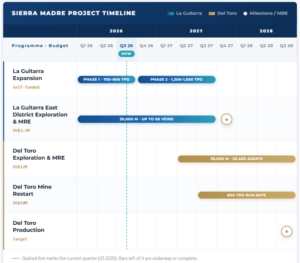
The expansion is designed around existing infrastructure rather than starting a new mine from scratch. Sierra Madre has increased its milling, crushing, material handling, and tailings capacity. It is also making progress in developing the Guitarra complex.
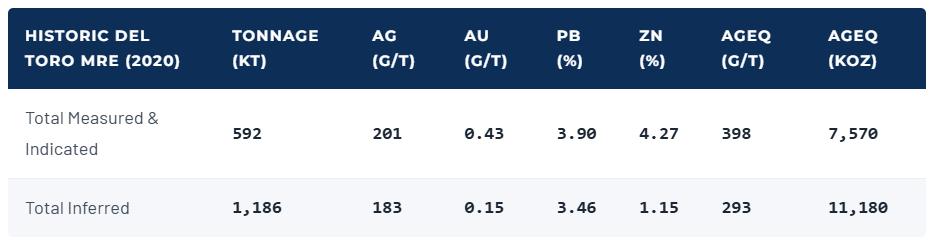
The company also now has Del Toro, a past-producing silver-lead-zinc complex in Zacatecas.
Del Toro includes three underground mines and a 3,000-tpd processing facility, along with more than 62.5 kilometers of underground development. Sierra Madre is evaluating a restart beginning at approximately 800 tpd, with potential to scale toward 1,600 tpd.
The significance is not that one company can solve the global supply problem.
Sierra Madre shows how producers can meet a market linked to long-term tech and electrification trends. They can: expand current operations, restart old infrastructure, and build more production capacity.
The Silver Market Is Becoming More Electrified
Silver’s industrial story is entering a broader phase. Solar remains a major source of consumption, but AI, data centers, EVs, electronics, and power infrastructure are creating additional demand channels.
Some applications will use less silver and become more efficient. But others will need more electrical equipment as economies go digital and electrified.
The result is a market where demand growth cannot be reduced to a single theme.
For producers, that creates a parallel challenge: supplying a metal that sits inside multiple growth industries while mine supply remains difficult to expand quickly.
Sierra Madre’s La Guitarra expansion and Del Toro restart strategy provide a direct example of how established mining assets can be positioned to participate in that changing market.
The bigger question for silver is whether new supply can keep pace as the metal moves from being primarily a precious metal into an increasingly important industrial and technology input.
DISCLAIMER
New Era Publishing Inc. and/or CarbonCredits.com (“We” or “Us”) are not securities dealers or brokers, investment advisers, or financial advisers, and you should not rely on the information herein as investment advice. Sierra Madre Gold and Silver Ltd. (“Company”) made a one-time payment of $25,000 to provide marketing services for a term of one month. None of the owners, members, directors, or employees of New Era Publishing Inc. and/or CarbonCredits.com currently hold, or have any beneficial ownership in, any shares, stocks, or options of the companies mentioned.
This article is informational only and is solely for use by prospective investors in determining whether to seek additional information. It does not constitute an offer to sell or a solicitation of an offer to buy any securities. Examples that we provide of share price increases pertaining to a particular issuer from one referenced date to another represent arbitrarily chosen time periods and are no indication whatsoever of future stock prices for that issuer and are of no predictive value.
Our stock profiles are intended to highlight certain companies for your further investigation; they are not stock recommendations or an offer or sale of the referenced securities. The securities issued by the companies we profile should be considered high-risk; if you do invest despite these warnings, you may lose your entire investment. Please do your own research before investing, including reviewing the companies’ SEDAR+ and SEC filings, press releases, and risk disclosures.
It is our policy that information contained in this profile was provided by the company, extracted from SEDAR+ and SEC filings, company websites, and other publicly available sources. We believe the sources and information are accurate and reliable but we cannot guarantee them.
CAUTIONARY STATEMENT AND FORWARD-LOOKING INFORMATION
Certain statements contained in this news release may constitute “forward-looking information” within the meaning of applicable securities laws. Forward-looking information generally can be identified by words such as “anticipate,” “expect,” “estimate,” “forecast,” “plan,” and similar expressions suggesting future outcomes or events. Forward-looking information is based on current expectations of management; however, it is subject to known and unknown risks, uncertainties, and other factors that may cause actual results to differ materially from those anticipated.
These factors include, without limitation, statements relating to the Company’s exploration and development plans, the potential of its mineral projects, financing activities, regulatory approvals, market conditions, and future objectives. Forward-looking information involves numerous risks and uncertainties and actual results might differ materially from results suggested in any forward-looking information. These risks and uncertainties include, among other things, market volatility, the state of financial markets for the Company’s securities, fluctuations in commodity prices, operational challenges, and changes in business plans.
Forward-looking information is based on several key expectations and assumptions, including, without limitation, that the Company will continue with its stated business objectives and will be able to raise additional capital as required. Although management of the Company has attempted to identify important factors that could cause actual results to differ materially, there may be other factors that cause results not to be as anticipated, estimated, or intended.
There can be no assurance that such forward-looking information will prove to be accurate, as actual results and future events could differ materially. Accordingly, readers should not place undue reliance on forward-looking information. Additional information about risks and uncertainties is contained in the Company’s management’s discussion and analysis and annual information form for the year ended December 31, 2025, copies of which are available on SEDAR+ at www.sedarplus.ca.
The forward-looking information contained herein is expressly qualified in its entirety by this cautionary statement. Forward-looking information reflects management’s current beliefs and is based on information currently available to the Company. The forward-looking information is made as of the date of this news release, and the Company assumes no obligation to update or revise such information to reflect new events or circumstances except as may be required by applicable law.
For more information on the Company, investors should review the Company’s continuous disclosure filings available on SEDAR+ at www.sedarplus.ca.
Disclosure: Owners, members, directors, and employees of carboncredits.com have/may have stock or option positions in any of the companies mentioned: None.
Carboncredits.com receives compensation for this publication and has a business relationship with any company whose stock(s) is/are mentioned in this article.
Additional disclosure: This communication serves the sole purpose of adding value to the research process and is for information only. Please do your own due diligence. Every investment in securities mentioned in publications of carboncredits.com involves risks that could lead to a total loss of the invested capital.