


The global CO₂ transport industry could attract $211 billion in investment by 2060 as countries build more infrastructure to capture and store carbon emissions. A new analysis from Wood Mackenzie, published on October 14, estimates that the industry could transport 3 billion tonnes of carbon dioxide (CO₂) each year, including 200 million tonnes across international borders.
The forecast highlights the growing role of transport infrastructure in carbon capture, utilisation and storage (CCUS). Companies must do more than capture CO₂ from factories and industrial facilities. They also need pipelines or specialised ships to move the gas to locations where they can use it or store it underground.
As more carbon capture projects emerge, pipelines and CO₂ shipping networks could create investment opportunities across the energy and industrial sectors. However, transport costs, storage availability and government policies will shape the industry’s growth.
Asia Pacific to Drive CO₂ Transport Investment
Wood Mackenzie expects Asia Pacific to attract nearly 60% of global CO₂ transport investment through 2060, followed by North America and Europe.
The region faces a mismatch between industrial emissions and available storage sites. Japan, South Korea, Singapore and Taiwan could generate significant demand for CO₂ transport, while Australia, Indonesia and Malaysia could provide storage capacity.
- By 2060, demand for cross-border CO₂ transport from Japan, South Korea, Singapore and Taiwan could reach 164 million tonnes per annum (Mtpa).
- Australia and Southeast Asia could offer 187 Mtpa of storage capacity to meet this demand.
Japan illustrates the challenge. The country aims to store 120 million to 240 million tonnes of CO₂ annually by 2050. However, limited domestic storage options could force it to rely more heavily on overseas facilities.
Wood Mackenzie estimates that Japan may need to ship nearly 50 Mtpa of CO₂ to other countries. For comparison, Japan imports around 65 million tonnes of liquefied natural gas (LNG) annually.
Transporting CO₂ across borders could add about $40 per tonne, accounting for nearly 30% of the total levelised cost of carbon capture and storage (CCS) in some cases. These additional costs could influence project returns and determine which transport routes companies choose.
Pipelines to Account for More Than 80% of Investment
Wood Mackenzie expects pipelines to attract more than 80% of global CO₂ transport investment. Pipelines can connect industrial facilities to onshore and offshore storage sites and move large volumes of captured CO₂ through shared networks.
However, developers must spend heavily on pipeline construction, steel, and supporting facilities. Operators also need a steady supply of CO₂ to recover these costs. Permitting delays, land acquisition, and regulatory uncertainty can further increase expenses.
Companies could reduce these costs by converting suitable natural gas pipelines to transport CO₂. Wood Mackenzie estimates these conversions could cut capital expenditure by more than 60% and halve total transport costs.
However, developers cannot convert every existing gas pipeline. They must assess each pipeline’s technical condition, suitability and safety requirements before repurposing it.
Specialised ships offer another option, particularly when industrial facilities sit far from storage sites or across international waters. These vessels carry liquefied CO₂ between export terminals and storage hubs.
Wood Mackenzie highlights several factors that could influence transport costs:
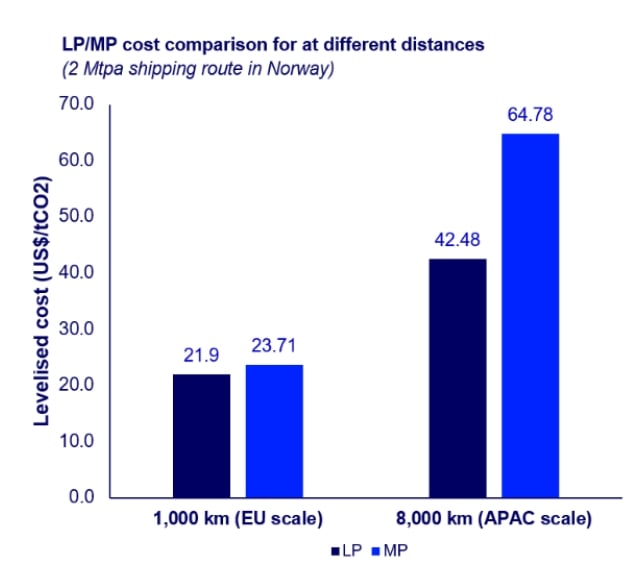
- Pipeline and shipping costs can be comparable over distances of up to 1,000 kilometres, depending on project conditions and existing infrastructure.
- Low-pressure CO₂ vessels could cut long-distance shipping costs by up to 34% compared with medium-pressure alternatives.
- Fuel and electricity account for more than 50% of the levelised cost of CO₂ shipping.
- In Japan, shipping could become more cost-effective than offshore pipelines for distances exceeding 400 kilometres at a transport volume of 5 Mtpa.
These figures show that companies must weigh transport distance, CO₂ volumes and infrastructure costs when selecting the most economical option.
Carbon Capture Needs Reliable Transport Networks
CCUS projects need an integrated system that connects industrial facilities, transport networks and storage sites.
Cement, steel and chemical producers could use carbon capture to reduce emissions from processes that are difficult to decarbonise. Companies can transport captured CO₂ to suitable geological formations and inject it underground for long-term storage.
However, building capture facilities alone will not guarantee that companies can transport and store CO₂ at the required scale. Limited pipeline capacity, insufficient shipping infrastructure, and delays in developing storage sites could restrict project operations.
This challenge could create opportunities for investors across several areas:
- Pipeline construction and conversion
- CO₂ liquefaction equipment and export terminals
- Specialised CO₂ carriers and shipping services
- Geological storage development and monitoring
Companies could also lower costs by connecting several industrial emitters to shared transport and storage networks. These hubs can spread infrastructure expenses across multiple customers and improve utilisation.
The climate benefits depend on how much CO₂ companies capture, the emissions generated during capture and transport, and the security of long-term storage. Transporting fossil-derived CO₂ for permanent storage can prevent emissions from entering the atmosphere, but it does not automatically qualify as carbon removal.
Policy Will Shape the Industry’s Growth
Governments must establish clear rules to support cross-border CO₂ transport. International projects need agreements that define transport standards, storage permits, long-term liability, and responsibility for monitoring stored carbon.
Wood Mackenzie identifies gaps in bilateral agreements, liability frameworks, and economic incentives as barriers to cross-border CCUS development. These issues matter particularly in Asia Pacific, where several countries could depend on international transport networks and overseas storage sites.
Governments will need to coordinate infrastructure planning and establish clear regulatory frameworks. Developers must also secure reliable access to storage facilities and enough committed CO₂ volumes before investing in large transport projects.
The projected $211 billion investment opportunity highlights the potential scale of the global CO₂ transport industry. Asia Pacific’s growing demand, the expected dominance of pipelines and the expansion of specialised shipping could shape the market over the coming decades.
Here’s another data from the IEA that highlights funding prospects:
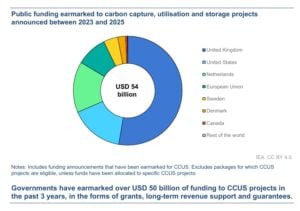
However, the forecast does not guarantee future investment. The industry will need commercially viable projects, sufficient storage capacity and supportive policies to move captured CO₂ efficiently from industrial facilities to permanent storage sites.