

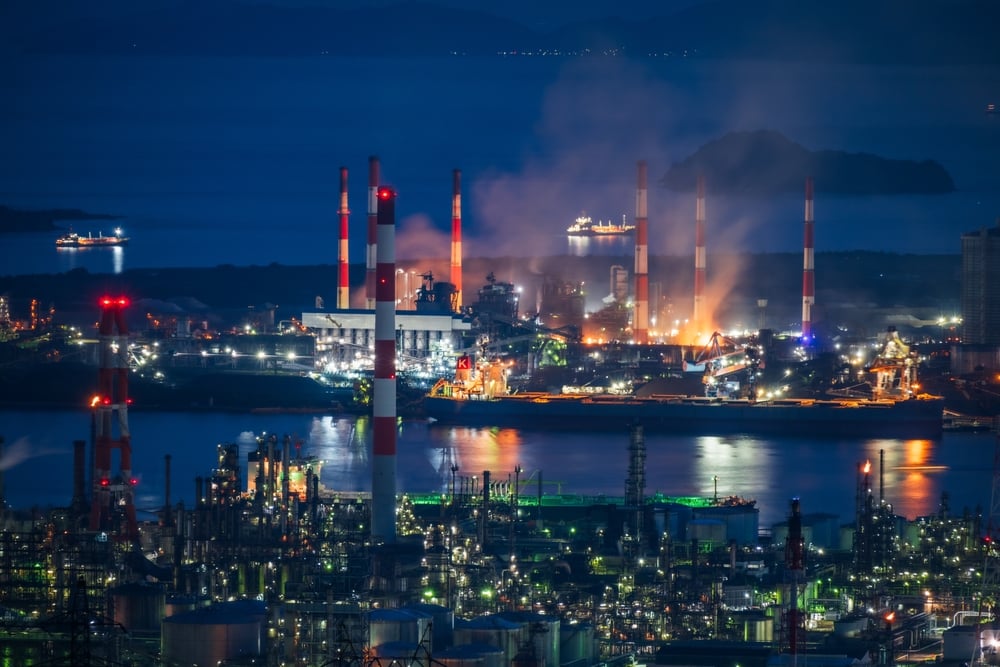
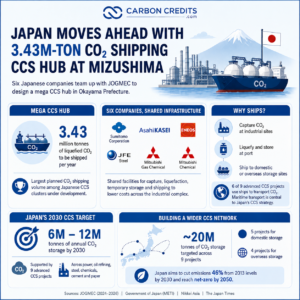
Japan is moving ahead with plans for a major carbon capture and storage (CCS) hub at the Mizushima Industrial Complex in Okayama Prefecture. Six Japanese companies have signed a contract with the Japan Organization for Metals and Energy Security (JOGMEC) to design facilities that will capture, liquefy, temporarily store and ship carbon dioxide. The planned hub could ship about 3.43 million tonnes of liquefied CO2 a year.
The project is part of Japan’s wider push to build a commercial CCS industry by 2030. It also shows how Japan plans to use ships to connect industrial areas with underground CO2 storage sites.
Six Companies Team Up on a Mega CCS Hub
The project brings together Sumitomo Corporation, Asahi Kasei, ENEOS, JFE Steel, Mitsubishi Gas Chemical and Mitsubishi Chemical. They will design facilities for CO2 capture, liquefaction, temporary storage and shipping.
The project covers the Mizushima industrial area in Kurashiki City, a major industrial center in western Japan. The companies plan to share infrastructure across the industrial area instead of having each company build its own system.
That could help lower costs and make CCS more practical for several industrial facilities at once.
The planned hub would ship about 3.43 million tonnes of liquefied CO2 per year when shipping starts. The companies say this would be the largest planned CO2 shipping volume among Japanese CCS clusters currently under development.
Why Japan Is Putting CO2 on Ships
CCS involves more than capturing carbon.
Companies must move the captured CO2 to a site where they can store it underground. But many of Japan’s large industrial centers do not sit close to suitable storage sites. Ships can solve part of this problem.
Captured CO2 can be turned into a liquid, stored at a port, and loaded onto specialized ships. The ships can then move the CO2 to domestic or overseas storage sites.
JOGMEC selected nine advanced CCS projects in 2024. Together, they aim to store about 20 million tonnes of CO2 a year. Six of the nine projects use ships to transport liquefied CO2, while three use pipelines. This makes maritime transport a key part of Japan’s CCS strategy.
Japan Targets 6M to 12M Tons of CO2 Storage by 2030
Japan wants to start commercial CCS operations by 2030.
JOGMEC’s nine advanced projects support a government target of 6 million to 12 million tonnes of annual CO2 storage by 2030. The nine projects cover industries such as power generation, oil refining, steel, chemicals, cement and paper.
Japan also aims to reach net-zero greenhouse gas emissions by 2050. It has set a 2030 target of cutting emissions by 46% from fiscal 2013 levels. McKinsey & Company shows below how the country could reach its climate goals.
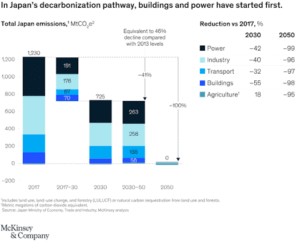
The Mizushima project could make a large contribution to the country’s CCS infrastructure if it reaches its planned shipping volume.
However, 3.43 million tonnes refers to CO2 shipped, not CO2 permanently stored. The climate benefit will depend on how much captured CO2 ultimately reaches approved storage sites and remains underground.
Shared Infrastructure Could Bring CCS Costs Down
Cost is one of the biggest challenges for maritime CCS. Ship-based systems require extra equipment to liquefy and temporarily store CO2 before shipping. JOGMEC says these steps can add costs compared with pipeline systems. Ship transport can also be more expensive.
Japan is therefore trying to build larger hubs.
In June 2026, JOGMEC selected six emitter clusters to study shared facilities for CO2 capture, liquefaction, temporary storage and shipping. The goal is to collect CO2 from several nearby facilities and share infrastructure.
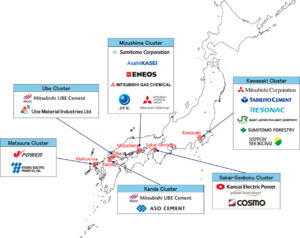
Mizushima follows this same approach. A shared hub could spread the cost of expensive equipment across several companies. It could also make it easier to add new emitters later.
Mizushima Aims Hard-to-Cut Emissions
The Mizushima industrial area includes companies from sectors such as chemicals, steel and energy. These industries face a difficult emissions challenge. Some emissions come directly from industrial processes and cannot be eliminated simply by switching to renewable electricity.
CCS can provide another tool.
Companies can capture CO2 at industrial facilities, transport it and store it underground. This could help reduce emissions from operations that are difficult to fully electrify.
The six companies say the project will also support the green transformation of the Mizushima industrial complex. For Japan, that links CCS with both climate policy and industrial competitiveness.
Japan Is Building a Wider CCS Network
Mizushima is only one part of Japan’s developing CCS system. JOGMEC began supporting advanced CCS projects in 2023. The first seven projects aimed to store about 13 million tonnes of CO2 per year.
The agency later expanded the program to nine projects with a combined target of about 20 million tonnes a year. The projects cover several regions and industries.
Some plan to store CO2 in Japan. Others will ship captured CO2 to storage sites elsewhere in the Asia-Pacific region. Four of the nine 2024 projects target overseas storage.
This approach could eventually create a regional CO2 transport network linking Japan with storage resources in other countries.
Japan Has Already Tested CCS
Japan has experience with both carbon storage and CO2 transport. At the Tomakomai CCS demonstration project in Hokkaido, the country injected about 300,000 tonnes of CO2 underground between 2016 and 2019. The government continues to monitor the stored CO2.
Japan has also tested technologies for transporting liquefied CO2 by ship. These projects have helped the nation develop experience with the equipment and processes needed for a larger CCS industry. The government is now moving from demonstration projects toward commercial-scale systems.
A New Legal Framework Supports CCS
Japan also created a legal framework for the industry. In May 2024, the country’s parliament passed the Act on Carbon Dioxide Storage Business. The law created a licensing system for companies that want to operate CO2 storage businesses. That framework is important because CCS projects require large investments and long operating periods.
Companies need clear rules covering storage rights, monitoring, safety, and responsibility for stored CO2. Government support also remains important as companies develop the first commercial projects.
JOGMEC is supporting the full CCS chain, from capture and transport to underground storage.
CCS Must Move Beyond Capture
The Mizushima project still has several steps to complete. The current agreement covers design work, so the 3.43-million-tonne figure is a planned shipping volume rather than operating capacity. The companies still need to complete engineering work, develop the business model and make further investment decisions.
The storage side is also critical. Capturing millions of tonnes of CO2 has little climate value if companies cannot transport and permanently store the gas safely.
Japan’s long-term goal shows the scale of the challenge. JOGMEC estimates that Japan could need 120 million to 240 million tonnes of annual CO2 storage by 2050 to support its net-zero goal. That means Mizushima would be an important step, but only one part of a much larger system.
Mizushima Could Set the Course for Asian CCS
Japan’s planned 3.43-million-tonne annual CO2 shipping hub shows how quickly the country is trying to build a commercial CCS network. The project combines several large industrial companies, shared infrastructure and maritime CO2 transport. That model could help lower costs and connect industrial regions with storage sites that are far away.
The key test will be whether Japan can move from design to investment and then to reliable, large-scale CO2 storage. And if it succeeds, Mizushima could become an important model for hub-based maritime CCS in Japan and across Asia.
For now, the project is another sign that Japan sees carbon capture and storage as a major tool for cutting emissions from heavy industry while building a new carbon-management infrastructure.