


Verra has approved the first carbon credits generated under its methodology for reducing food loss and waste, opening a new pathway for food rescue projects to access carbon market finance.
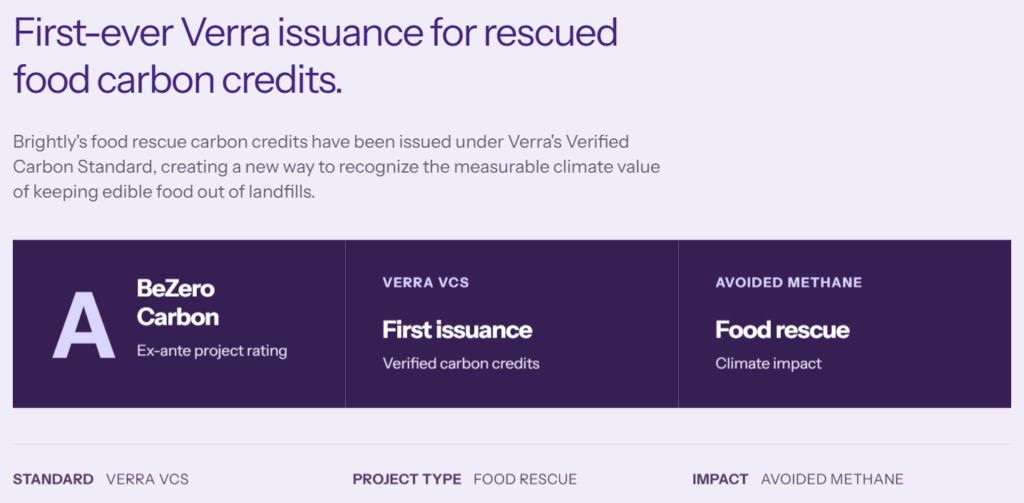
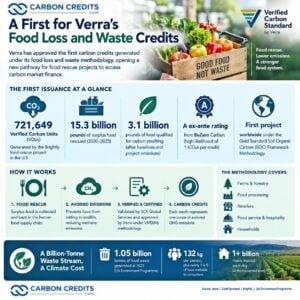
The credits come from the Brightly – Reducing Food Loss and Waste project in the United States. The project generated 721,649 Verified Carbon Units (VCUs) by redirecting surplus food to people instead of allowing it to enter waste streams.
The milestone gives food rescue organizations a new way to monetize avoided methane emissions while addressing food insecurity. It also broadens the types of activities that can earn verified carbon credits. This goes beyond traditional areas like forestry, renewable energy, and methane capture.
Verra approved the credits under its VM0046 Methodology for Reducing Food Loss and Waste, v1.0. Mandy Rambharos, CEO, Verra, remarked:
“Food waste is one of the most overlooked sources of methane, and preventing it is one of the most solvable issues. This first issuance under VM0046 proves that keeping food out of landfills can be measured with integrity, and that carbon markets can move finance to the organizations making it happen. It also shows why Verra keeps broadening its methodology portfolio: there are many ways to cut emissions, and each one needs a credible pathway to carbon finance.”
721,649 Credits Put Food Rescue on the Carbon Map
Brightly’s project covers food rescue activities carried out between March 2020 and December 2023. During that period, participating organizations rescued 15.3 billion pounds of surplus food. After applying historical baselines and accounting for project-related emissions, 3.1 billion pounds of the rescued food qualified for carbon crediting.
That activity produced 721,649 VCUs, with each credit representing one tonne of avoided greenhouse gas emissions. The credits received an A ex-ante rating from BeZero Carbon, indicating a high likelihood that each credit represents one tonne of avoided emissions.
SCS Global Services, a Verra-approved body, independently validated and verified the project. Then, Verra reviewed and approved the issuance.
The first issuance follows Verra’s registration of Brightly’s project in May 2026. At that stage, Verra expected the project to save about 167 million pounds of food over seven years, from 2020 to 2027. It would also cut emissions by about 115,118 tonnes of CO2e.
The latest issuance reflects verified historical activity rather than the entire future potential of the project.
How Verra’s Food-Waste Methodology Works
Verra’s VM0046 methodology has been active since July 12, 2023. It falls under the Verified Carbon Standard’s waste-handling and disposal sector.
The methodology allows projects to quantify emissions avoided when food that would otherwise become waste remains in the human food supply chain. Projects can operate at several points along the food chain, including:
- Farms,
- Food processing facilities,
- Retailers,
- Food-service and hospitality businesses, and
- Households.
The methodology measures the emissions that would happen if the food went to a waste site, like a landfill. That makes it different from carbon removal projects. The credits represent avoided emissions, primarily by preventing food from decomposing in waste streams and generating methane.
The methodology also addresses additionality. Brightly establishes a conservative historical baseline for participating organizations, with only food rescued above that baseline eligible for crediting. This ensures that credits show real climate impact. They don’t just reward current food-rescue efforts.
A Billion-Tonne Waste Stream With a Climate Cost
The potential market for this type of project is large because food loss and waste occur across the global food system.
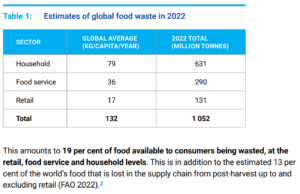
The UN Environment Programme estimates that 1.05 billion tonnes of food waste were generated in 2022 at the retail, food service and household levels. That amounted to 132 kilograms per person and nearly one-fifth of food available to consumers. Households alone wasted more than 1 billion meals per day.
Food loss also occurs before food reaches consumers.
The Food and Agriculture Organization estimates that 13.2% of food is lost worldwide from harvest to retail. Additionally, 19% is wasted at retail, food service, and households, according to 2024 UNEP statistics. Together, food loss and waste account for an estimated 8% to 10% of global greenhouse gas emissions, according to FAO.
This gives carbon markets a large potential emissions reduction opportunity. However, not every tonne of wasted food automatically translates into a carbon credit.
Projects must establish baselines, quantify eligible activity, and account for emissions associated with the intervention. VM0046 provides the framework for doing that.
Carbon Revenue Could Help Scale Food Rescue
The Brightly project connects climate finance with food rescue. The company works with food rescue organizations that collect edible surplus food and redistribute it instead of allowing it to enter waste streams. The organizations can then receive revenue from carbon credit sales.
Feeding America said the majority of net proceeds from credit sales will return to participating food rescue organizations. The funding can cover costs like trucks, drivers, refrigeration, staff, and other infrastructure needed to recover and distribute food.
The scale of the network has also expanded significantly.
Brightly partners with 198 Feeding America food banks and 28 independent food rescue groups. This helps us reach communities in every U.S. state and about 97% of U.S. counties. Together, these organizations rescue more than 5 billion pounds of surplus food each year, according to Feeding America.
This can lead to a feedback loop. More carbon revenue helps organizations recover more food. This, in turn, can create further measurable emissions reductions.
Carbon Markets Broaden Beyond Forests and Renewables
The first food-loss-and-waste issuance comes as the broader carbon credit market continues to develop.
The World Bank reported that global carbon credit issuances increased 8% between 2024 and 2025, although issuance remained about 20% below its 2022 peak. Independent crediting mechanisms still accounted for about 70% of total issuance.
At the same time, carbon credit retirements fell by more than 10% in 2025. Voluntary uses made up over 80% of retired credits. Meanwhile, companies and other buyers signed around $12 billion in offtake agreements for future carbon credits. This amount is three times what was recorded in 2024.
Prices also varied sharply by project type. The World Bank said carbon credit prices declined slightly across 2025, but higher-quality and compliance-eligible credits continued to command premiums. CORSIA-eligible credits, for example, traded at around $15 to $22 per tonne, compared with roughly $1 to $14 for most other credit types.
For food-loss-and-waste projects, the key question will be whether buyers place a premium on the combination of methane avoidance, food security, and measurable local impact.
Food Rescue Enters the Carbon Credit Economy
Verra’s first VM0046 issuance does more than create another category of carbon credits. It demonstrates that food rescue can be measured through a standardized carbon methodology and converted into a tradable environmental asset.
The Brightly project also shows how carbon finance can potentially reach organizations that traditionally depend heavily on grants and donations.
With 721,649 credits now approved from the first issuance, the project provides an initial test of demand for this new credit type. Future projects could expand the market to other parts of the food supply chain, including retailers, food processors, farms, and food-service businesses.
The climate opportunity is significant. Over 1 billion tonnes of food waste are created each year at the consumer level. This waste contributes to nearly 10% of global greenhouse gas emissions.
VM0046 does not solve that problem by itself. But it gives project developers a standardized way to measure a portion of the emissions avoided when food stays in the human food system. For carbon markets, that creates a new pathway to finance climate action while also reducing food waste and supporting food security.