

Rio Tinto and Chinese steelmaker Shougang Group have commissioned an industrial-scale carbon capture trial facility designed to capture carbon dioxide directly from blast furnace gas at Shougang’s Jingtang steelmaking base in China.
The facility can process up to 3,000 cubic metres of blast furnace gas per hour and is designed to capture as much as 10,000 tonnes of CO₂ annually.
The project targets one of the hardest parts of steelmaking to decarbonize: existing blast furnace operations. Rather than replacing the blast furnace with a different production route, the technology captures CO₂ from gas generated during ironmaking and could potentially allow existing assets to continue operating with lower emissions.
The facility is part of a broader technology partnership between Rio Tinto and Shougang that began with a 2022 memorandum of understanding. The companies are working on low-carbon sintering, blast furnace and basic oxygen furnace optimization, and carbon capture and utilization technologies.
Steelmaking Remains a Major Source of Global Emissions
The project comes as the steel industry faces growing pressure to reduce its carbon footprint.
- Steelmaking accounts for about 7% to 9% of global CO₂-equivalent emissions, according to a 2025 review published in Nature Reviews Clean Technology.
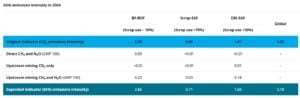
Around 70% of global steel production still uses the blast furnace-basic oxygen furnace (BF-BOF) route, which has an emissions intensity of about 2.32 tonnes of CO₂e per tonne of steel.
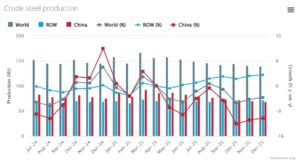
Global crude steel production reached about 1.85 billion tonnes in 2025. China remained by far the world’s largest producer, producing 960.8 million tonnes, or more than half of global output.
China’s steel industry is particularly important to global decarbonization efforts. Research published in 2026 estimates that China’s iron and steel sector accounts for roughly 15% of the country’s CO₂ emissions and more than 30% of its industrial emissions.
China’s total energy-related CO₂ emissions declined by around 0.5% in 2025, according to the International Energy Agency (IEA), with lower steel and cement production contributing to the decline. However, the scale of China’s steel industry means even incremental changes in emissions intensity can have a significant impact globally.
Shougang’s Steel Footprint
Shougang Group produced 30.23 million tonnes of crude steel in 2025, ranking it 12th among the world’s largest steelmakers, according to World Steel Association data. The company’s production declined from 31.57 million tonnes in 2024.
The company does not appear to publicly disclose a single consolidated current CO₂ footprint for the entire group that can be directly attributed to its 2025 steel production. However, the company has expanded its carbon accounting and product-level carbon footprint systems.
Shougang says Beijing Shougang and Shougang Jingtang have completed organization-level carbon emissions accounting and carbon footprint assessments for customer products. Both operations have also received carbon certification from SGS.
At Jingtang, the company has already been pursuing several measures to lower emissions from conventional steelmaking. Its blast furnace process has increased the share of pellet ore to more than 55%, which Shougang says has reduced CO₂ emissions by more than 167 kilograms per tonne of iron compared with the previous process.
Jingtang has also demonstrated steelmaking using more than 50% scrap in automotive steel production. Higher scrap use can reduce the need for carbon-intensive primary ironmaking.
Rio Tinto and Shougang Scale Up Carbon Capture
The new carbon capture facility follows a smaller-scale blast furnace carbon capture unit commissioned in 2024.
The companies are now testing the technology at a larger industrial scale and plan to operate the facility over the longer term for research and technology development.
Using waste heat from existing steelmaking operations could help reduce the energy requirements and costs associated with carbon capture. If costs can be lowered sufficiently, the approach could eventually be applied to other existing blast furnace facilities.
Rio Tinto Iron Ore Sales and Marketing Vice President Ramona Sim said:
“This milestone is an important step in our 30-year relationship with Shougang and our work together to find practical ways to reduce emissions from steelmaking.
“Steelmakers are exploring a range of technologies to lower emissions from existing blast furnace operations, and carbon capture and utilisation could play a key role as these technologies continue to develop.
“We’re committed to working with our customers to find better ways to use Pilbara ores in a lower-carbon future.”
A Partnership that Dates Back to 1996
The partnership between the two companies dates back to 1996, when Shougang received its first shipment of Rio Tinto iron ore from Australia’s Pilbara region. Three decades later, the relationship is increasingly focused on how that iron ore can be used in a lower-carbon steel industry.
Shougang Group Vice President Zhu Guosen said:
“Through this collaboration with Rio Tinto on carbon capture technology, Shougang has successfully developed and commissioned a 10,000-tonne-scale industrial trial facility.
“This achievement represents an important milestone for blast furnace decarbonisation and provides valuable demonstration value for reducing emissions in the conventional steelmaking route.
“The project has effectively addressed key challenges associated with carbon reduction in the blast furnace process and serves as an important example of our commitment to China’s dual-carbon goals and the advancement of low-carbon, green development.
“Looking ahead, we will continue to optimise the technology, advance the utilisation of captured carbon resources, and contribute to the green and low-carbon transformation of the steel industry.”
Captured CO₂ Could Be Reused in Steelmaking
The project is focused not only on capturing CO₂ but also on finding ways to use the captured carbon.
Rio Tinto and Shougang are exploring the conversion of captured CO₂ into syngas that could be recycled into the steelmaking process. Such an approach could reduce the amount of new carbon-based inputs required by steelmakers while creating a circular carbon pathway inside the plant.
That could become increasingly important as steelmakers look for ways to decarbonize existing BF-BOF assets without waiting for complete replacement with hydrogen-based direct reduced iron or electric arc furnace technologies.
The Broader Carbon Capture Market
Carbon capture is also becoming a larger commercial market.
- According to Mordor Intelligence, the CCS market size is expected to grow from USD 2.76 billion in 2025 to USD 3.15 billion in 2026 and is forecast to reach USD 6.05 billion by 2031 at 13.98% CAGR over 2026-2031.
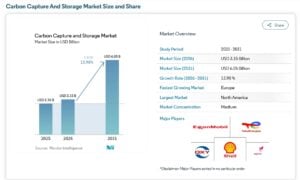
Other market estimates vary significantly depending on whether they include transportation, utilization, and storage infrastructure.
The growth reflects rising demand for industrial carbon management, particularly in sectors such as steel, cement, chemicals and refining where process emissions can be difficult to eliminate through electrification alone.
Carbon Capture Targets Existing Steel Assets
The Rio Tinto-Shougang project highlights a broader debate over how quickly the global steel industry can move away from conventional blast furnace technology.
Hydrogen-based direct reduced iron and electric arc furnaces offer a potential pathway to much lower-emission steel, but replacing the world’s existing blast furnace fleet would require significant investment, new infrastructure and large amounts of low-carbon electricity or hydrogen.
Carbon capture offers another route by targeting emissions from facilities that are already operating.
The challenge will be cost. Capturing 10,000 tonnes of CO₂ annually at Jingtang is small compared with the emissions generated by a large integrated steel mill. But the trial could provide data on capture efficiency, energy use, operating costs, and the potential value of using captured CO₂.
For Rio Tinto, the project also extends its role beyond supplying iron ore into technologies that could lower emissions further down the steel value chain.