


US-based Antora Energy is planning a 5.8 gigawatt-hour (GWh) multi-day thermal energy storage project at Pratt Energy’s biorefinery in Pratt, Kansas.
The project will provide reliable, around-the-clock energy to the ethanol facility while supporting local jobs, workforce training, and new investment in Pratt County.
The press release also highlighted that once completed, the project is expected to rank among the world’s largest battery storage systems. Antora plans to begin delivering energy to Pratt Energy next year under a long-term heat offtake agreement.
- The project is backed by Copenhagen Infrastructure Partners (CIP), Australian investment firm Grok Ventures and University Pension Plan Ontario (UPP). CIP led the third-party equity financing through its credit platform investments.
The deal comes as U.S. industries face rising electricity demand and growing pressure to secure reliable, affordable energy while reducing emissions.
Antora’s Thermal Battery Targets Industrial Energy Demand
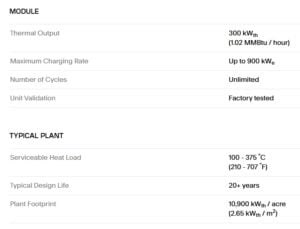
Antora Energy is a U.S. energy storage company focused on thermal batteries that store electricity as heat and later deliver it as heat or power.
Instead of relying on conventional lithium-ion battery chemistry, Antora stores energy in insulated blocks of solid carbon. The system can absorb low-cost electricity when it is available and release energy when industrial customers need it.
This approach allows the company to target industrial facilities that require continuous heat and power.
Antora says its technology does not rely on supply-constrained critical minerals. It also uses factory-built modules, which could help reduce construction timelines compared with some large energy infrastructure projects.
“Antora’s thermal energy storage is the new standard for powering always-on operations with low-cost energy”
Expanding Its U.S. Energy Storage Footprint
The Kansas project follows Antora’s recent expansion in the U.S. energy storage market. Earlier this year, the company commissioned a 5 GWh thermal energy storage system in Big Stone City, South Dakota.
The company also expects the project to create and support more than 100 construction and operations jobs.
David Bierman, co-founder and Chief Commercial Officer of Antora, said:
“American industry runs on affordable, reliable energy. Our partnership with Pratt Energy delivers it, helping meet Kansas’s rising energy demand without increasing power bills for homes or businesses. This biorefinery project is creating jobs and spurring local investment without straining the resources the community depends on.”
Pratt Energy Could Move Toward Lower-Carbon Ethanol
Pratt Energy operates an ethanol biorefinery that processes locally grown corn and sorghum into transportation fuel and co-products used in biodiesel and animal feed.
The company has operated in Pratt since 2013 and works with farmers across the region.
The new thermal storage system could help the facility improve energy efficiency while lowering the carbon intensity of its products.
Antora said the project could help Pratt Energy move toward producing ethanol with a 100% zero-carbon-intensity profile. Lower-carbon ethanol could also open additional markets for Kansas agricultural products as fuel buyers place greater emphasis on emissions.
Additionally, the project is expected to use little additional water beyond Pratt Energy’s existing operations. It is also designed to operate without increasing noise levels for nearby properties.
For the ethanol industry, access to lower-carbon energy can become increasingly important as producers seek to reduce emissions across their operations and improve the environmental profile of their fuels.
The long-term heat offtake agreement also gives Antora a committed industrial customer for the project, creating a direct link between energy storage and industrial demand.
Investors Back Large-Scale Thermal Energy Storage
Copenhagen Infrastructure Partners is one of the investors backing the Kansas project.
CIP is a global energy infrastructure investment firm that invests across areas including renewable power, energy storage, transmission, low-carbon fuels, advanced bioenergy and carbon capture.
The firm has raised about $49 billion to date and manages 15 funds, according to the company.
CIP’s involvement highlights the growing interest from infrastructure investors in energy storage technologies that can serve industrial customers and provide longer-duration energy.
Grok Ventures is also participating in the financing. The Australian investment firm focuses on technology-driven solutions across major global challenges, including the energy transition.
UPP, a Canadian pension fund, is the third financial participant in the project.
The investment group gives Antora access to capital as it moves from individual demonstrations toward larger commercial deployments.
The US Battery Storage Market Capacity
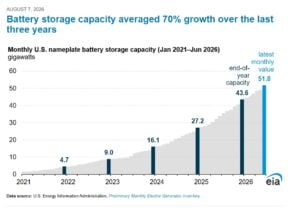
Utility-scale battery storage capacity reached nearly 52 gigawatts (GW) by June 2026, after operators added 8.3 GW during the first half of the year. The U.S. had 43.6 GW of operational utility-scale battery storage at the end of 2025, with capacity growing at an average annual rate of 70% over the past three years, according to EIA data.
The growth is expected to continue. U.S. developers plan to add about 24 GW of utility-scale battery storage in 2026, up from a record 15 GW added in 2025.
Battery storage accounts for about 28% of the 86 GW of new utility-scale generating capacity planned for the U.S. this year.
Battery Storage Market Moves Beyond Short-Duration Systems
The Kansas project also highlights how the battery storage market is expanding beyond conventional short-duration electricity storage.
Most large battery projects deployed today use lithium-ion technology and typically provide power for a few hours. Thermal energy storage can address a different part of the market by storing energy for longer periods and delivering industrial heat directly.
- That matters because many industrial facilities cannot simply replace fossil-fuel-based heat with electricity without changing how they operate.
- Thermal batteries could provide another pathway by storing electricity during periods of lower prices and then supplying heat when needed.
The approach could become particularly useful as renewable energy expands and power markets experience larger differences between periods of high and low electricity prices.
Antora’s system is designed to provide both heat and power, allowing the same basic technology to serve industrial facilities or potentially support the wider grid.
The company says its thermal batteries can be deployed for industries including chemicals, food production and steel, as well as for grid applications.
The Bottom Line
For Antora, the Kansas project represents another step toward commercial-scale deployment. For Pratt Energy, it could provide reliable energy while supporting efforts to lower the carbon intensity of ethanol production.
The project also shows how energy storage investments can extend beyond batteries and grid services. By connecting storage directly with industrial heat demand, companies can use new energy technologies to improve operations, reduce emissions, and strengthen the economics of low-carbon products.
As more U.S. industries look for reliable energy and lower-carbon production, projects like Pratt could help expand the role of thermal batteries in the country’s energy transition.