

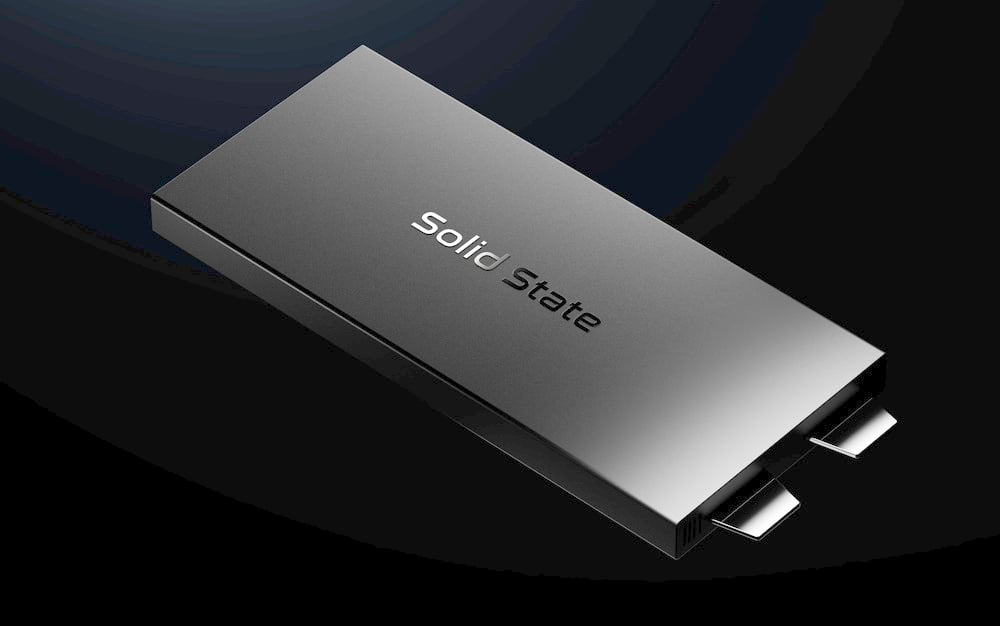
The top U.S. battery developer Factorial Energy (Nasdaq: FAC) is bringing in a major Japanese materials company as it works to take its solid-state battery technology from advanced testing to commercial production.
It recently announced a strategic partnership with Japan’s Mitsui Kinzoku Company to support industrializing its Solstice™ all-solid-state battery platform.
The deal brings together two different pieces of the battery puzzle. Factorial focuses on cell design and manufacturing processes, while Mitsui Kinzoku brings its experience in sulfide-based solid electrolytes.
Siyu Huang, CEO of Factorial, noted:
“Battery innovation can’t be done by one single company. It’s driven by the entire supply chain and, increasingly, by an entire industry coalition. Mitsui Kinzoku’s foundational electrolyte technology brings critical materials expertise to our work to move Solstice™ toward commercial deployment. We’re not just building a battery. We’re building the connective thread that helps the whole industry move forward together.”
Mitsui Kinzoku Brings Materials Expertise
Factorial will continue to lead the Solstice platform as a fabless battery technology company. Its work covers cell design, process development, supply-chain qualification, production-line integration, and manufacturing validation.
Mitsui Kinzoku will contribute its expertise in advanced battery materials.
The Japanese company is one of the few major producers of sulfide-based solid electrolytes, an important component in all-solid-state batteries. Its A-SOLiD™ technology has been under development since 2016, and the company is working toward mass production at a dedicated facility in Saitama, Japan.
Mitsui Kinzoku also has a major position in semiconductor materials. It is a leading producer of ultra-thin copper foil and estimates that it holds about 90% of the global semiconductor market for that type of foil.
The partnership gives Factorial access to an established materials supplier while allowing Mitsui Kinzoku to work with a U.S. developer that is already testing solid-state cells in vehicles and other applications.
Dr. Kiyotaka Yasuda, Senior Executive Officer, General Manager, Business Creation Division of Mitsui Kinzoku Company, Limited, says:
“I am very pleased that we have been able to enter into this joint development agreement with Factorial. Batteries are a key technology for realizing an electrified society, but significant technical challenges still remain. That is precisely why we believe it is necessary to go beyond the extension of existing technologies and take on the challenge of creating new value.”
“By leveraging Mitsui Kinzoku’s long-established expertise in materials and manufacturing technologies and combining it with Factorial’s advanced technological capabilities, we aim to accelerate the realization of next-generation batteries.”
Why sulfide electrolytes matter
Traditional lithium-ion batteries use a liquid electrolyte to move lithium ions between the electrodes. Solid-state batteries replace that liquid with a solid material.
But sulfide-based electrolytes are attracting attention because they can provide high ionic conductivity while supporting the thin battery designs needed for high energy density.
However, they also bring manufacturing challenges. Producing consistent layers, managing moisture sensitivity, and integrating the materials into existing battery production lines can be difficult.
This makes manufacturing know-how just as important as the chemistry itself.
- RELATED: Live Lithium Prices Today
Solstice Targets More Energy With Less Weight
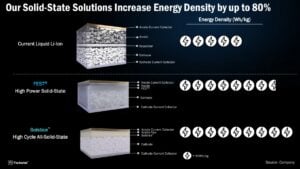
Factorial says its Solstice platform can reach up to 450 Wh/kg and deliver up to 80% higher energy density than traditional lithium-ion batteries.
Higher energy density could allow automakers and other customers to choose between longer range and lighter battery packs.
The company is also working on the manufacturing side. Solstice uses proprietary dry-cathode processing, which Factorial says can reduce manufacturing costs and energy use compared with conventional wet-coating methods.
The platform is designed around several potential advantages:
- Energy density of up to 450 Wh/kg, according to Factorial
- Operation at temperatures up to 90°C
- A sulfide-based all-solid-state electrolyte
- Dry-cathode processing designed to simplify production
- Compatibility with parts of existing lithium-ion manufacturing infrastructure
The last point could be particularly important. Battery companies have already invested billions of dollars in lithium-ion factories, so a solid-state technology that can use some existing equipment could potentially reduce the cost and time required to scale.
Factorial Has Already Put Its Batteries to the Test
The company is not starting from a laboratory bench.
Testing with Stellantis
Factorial and Stellantis have been testing FEST® solid-state battery cells in North America. The technology was integrated into a Dodge Charger Daytona prototype as part of the development program.
Stellantis previously reported that Factorial’s 77 Ah FEST cells reached an energy density of 375 Wh/kg over more than 600 cycles.
The cells also demonstrated:
- Charging from 15% to 90% in 18 minutes
- Discharge rates of up to 4C
- Operation from -30°C to 45°C
These results are from testing programs rather than mass-market production, but they show the stage the technology has reached.
Mercedes-Benz pushes range
Mercedes-Benz has also tested Factorial’s technology. A modified EQS equipped with Factorial’s solid-state cells traveled more than 1,200 kilometers, or about 745 miles, on a single charge during a road test.
The test showed why solid-state batteries continue to attract interest from premium automakers. More energy packed into a smaller and lighter battery could make long-range EVs easier to build without simply adding more battery cells.
The U.S. Solid-State Battery Market Is Still Young
Solid-state batteries remain a small commercial market in the U.S., but market researchers expect the sector to expand quickly as automakers move toward pilot production and early commercial applications.
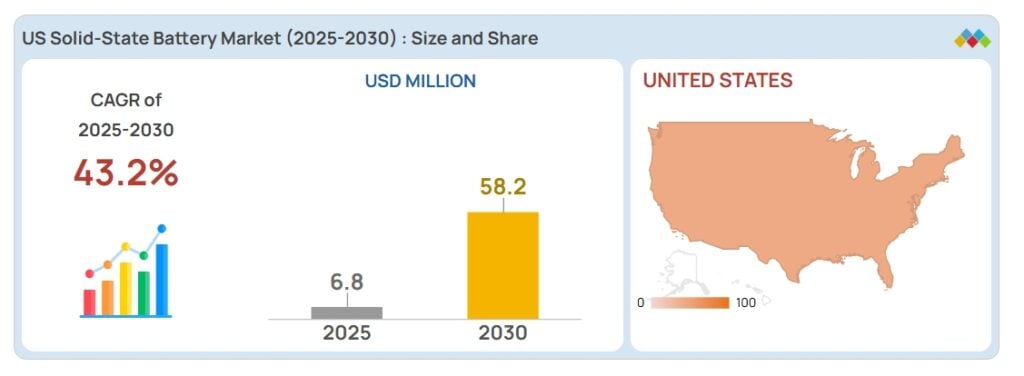
Other forecasts, like Grand View Research, estimate that the U.S. solid-state battery market could reach $4.13 billion by 2033, with a 40.7% CAGR between 2026 and 2033.
The difference between these estimates is significant. It also shows how early the industry is and how much future growth depends on commercialization.
Factorial’s Ecosystem is helping move the market forward
The U.S. is becoming an important testing ground for solid-state batteries because the country has major automakers, battery manufacturers, and government-backed efforts supporting domestic battery production.
Factorial is building its own network around that ecosystem. The company has worked with Mercedes-Benz, Stellantis, Hyundai, and Kia. It also has strategic backing from In-Q-Tel and POSCO Future M.
In July, it signed an MOU with SK On to explore bringing its solid-state battery technology into SK On’s global manufacturing network. This approach could help Factorial avoid building an entirely new manufacturing footprint from scratch.
Solid-State Batteries Could Go Beyond EVs
Electric vehicles remain one of the biggest potential markets for solid-state batteries, but Factorial is looking beyond cars. The company announced its first commercial aerospace order in July and is also developing applications for drones, defense, and robotics.
These markets have different battery requirements from passenger vehicles.
For an electric car, a lighter battery can improve range and efficiency. For a drone or aircraft, reducing battery weight can directly affect how long the vehicle can stay in the air.
Robotics could also become an important market as AI moves from software into physical machines.
Factorial describes this broader opportunity as an emerging “energy layer,” where batteries become a critical part of the infrastructure needed for electric mobility, aerospace and physical AI.
Factorial Moves Into Its Next Phase
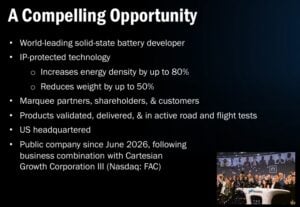
Factorial’s Nasdaq debut in June 2026 under the ticker FAC marked another step in its commercialization strategy.
The partnership does not mean solid-state batteries are ready to replace lithium-ion cells across the market. Manufacturing scale, cost, durability, and supply-chain development remain major hurdles for the industry.
But the direction is becoming clearer.
Factorial has moved from developing battery chemistry toward testing cells in vehicles and other real-world applications. Its latest deal with Mitsui Kinzoku focuses on the next challenge: building a materials and manufacturing system that can support larger-scale production.
Last but not least, for FAC investors, that shift from laboratory performance to manufacturing execution could become one of the most important parts of Factorial’s next stage of growth.