


Climate adaptation could become a major investment opportunity as rising temperatures increase the need to protect people, businesses, and infrastructure from extreme weather. A report from McKinsey Global Institute estimates that $460 billion in annual adaptation costs could be ready for deployment by 2050.
The report, Advancing Adaptation: Breaking Barriers to a Trillion-Dollar Opportunity, examines 20 established measures that protect against four major climate risks: extreme heat, wildfires, drought, and flooding.
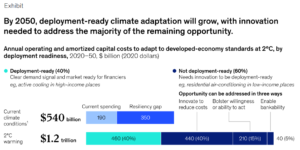
McKinsey estimates that the full annual cost of protecting people and assets from these hazards could reach $1.2 trillion by 2050 under a 2°C warming scenario. Yet, only about 40% of that amount, or $460 billion, could be ready for deployment under current conditions.
The findings point to growing demand for cooling systems, flood defenses, irrigation, and other climate-resilience solutions. However, financing gaps, high costs, and weak incentives could prevent many projects from moving forward.
How Climate Protection Costs Could Reach $1.2 Trillion a Year
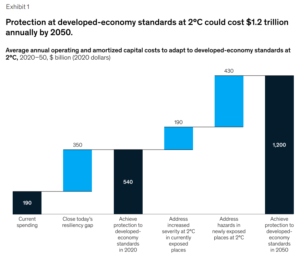
McKinsey estimates that annual costs for the 20 adaptation measures it studied could rise from about $540 billion in 2020 to $1.2 trillion by 2050. These figures include the cost of building, operating, and maintaining adaptation systems. They are expressed in 2020 dollars.
The estimate uses a scenario in which global temperatures reach 2°C above preindustrial levels by mid-century. It is a planning scenario, not a firm prediction.
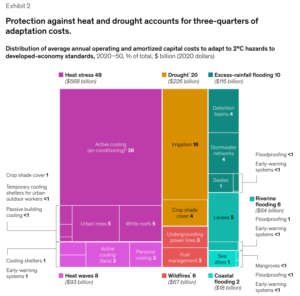
Heat and drought would account for about three-quarters of the total. More than half of the estimated annual cost would go toward heat protection, with cooling systems such as air conditioners making up the largest share. Drought protection would account for about one-fifth, including irrigation.
The remaining costs would cover measures such as flood defenses, drainage systems, wildfire protection, and early-warning systems.
About 40% of the total cost would go toward capital spending, such as building levees and buying cooling equipment. The other 60% would cover operating costs, including maintenance, electricity, and water.
Why Only $460 Billion Could Be Ready for Deployment
Not all adaptation needs can easily become funded projects. McKinsey estimates that $460 billion a year could be deployment-ready by 2050, equal to 40% of the $1.2 trillion annual need.
-
This is more than twice the roughly $190 billion currently spent each year on the 20 measures studied.
Deployment-ready projects have clear demand and can attract financing. Households, businesses, or governments have a reason and ability to pay, while lenders and investors can provide funding on acceptable terms.
More than two-thirds of the $460 billion opportunity could be in high-income regions. These areas are more likely to have the resources and financial systems needed to support investment.
Potential opportunities include active and passive cooling, stormwater management, early-warning systems, and irrigation. Companies could also benefit from demand for equipment installation, maintenance, and building upgrades.
However, the $460 billion figure is an estimate of potential annual adaptation costs that could be deployed. It is not a forecast of actual spending or guaranteed company revenue.
Financing and Affordability Are Major Barriers
The other $690 billion in annual adaptation costs could face major barriers by 2050. McKinsey identifies affordability and access to financing as key challenges. The largest barrier is cost. Innovation could make about $440 billion of adaptation measures more affordable and ready for deployment.
Another $210 billion could move forward if governments and businesses improve incentives, coordination, and public awareness of the benefits. This includes projects that require cooperation between government agencies or stronger reasons for households and companies to invest.
The remaining $40 billion could become easier to finance through new revenue models and funding structures. These could help projects such as early-warning systems attract lenders, even when their benefits do not produce direct income.
Some projects are difficult to fund because they prevent future losses but do not generate steady revenue. Flood defenses, for example, can protect entire communities, but the benefits may be spread across many people while the costs fall on one government or organization. This creates a gap between the value of a project to society and its ability to attract private investment.
Lower-Income Regions Face the Largest Funding Gap
The report finds that poorer regions face greater challenges in turning adaptation needs into funded projects. Less than 20% of the investment needed in Sub-Saharan Africa and India under the 2°C scenario is expected to be deployment-ready. In higher-income regions, more than half could meet that standard.
The cost of protection is also higher relative to local economic capacity. By 2050, adaptation costs could equal about 2% to 3% of exposed GDP in India and Sub-Saharan Africa. In higher-income regions such as North America, the European Union, and advanced Asia, the share could be around 0.3% to 0.5%.
Financing risks also differ. In lower-income regions, lenders may worry that borrowers cannot repay loans. In wealthier regions, projects may face revenue risks because they do not generate enough direct income to support private financing.
This means the regions that need climate protection most may have the hardest time paying for it. Despite these barriers, McKinsey finds that adaptation can provide strong economic returns.
Climate Protection Could Deliver Up to 7x Its Cost
Across the 20 measures studied, the benefits from avoided damage were roughly three times their costs in 2020. That ratio could rise to about seven times costs under the 2°C scenario.
Benefits include less damage to buildings and infrastructure, lower crop and business losses, and fewer health impacts. Adaptation can also help protect jobs and extend the useful life of exposed assets.
However, results vary by location and project. Poorly planned measures can also create new problems. For example, flood defenses in one area could increase flood risks elsewhere. Air conditioning can protect people from heat but also raises electricity demand.
Careful planning is therefore important. Projects need to reduce climate risks without creating other environmental or economic costs.
Innovation and New Funding Models Could Unlock More Projects
McKinsey estimates that targeted action could make much more of the $690 billion opportunity ready for deployment.
Reducing costs through new technology and better project design could address the largest barrier. Better coordination and stronger incentives could also help governments, businesses, and households move ahead with projects.
New financing models are important, too. These could give lenders clearer ways to assess risks and help projects with broad public benefits attract private capital.
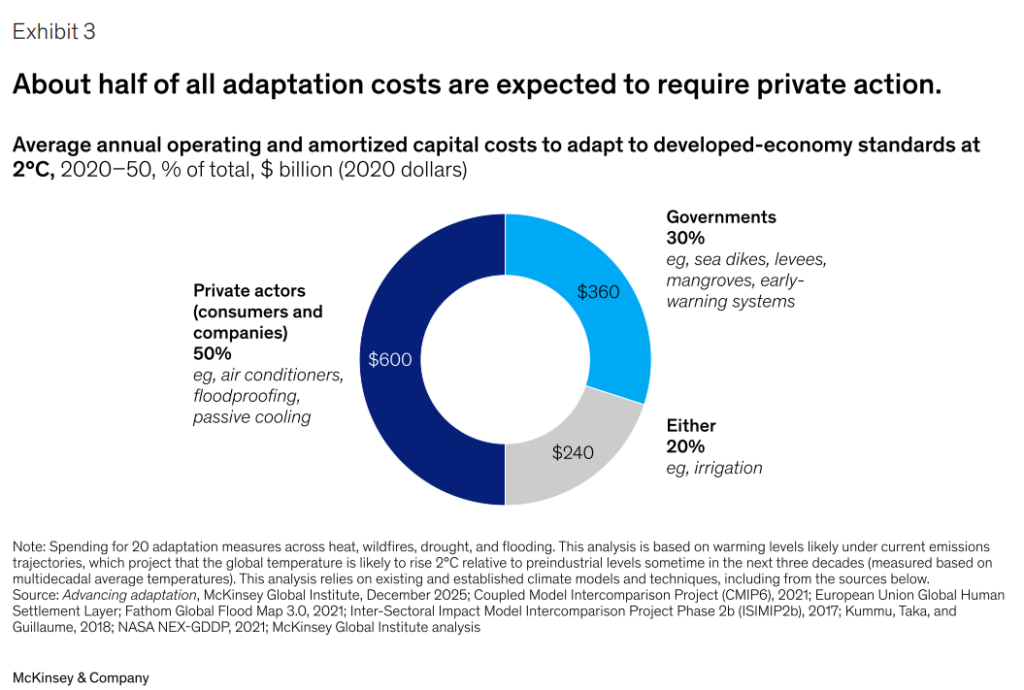
Governments can support this shift by improving policies and helping close affordability gaps. Companies can develop adaptation solutions and work with local partners. Banks and investors can create financing structures that make projects easier to fund.
A Large Opportunity, But Not a Guaranteed Market
McKinsey’s findings point to a growing need for climate-resilience solutions. Cooling, irrigation, flood protection, and stormwater management could all see greater demand as climate risks increase.
But the $460 billion figure is a potential annual opportunity, not a guaranteed market outcome. It covers 20 established measures and depends on projects remaining ready for deployment as conditions change.
The larger challenge is turning adaptation needs into projects that communities can afford, governments can deliver, and investors can finance. Without progress on these barriers, much of the protection needed by 2050 could remain out of reach, especially in lower-income regions.