

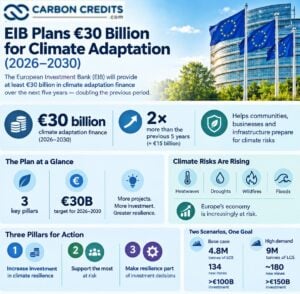
The European Investment Bank (EIB) Group plans to provide at least €30 billion in climate adaptation finance from 2026 to 2030. This doubles the amount it provided over the previous five years. The funding will help communities, businesses and infrastructure prepare for climate risks such as heatwaves, droughts, wildfires and floods.
The bank announced the new target, along with its Climate Adaptation Plan Phase 2. The plan explains how the EIB Group will turn climate risks into investment projects across Europe and in vulnerable countries outside the European Union (EU).
The commitment builds on about €15 billion in adaptation finance provided during the previous five-year period. However, the new €30 billion figure is a funding target for 2026–2030. It is not money that has already been spent. The plan also does not say that the full amount has already been set aside for specific projects.
The strategy marks a change in the bank’s approach. The EIB Group is shifting its focus. Instead of just raising awareness of climate risks, it now wants to prepare more projects. The goal is to attract both public and private investment, and it aims to make climate adaptation easier to fund.
Climate Risks Put Pressure on Europe’s Economy
Climate adaptation means taking steps to prepare for climate change and reduce the harm it causes. These steps can include stronger flood defenses, better water management, buildings designed to handle heat, and farming methods that use less water.
The EIB Group says climate resilience is becoming vital to Europe’s economic security. Extreme weather can damage roads, power networks and public buildings. It can also disrupt businesses, reduce farm output and put pressure on food and water supplies.
The bank’s plan notes that Europe is warming faster than any other continent. Economic losses from extreme weather have also risen sharply in recent decades. Heat contributes to tens of thousands of premature deaths each year.
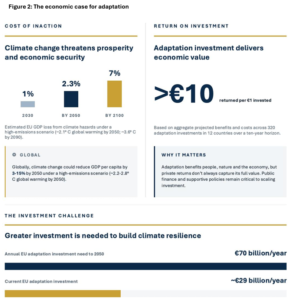
Investing in adaptation can also reduce the cost of future climate damage. According to the EIB’s announcement, research suggests that every euro invested in climate prevention and adaptation can bring up to €10 in benefits to people and the economy. The actual results will depend on the type of project and the risks it addresses.
EIB Group President Nadia Calviño remarked:
“Climate adaptation is a no-brainer. Every euro invested in prevention and adaptation to climate change saves 10 euros in damages and repairs.”
However, adaptation investment remains below what is needed. Many projects face funding gaps, a lack of technical skills, and limited financial incentives. Smaller businesses and local authorities may understand their climate risks but lack the resources to develop projects that lenders are willing to finance.
The EIB Group wants to address these problems by combining loans and other funding with expert advice, guarantees, and tools that help share investment risks.
Three Pillars Guide the €30 Billion Plan
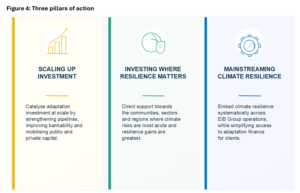
The plan has three main pillars. They aim to increase investment, direct support to those most at risk from climate change, and make climate resilience a normal part of investment decisions.
1. Increase investment in climate resilience
The first pillar focuses on developing more projects that can attract funding.
The EIB Group plans to support measures such as early-warning systems, flood protection and the protection and restoration of natural areas. It will also support stronger water, energy, transport and communication networks. These investments can help keep essential services running during extreme weather.
The bank will provide advice to help clients assess climate risks, prepare projects and plan their funding. Programmes such as the Climate Adaptation Investment Advisory Platform (ADAPT), Green Gateway and JASPERS will help turn climate needs into projects that are ready for investment.
The EIB Group will also use blended finance. This means combining different types of funding, such as public grants and loans, to help projects attract more investment. Guarantees and other tools that share risks can also make projects more appealing to investors.
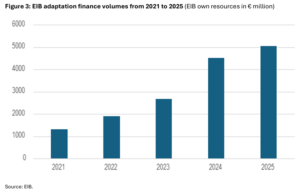
The bank plans to support green bonds that help fund climate adaptation. It will also back financing tools that improve disaster preparation and recovery. Between 2020 and 2025, the bank deployed around €15 billion for adaptation projects, as annual lending nearly quadrupled.
2. Direct funding to the areas most at risk
The second pillar focuses on vulnerable communities, small and medium-sized businesses, farmers, cities and regions. It also covers countries outside the EU that face serious climate risks.
In Europe, the bank plans to support projects that address heat, drought, wildfires, floods and other climate threats. These could include cooler public buildings, greener city spaces, better systems for managing rainwater and stronger flood protection.
Small businesses and farmers are another priority. Many do not have enough money, skills or insurance to prepare for climate impacts. The EIB Group plans to work with financial institutions to improve their access to loans, expert advice and tools that help manage risk.
Projects could include water-saving irrigation, monitoring technology, backup power systems, cooling equipment and production methods that can better withstand extreme weather.
The plan also highlights nature-based solutions. Restoring wetlands, forests and floodplains can help manage water, reduce flood risks and protect ecosystems. These measures can work alongside traditional infrastructure, although the best option will depend on local conditions.
Outside the EU, the EIB Group plans to increase support for vulnerable partner countries, especially Small Island Developing States and Least Developed Countries. EIB Global, in partnership with the European Commission, helps countries develop projects. These projects focus on water management, coastal protection, early-warning systems, stronger transport networks, and disaster planning.
3. Make climate resilience part of investment decisions
The third pillar aims to include climate resilience more often in the EIB Group’s investment decisions. It also seeks to make adaptation funding easier for clients to access.
The bank will improve its climate risk checks and the tools available to clients and financial partners. It also plans to reduce reporting work while keeping clear and reliable standards for identifying and measuring adaptation projects.
One key initiative is ClimateSET, a free digital tool being developed with the Copernicus Climate Change Service. It will help users find climate information for specific locations, identify risks and weaknesses, and explore ways to prepare for climate impacts.
The EIB plans to add ClimateSET to its Green Checker tool, which helps financial partners check whether investments meet relevant climate standards. Together, the tools should help businesses and other borrowers understand their risks and prepare suitable projects.
The bank also wants to improve how it measures the results of adaptation projects. This includes checking whether investments reduce risks and prevent losses. Better measurement should help the EIB Group understand which measures work and guide future investment decisions.
New Financing Could Support Climate Adaptation Technology
The EIB Group’s plan aims to help European companies develop climate adaptation technologies, including cooling systems, water-saving solutions and stronger energy infrastructure. Through its TechEU platform, the bank will connect innovators with funding, guarantees and expert advice to bring these solutions to market.
The plan supports the bank’s Climate Bank Roadmap Phase 2 for 2026–2030, which aligns with the Paris Agreement and the EU’s climate goals. Separately, the EIB and European Investment Fund approved €11.8 billion in new financing, including €5.5 billion to strengthen Europe’s energy independence and reduce power costs. This is a separate decision and should not be counted toward the €30 billion adaptation target without confirmation.
The plan also supports global efforts to increase adaptation finance. At COP30 in 2025, countries adopted the Belém Political Package, which included a commitment to triple adaptation finance by 2035.
However, more funding alone will not guarantee results. Projects must be prepared to attract investment and deliver clear benefits. The EIB Group plans to combine finance with expert advice, better climate data and partnerships to help overcome these barriers. It also stresses that adaptation must go hand in hand with cutting greenhouse gas emissions.
Over the next five years, the success of the €30 billion target will depend on how quickly projects are developed, how much additional funding is mobilized, and whether support reaches the communities and infrastructure most exposed to climate risks.