

Global healthcare company GSK has signed an eight-year deal with Indian climate company Varaha to cut emissions and enhance carbon removal. It will support regenerative agriculture on 50,000 hectares of smallholder farmland in Punjab and Haryana.
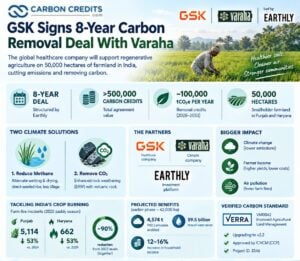
The deal was structured by climate investment platform Earthly and covers more than 500,000 carbon credits. The project is expected to deliver about 100,000 tonnes of removal credits a year between 2028 and 2033. The wider agreement runs for eight years.
The project will help farmers move away from crop residue burning, intensive tillage and flood-irrigated rice farming. Instead, farmers will use practices such as direct-seeded rice, reduced tillage and crop-residue incorporation.
The deal is notable because it links carbon finance with three major issues in northern India: climate change, farm income and air pollution.
Adele Cheli, VP Environmental Sustainability at GSK, said:
“For GSK, environmental sustainability is core to business resilience and human health. This investment demonstrates how we’re progressing in our net-zero journey, whilst also delivering co-benefits for human health, nature and local communities.”
Carbon Finance Targets India’s Crop Burning Problem
Farmers in Punjab and Haryana often burn rice residue after harvest because they have only a short period to prepare fields for the next crop. India has been working to reduce the practice, and the number of farm fires has fallen sharply.
During the 2025 paddy season, Punjab recorded 5,114 farm-fire incidents, down 53% from 2024. Haryana recorded 662, also a 53% fall. Together, the two states recorded about a 90% reduction from 2022 levels.
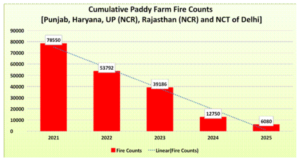
Despite that progress, the government continues to identify crop-residue burning as an important source of seasonal air pollution in northern India.
The carbon project aims to address the economic reasons farmers burn the residue. Farmers will receive subsidized access to machinery and a share of carbon credit revenue.
That can help cover the extra cost and labour needed to manage crop residues without burning them. This makes the carbon market part of the solution rather than simply paying for an emissions calculation after the fact.
Regenerative Farming Targets Carbon, Water and Farm Income
The Varaha project is designed to generate both emissions reductions and soil carbon removals.
Reduced tillage can lower fuel use and soil disturbance. Direct-seeded rice can reduce the need for intensive field preparation and flooding. Incorporating crop residues into the soil can also return organic matter to farmland.
Varaha’s project has already reported results from an earlier monitoring period covering 42,000 hectares. The project estimated it avoided about 4,574 tonnes of PM2.5 emissions from crop burning. It also saved around 59.5 billion litres of water.
Moreover, participating households saw an average 12% to 16% increase in income. This rise came from higher yields, lower fertilizer costs, and carbon revenue.
The water figure is particularly notable. Across the 42,000-hectare monitoring area, the reported savings work out to roughly 1.4 million litres per hectare.
These figures are project results, not a guarantee for the full 50,000-hectare expansion. Future performance will depend on farmer adoption, weather, crop yields and verification.
The Project Uses Verra’s Agricultural Carbon Methodology
The project is registered under the Verra Verified Carbon Standard, using VM0042 Improved Agricultural Land Management. Earthly says it is also upgrading the project to version 2.2 of the methodology. The project is listed on the Verra system as Project 3346.
VM0042 covers greenhouse gas reductions and soil organic carbon removals from improved farming practices. These include reduced tillage, better fertilizer use, and residue and water management.
The updated VM0042 v2.2 is approved by the Integrity Council for the Voluntary Carbon Market as meeting its Core Carbon Principles (CCP) requirements. However, that does not automatically give every project or credit a CCP label. Projects must meet additional conditions at verification.
Those rules are important for agricultural carbon because soil carbon can be difficult to measure and can change over time. The updated methodology includes stronger requirements around baselines, additionality, leakage, and soil carbon measurement.
GSK Is Building a Larger Carbon Removal Portfolio
The Varaha deal fits directly into GSK’s broader climate strategy. The pharma giant plans to reduce 80% of greenhouse gas emissions from all scopes by 2030, using a 2020 baseline. Nature-based solutions will address the final 20%.
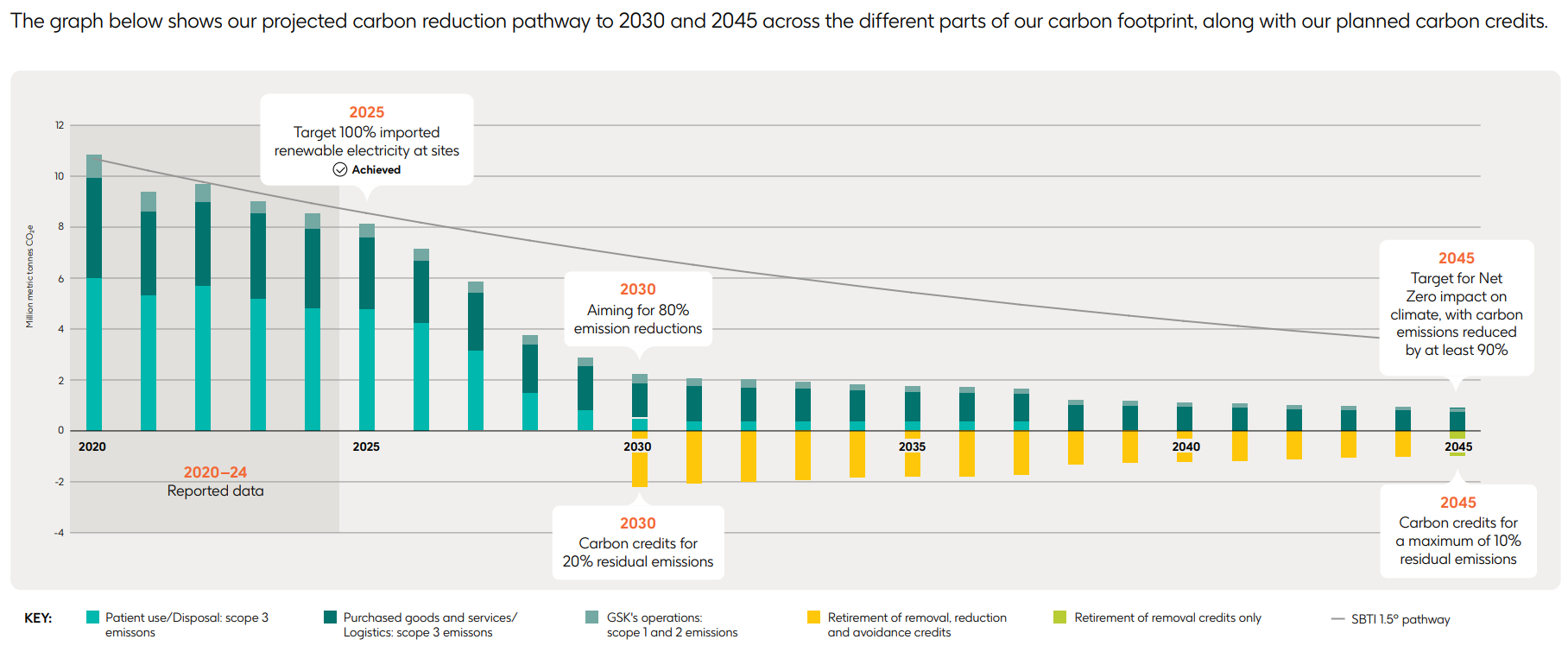
It also targets net zero across its full value chain by 2045, including a 90% absolute emissions reduction and neutralization of residual emissions. GSK says it prioritizes carbon removals for its 2030 target and plans to use only carbon removals for its 2045 net-zero target.
The company announced that by the end of 2025, it had secured carbon credits for 8% of its expected residual emissions. This is 40% of the credits it anticipates needing.
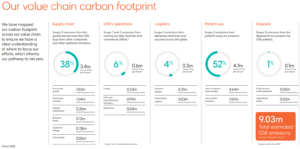
The Varaha agreement, therefore, adds to a growing pipeline of nature-based carbon projects that GSK is developing ahead of its future residual emissions needs. Importantly, GSK says carbon credits are being used alongside direct emissions cuts, rather than as a replacement for them.
Agriculture Is Becoming a Larger Carbon Market
The deal also shows why agriculture is becoming an important part of the carbon removal market. Verra said in 2025 that around 200 projects were listed under earlier versions of VM0042. Together, those projects had the potential to issue an estimated 126 million tonnes of emissions reductions and removals annually.
That is potential supply, not actual issuance. Still, it shows the size of the pipeline being developed around improved farming practices.
Agricultural projects can also offer benefits that are difficult to obtain from some industrial carbon removal technologies. These include improved soil health, lower water use, better farm resilience, and additional income for farmers.
At the same time, they face measurement challenges. Soil carbon changes slowly and can vary between fields. Weather and farming practices can also affect results. That makes strong measurement and independent verification essential for buyers such as GSK.
A Long-Term Deal Gives Farmers More Certainty
One of the most important parts of the agreement is its length. Many voluntary carbon transactions are relatively short-term purchases. An eight-year commitment helps Varaha see future demand better. This can support investments in farm equipment, field support, and measurement systems.
That matters because farmers need to change practices before carbon benefits can be measured.
The project also includes ongoing reporting. Earthly says the agreement includes quarterly reporting covering carbon, water, farmer income, and community engagement through the project period. This wider reporting is becoming more important as buyers look beyond the number of tonnes generated.
The Deal Is a Test for High-Quality Farm Carbon
The GSK-Varaha agreement is significant because it moves beyond a small demonstration project. The planned 50,000 hectares represent a large expansion of regenerative farming in a region where crop burning, water use, and soil management remain major challenges.
However, the more important test will be delivery. The project must show that farmers maintain the new practices, that soil carbon gains are measured accurately, and that the claimed emissions reductions are independently verified.
For GSK, the deal adds a significant source of future removals as it works toward its 2030 and 2045 climate targets. For Varaha, it provides long-term demand to scale regenerative agriculture. And for India’s farmers, the model could create another source of income while reducing burning and improving soil management.
For the carbon market, long-term corporate commitments can help turn agricultural carbon projects into real investments in climate, farming, and public health.