

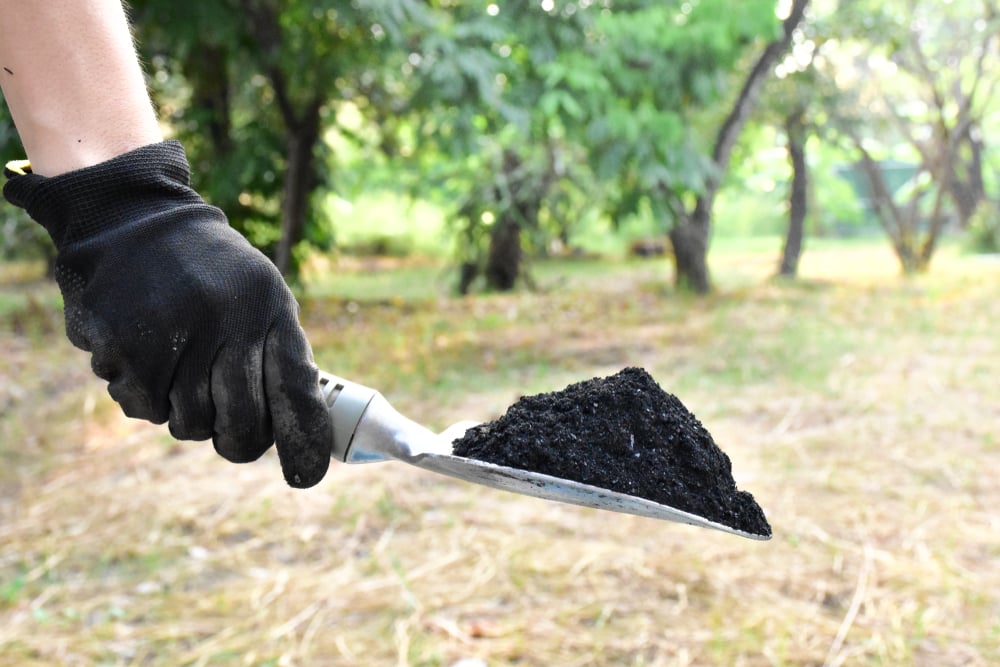
The biochar carbon removal market is moving toward larger, longer-term deals as corporate buyers look for supply they can actually verify and receive. Exomad Green and Carbonfuture are now expanding their partnership to more than 1.1 million tonnes of biochar carbon removal supply.
The additional volume, which includes an allocation already secured for 2026, will be available to corporate buyers through Carbonfuture through 2035. The companies also reaffirmed more than 1.2 million tonnes already contracted for delivery under existing multi-year agreements.
The agreement comes as buyers increasingly focus on delivery records, traceability and independently verified tonnes rather than simply future production promises.
Exomad Green Adds More Biochar Supply
Bolivia-based Exomad Green produces biochar by converting sustainably sourced forestry and sawmill residues through industrial pyrolysis. The company operates facilities in Concepción and Riberalta and is developing another large-scale facility in Guarayos.
- Its longer-term goal is to reach 1 million tonnes of annual carbon removal capacity. Its biochar carbon removal activity is certified under the Puro Standard’s Biochar Methodology, while Carbonfuture provides digital tracking for selected major agreements.
Exomad Green has also built a substantial delivery record.
The companies began working together in mid-2023, when Carbonfuture facilitated two Exomad Green transactions totaling 30,000 tonnes and 32,000 tonnes. At the time, both deals ranked among the largest biochar carbon removal agreements announced.
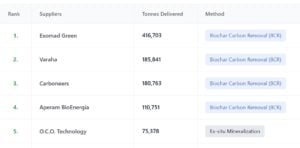
Since then, Exomad Green has delivered more than 400,000 tonnes of durable carbon removal. CDR.fyi data as of August 2026 placed it as the global leader by cumulative delivered durable carbon removal volume.
Carbonfuture Connects Buyers With Carbon Removal Projects
Carbonfuture provides digital infrastructure for the carbon removal market. Its digital tools are capable of doing the following tasks:
- tracks projects and tonnes across the removal lifecycle,
- supports data transparency
- third-party verification and credit issuance
- connecting suppliers with corporate buyers.
The company works with suppliers across five continents and covers several carbon removal methods, including biochar, bioenergy with carbon capture and storage (BECCS), direct air carbon capture and storage (DACCS), and mineralization.
Some of its customers and partners include major climate-focused organizations such as Microsoft, Swiss Re and the World Economic Forum’s First Movers Coalition.
Biochar Demand Is Surging
The timing of the agreement reflects a broader shift in the biochar market.
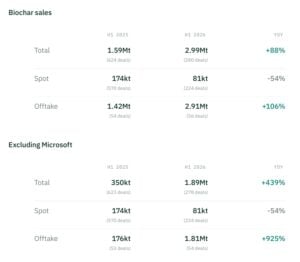
Supercritical data shows that global biochar sales nearly doubled year over year in the first half of 2026, rising from 1.59 million tonnes across 624 deals in H1 2025 to 2.99 million tonnes across 280 deals in H1 2026.
The headline numbers hide an even sharper shift toward long-term procurement:
- Total biochar sales rose 88% year over year to 2.99 million tonnes.
- Offtake volume jumped 106% to 2.91 million tonnes.
- Spot-market volume fell 54% to 81,000 tonnes.
- Excluding Microsoft, total purchases climbed from 350,000 tonnes to 1.89 million tonnes.
- Non-Microsoft offtake volume surged from 176,000 tonnes to 1.81 million tonnes, a 925% increase.
The result is a market where buyers are securing supply earlier instead of waiting for spot availability later in the year.
By July 2026, 81% of high-quality biochar supply had already been committed through offtakes and exclusive agreements. The same threshold was not reached until October 2025. Supercritical also estimates that active enterprise RFPs could claim as much as 70% of the remaining unsold high-quality supply.
This does not mean the world lacks biochar projects. Hundreds of projects are developing capacity, but the amount of supply that meets stringent quality and delivery requirements is considerably smaller.
The research firm said its climate science team has evaluated more than 400 biochar projects, with only 13 passing its assessment.
- COMPLETE DETAILS: Biochar Demand Hits 2.99 Million Tonnes: Can Corporate Buyers Trigger a Supply Crunch?
Biochar Dominates Durable Carbon Removal
Biochar’s position in the broader carbon removal market has strengthened sharply in 2026.
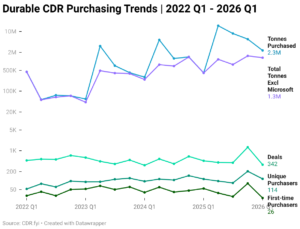
CDR.fyi reported that the durable carbon removal market contracted 2.3 million tonnes in the first quarter, making it the largest Q1 on record. Biochar accounted for 93% of those contracted tonnes.
More than 113 buyers other than Microsoft contracted 1.3 million tonnes, while 145,000 tonnes of durable carbon removal were delivered during the quarter and just over 100,000 tonnes were retired.
Exomad Green was among the leading suppliers. In Q1, it secured a 500,000-tonne agreement with Supercritical and another 105,000 tonnes with undisclosed buyers through Senken, taking its total tonnes sold to just over 2.35 million tonnes at the time.
Production Is Scaling, Too…
Physical biochar production is also expanding rapidly.
- The International Biochar Initiative’s 2025 Global Biochar Market Report estimates that global biochar production reached 520,810 metric tonnes in 2025, up from 180,150 tonnes in 2023. That represents an approximate 70% compound annual growth rate.
- The report, based on responses from 930 stakeholders across 96 countries, projects global production could reach 3.5 million tonnes by 2027 and nearly 9.3 million tonnes by 2030.
Asia became the largest producing region in 2025, overtaking North America, while Africa recorded the fastest regional growth among the surveyed markets. South America ranked as the third-largest producing region.
Still, production growth and carbon removal supply are not the same thing. Buyers increasingly want projects with reliable feedstock, consistent production, strong monitoring and verification, and an established record of delivering credits.
That distinction is becoming increasingly important as corporate demand moves toward multi-year contracts.
Why The Deal Matters for Carbon Removal Investors
Exomad Green’s business is about more than selling carbon credits. It turns sawmill waste into biochar and gives it to local farmers and communities for free. The biochar can improve soil while also reducing open burning, air pollution, and fire risk.
For investors, the key point is growth. Exomad Green has already delivered more than 400,000 tonnes of carbon removal. It now has another 1.1 million tonnes available through 2035, on top of more than 1.2 million tonnes already covered by long-term deals.
The deal also shows how the biochar market is changing. Buyers want projects that can produce and deliver carbon removal, not just promise future supply. As demand grows, companies with proven production and long-term contracts could become increasingly important in the carbon removal market.