


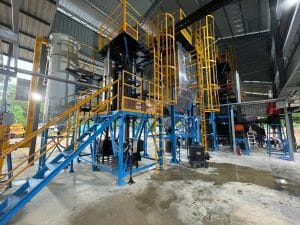
Carbon Plus has launched Malaysia’s first industrial biochar facility, the Bukit Selar Carbon Station, located in Bukit Selar, Kelantan. This pioneering facility, which will produce 500 tonnes of high-quality biochar annually, utilizes advanced gasification technology provided by Renewables Plus. The feedstock for biochar production includes wild, mature bamboo and Palm Kernel Shell (PKS), a byproduct of palm oil production.
To enhance the efficiency and transparency of its operations, Carbon Plus has integrated CrystalTrade’s digital Monitoring, Reporting, and Verification (dMRV) solution. This technology allows Carbon Plus to track and optimize its carbon removal processes while generating CO2 Removal Certificates (CORCs) under the Puro.earth methodology.
dMRV Integration: Boosting Efficiency and Transparency
By employing the CrystalTrade dMRV system, Carbon Plus can monitor each stage of biochar production with precision. This ensures accurate, real-time calculations of the carbon removed and enables detailed tracking of the entire process—from biomass sourcing to emissions monitoring and carbon storage. The data-driven insights provided by dMRV offer full traceability, allowing Carbon Plus to continually optimize its operations and guarantee the integrity of its carbon removal projects.
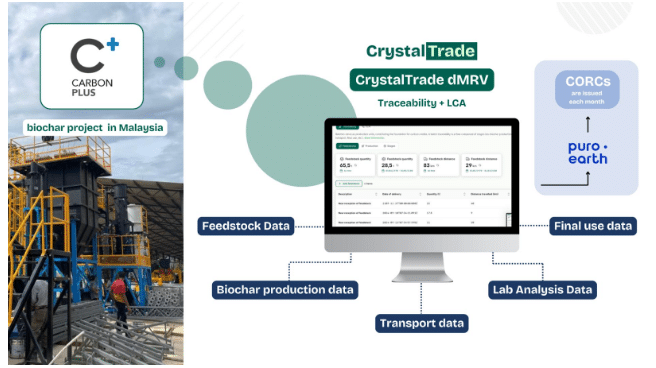
Source: CrystalTrade Press Release
Who is Carbon Plus?
Carbon Plus is a pioneer in biochar project development and implementation across Malaysia and the surrounding region. Their innovative approach centers on converting biomass into biochar through gasification at temperatures exceeding 850˚C. This process produces highly stable biochar, which ensures long-term carbon storage and makes their carbon credits especially appealing to buyers.
The Bukit Selar Carbon Station, a demonstration project implemented by Carbon Plus’s subsidiary Carbon Zero, is just the beginning. With the facility’s current capacity to remove 1,200 tonnes of CO2e annually, Carbon Plus plans to scale up operations, establishing larger biochar facilities next year. This expansion is set to position the company as a key player in carbon removal across Southeast Asia.
Carbon Plus Biochar Facility
CrystalTrade’s dMRV: Unlocking Value for Carbon Credits
The integration of CrystalTrade’s dMRV system highlights the value of Carbon Plus’s high-quality carbon credits by ensuring they are backed by precise data. As the demand for carbon removal solutions grows, this technology will enable Carbon Plus to monitor and scale its projects efficiently.
Project developers interested in enhancing their carbon removal initiatives can adopt their unique solution. They offer all the necessary tools to optimize performance, ensure transparency, and remain competitive in an evolving carbon market.
The Unique dMRV Carbon Management Software for Carbon Removal Technologies
They manage the entire lifecycle of a biochar project, from feasibility studies to the sale of carbon credits. The entire process is backed by their hallmark dMRV for biochar platform. It typically has 5 stages:
1. Pre-feasibility studies
- Technical analysis (pyrolysis technology, credits estimations…)
- Carbon crediting comparison (Puro.earth, CSI, Verra)
- Analysis of needed parameters for verification
2. Life Cycle Analysis
- Collection of data (Upstream, core and downstream processes)
- Production of the LCA model aligned with Puro.earth requirements and ISO 14040/44 standard
3. Project Registration
- Carbon documentation (Environmental permits, Final use…)
- Support in the submission of the documentation to the Standard
4. Pre-sale / sale of carbon credits
- Offtake agreement on the future deliveries of credits
- Sale of the credits to buyers through our client’s base, RFPs…
- Portfolio constitution of credits for buyers
dMRV for biochar project
- Traceability of the biochar at a batch level. Use of QR-Code, and bar code scanning to track bags from the factory to the final use.
- Real-time LCA monitoring of the emissions on the Biomass, production, and use of the biochar.
Disclaimer: Information disseminated for CrystalTrade
FURTHER READING: PETRONAS, ADNOC, and Storegga Forge Deal to Explore CCS in Malaysia