


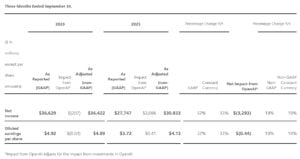
Microsoft (MSFT stock) reported strong first-quarter results for fiscal 2027 as demand for artificial intelligence (AI), cloud computing and enterprise software continued to grow. Revenue reached $92.3 billion for the quarter ended September 30, 2026, up 19% year over year. Microsoft Cloud revenue climbed 30% to $63.9 billion, highlighting the growing importance of AI infrastructure to its business.
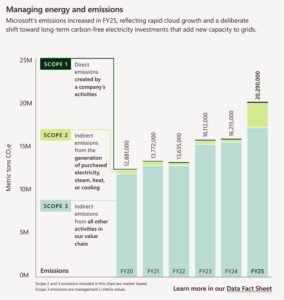
However, this expansion brings a major sustainability challenge. Microsoft’s 2026 Environmental Sustainability Report shows that its greenhouse gas emissions rose 25% in fiscal 2025 as the company expanded its data centers and changed how it procures renewable electricity.
The results highlight a growing tension for the technology giant: scaling AI services while working toward its goal of becoming carbon negative by 2030.
Microsoft Revenue Reaches $92.3 Billion as Cloud Demand Grows
Microsoft’s first-quarter results show continued strength across its cloud and AI businesses.
- Revenue increased 19% to $92.3 billion, while operating income rose 21% to $45.9 billion.
- Net income reached $36.6 billion on a GAAP basis, up 32% year over year.
- Diluted earnings per share increased 32% to $4.92.
The company also reported commercial remaining performance obligations of $677 billion, up 73% year over year. This represents contracted revenue that Microsoft expects to recognize in the future, although the timing depends on customer demand and contract terms.
Microsoft returned $10.2 billion to shareholders through dividends and share repurchases during the quarter.
CEO Satya Nadella highlighted the company’s technology capabilities, while CFO Amy Hood pointed to strong cloud growth and results that exceeded expectations for revenue, operating income, and earnings per share.
Azure and AI Infrastructure Lead Growth
Microsoft’s Agents and Infra segment generated $76.8 billion in revenue, up 25% year over year. Azure revenue increased 48% to $33.2 billion, while Microsoft 365 cloud revenue rose 17% to $27.8 billion.
Industry solutions revenue increased 9% to $5.3 billion. Search and advertising revenue grew 10% to $6.6 billion.
Other businesses showed mixed results. Windows OEM and devices revenue declined 22% to $3.6 billion, while Xbox revenue fell 2% to $5.4 billion. The Devices and Consumer segment generated $15.5 billion, down 3% year over year.
These results show how cloud computing and AI are becoming central to the company’s growth.
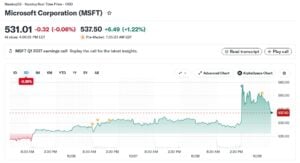
Microsoft shares (MSFT stock) gained more than 3% in after-hours trading following its October 28 earnings announcement, as Azure growth of 48% and stronger-than-expected results eased concerns about returns on AI infrastructure spending.
Microsoft’s Emissions Rise 25% as AI Expansion Continues
The latest sustainability report shows that the company’s total greenhouse gas emissions increased 25% year over year. It attributed the rise mainly to expanding data-center infrastructure and its decision to stop using non-additional, unbundled renewable energy certificates as it prioritizes investments that bring new carbon-free electricity to power grids.
This distinction matters. Renewable energy certificates can help companies account for renewable electricity, but they do not always lead to new clean energy generation. Microsoft is shifting toward projects and contracts intended to add new electricity supply.
The latest report highlights the difficulty of reducing emissions while building data centers at speed. Microsoft’s climate strategy must address both the electricity used to operate its infrastructure and the carbon embedded in the materials and equipment required to expand it.
Energy Efficiency and Renewable Electricity Take Center Stage
Microsoft continues to improve data-center efficiency as demand for AI computing rises.
- Its global power usage effectiveness (PUE) stood at 1.17 in FY2025, compared with 1.16 in FY2024. PUE measures total data-center energy use against the energy consumed by IT equipment. A value closer to 1 indicates better efficiency.
- Global water usage effectiveness (WUE) improved from 0.30 to 0.27 liters per kilowatt-hour. This measures the water used for cooling and humidification relative to the energy consumed by IT equipment.
Microsoft is also developing cooling technologies that reduce water demand. In its Phoenix data centers, cooling improvements delivered a 23% year-over-year reduction in WUE in FY2025. The company is extending similar improvements to other facilities.
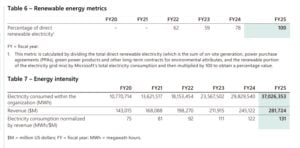
On clean electricity, it achieved its milestone of matching 100% of its annual global electricity consumption with renewable energy in FY2025. In February 2026, it reported that it had contracted 40 gigawatts of new renewable energy across 26 countries, with 19 GW already online.
Matching electricity consumption with renewable energy is an important milestone, but it does not mean every data center runs entirely on renewable power at every hour. Grid conditions, project availability and the timing of electricity generation still matter.
Water, Waste and Carbon Removal Support 2030 Goals
Microsoft also reported progress on water and waste. In FY2025, it replenished more than 14.2 million cubic meters of water, exceeding the amount it withdrew.
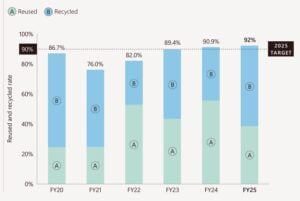
The company achieved a 92% reuse and recycling rate for decommissioned cloud hardware, surpassing its 90% target for the second consecutive year. Reusing equipment and components can reduce waste and limit demand for new materials.
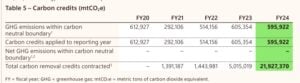
Microsoft continues to invest in carbon removal as part of its plan to become carbon negative by 2030. Its 2026 report highlights an agreement with Rubicon Carbon to purchase up to 18 million metric tons of afforestation, reforestation and revegetation credits.
These projects can help remove carbon from the atmosphere, but carbon removal alone cannot solve the emissions challenge. Microsoft must also reduce emissions from its operations, electricity purchases and supply chain.
Can Microsoft Balance AI Growth With Climate Goals?
Microsoft’s latest earnings show that AI and cloud computing remain powerful growth drivers. Its sustainability report, however, shows that rising infrastructure demand continues to put pressure on its climate targets.
For investors, the key question is whether Microsoft can improve efficiency, add new carbon-free electricity and cut supply-chain emissions fast enough to support its 2030 commitments.
The company has made progress on renewable electricity, water replenishment and hardware reuse. Yet the 25% annual increase in emissions shows that its sustainability strategy faces a difficult test as AI infrastructure expands.