

Copper prices are gaining support from artificial intelligence (AI) infrastructure, rising electricity demand and growing concerns about mine supply. The metal plays a central role in data centers, power grids, transformers and electrical equipment needed to expand AI computing capacity.
On October 27, benchmark three-month copper on the London Metal Exchange (LME) rose 1.1% to $14,487.50 per metric ton, its highest level since October 16, according to Reuters. Improving sentiment around AI stocks and stronger demand signals from China supported the rebound.
The rally comes as the copper market faces a longer-term challenge: announced mining projects may not produce enough metal to meet future demand. The International Energy Agency (IEA) estimates that the market could face a substantial supply gap by 2035, even as new projects improve the outlook.
For investors, the opportunity extends beyond the immediate price rally. Copper’s long-term outlook will depend on whether AI investment translates into actual metal consumption and whether mining companies can expand production fast enough to meet demand.
LME Copper Price Rises as AI and China Support Demand
The latest copper price movement reflects a combination of demand expectations, physical market tightness, and supply concerns.
According to the LME’s official pricing data, the cash copper bid and ask prices stood at $14,733 and $14,735 per metric ton, respectively, on October 28. The three-month contract stood at $14,655 bid and $14,658 ask. These are official prices for October 28 and differ from Reuters’ October 27 intraday quotation.
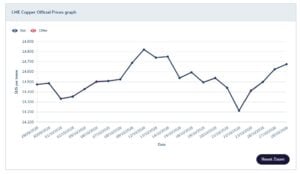
The recent rally also reflects copper’s strong performance through 2026. S&P Global reported during LME Week that the metal’s average price reached $13,395 per metric ton in 2026, about 35% above its 2025 average. Mine disruptions, lower ore grades and delays in developing new projects have added pressure to the market.
However, rising prices do not guarantee uninterrupted demand growth. High prices can discourage purchases by manufacturers, encourage substitution with aluminium and increase incentives to recycle scrap copper.
The market must therefore balance two competing forces: rising demand for electricity infrastructure and the risk that elevated prices will reduce consumption in more price-sensitive industries.
AI Data Centers Could Become a Major Copper Demand Driver
AI is creating a new source of demand for copper through data centers, high-performance computing systems and the electricity infrastructure that supports them.
Data centers need copper for power cables, transformers, electrical distribution systems, cooling equipment, and backup power systems. As operators build larger facilities to support AI workloads, they also need more grid connections and electricity capacity.
A recent estimate from commodity trader Trafigura highlights the potential scale of this demand. Bloomberg reported this on October 20 that copper consumption associated with AI infrastructure could reach 2.5 million to 3 million metric tons in 2028, compared with an estimated 1 million tons in 2026, if hyperscalers deliver their announced investment plans. Trafigura stressed that this was an implied outcome rather than its base-case forecast.
The estimate points to a potentially important shift in the copper market. However, the actual increase will depend on how quickly companies complete their projects and connect new data centers to electricity grids.
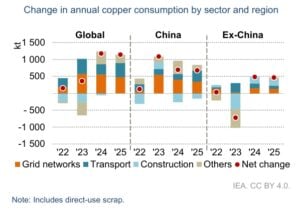
AI-related demand also competes with established copper users. Electric vehicles, renewable energy installations, electricity transmission networks and industrial equipment continue to require substantial quantities of the metal.
IEA Warns of a Copper Supply Gap by 2035
The International Energy Agency (IEA) sees copper as one of the most important minerals for the energy transition and emerging technologies.
- Its Global Critical Minerals Outlook 2026 projects that copper demand will increase by approximately 7 million metric tons between the present and 2040. Electricity networks and next-generation technologies will drive much of that growth.
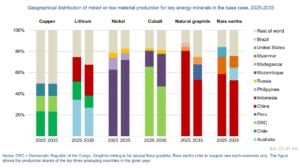
The report also warns that announced mining projects may fall short of future requirements. Under its base-case assessment, expected supply from existing and announced projects would cover only about 75% of primary copper supply requirements in 2035 under the Stated Policies Scenario. This implies a potential supply gap of around 25%.
The supply gap is a projection, not a confirmed current shortage.
The IEA’s outlook has improved from its previous assessment, which projected a supply gap of around 30%. New projects, particularly in the Democratic Republic of the Congo (DRC) and Zambia, have helped narrow the expected shortfall. However, the remaining gap suggests that the market will need additional production beyond the projects currently announced.
This creates a long-term challenge for miners. Developing a new copper mine requires exploration, feasibility studies, permits, infrastructure, and substantial capital. Even when prices rise, companies cannot bring large volumes of new production online immediately.
Mine Disruptions Add Pressure to Global Supply
Production challenges are already affecting the market.
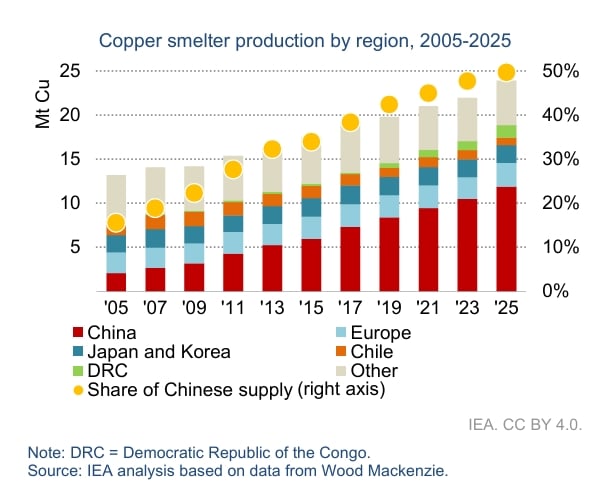
S&P Global reported during LME Week that copper output from the 20 largest producers fell 2.5% year over year in the first half of 2026 to about 7 million metric tons. Lower ore grades, maintenance, and operational issues at major mines drove the decline.
Chile, the world’s leading copper-producing country, remains central to the supply outlook. Indonesia also matters because disruptions at major operations can remove significant volumes from the global market.
At the same time, the industry faces a shortage of readily available copper concentrate. The IEA reported that benchmark annual copper smelting and refining treatment charges for 2026 settled at zero, reflecting intense competition among smelters for raw materials. Spot charges have also remained negative.
These conditions show why higher copper prices do not automatically translate into higher refined production. Miners must deliver enough concentrate, while smelters need viable economics to process it.
Can AI Demand Support Copper Prices Further?
The outlook remains positive over the long term, but investors should not treat every AI demand estimate as a certainty.
At LME Week in October, market experts warned that some projections for data-center copper consumption could be overstated. They also highlighted the possibility of aluminium replacing copper in certain applications as manufacturers seek to control costs.
China’s economic performance presents another important factor. The country remains a major consumer of copper, and weaker industrial activity could offset part of the growth generated by AI infrastructure. Higher prices could also encourage manufacturers to delay purchases or use existing inventories.
For investors, the key indicators to monitor include:
- LME copper prices and warehouse inventories.
- Quarterly mine production from major producers.
- New mine approvals, project delays and revised production guidance.
- AI data-center investment and electricity grid expansion.
- Chinese manufacturing activity and copper import demand.
Copper’s Long-Term Investment Case Depends on Supply
Copper’s recent rally reflects more than enthusiasm about AI. The metal benefits from several structural demand drivers, including electrification, grid upgrades, renewable power and electric vehicles.
The IEA’s projected 25% supply gap by 2035 strengthens the case for investment in new mines, mine expansions and recycling capacity. The agency also reported that copper-focused companies increased capital spending by 8% in 2025, even as overall investment in critical minerals declined.
However, the market must still overcome project delays, lower ore grades and rising production costs. AI demand could provide another source of growth, but its actual impact will depend on how much announced infrastructure reaches completion.
For now, copper has a strong long-term demand story, while near-term prices remain sensitive to Chinese consumption, mine disruptions and market positioning. The strongest investment case will emerge if physical demand continues to grow while new supply struggles to keep pace.