


The United States and Argentina are building a new economic corridor to move critical minerals, energy, and other resources from Argentina’s interior to global markets.
The Andes-Atlantic Corridor, launched during United Nations General Assembly week in New York, will connect Argentina’s mineral-rich northwest and the Vaca Muerta energy basin with Atlantic ports and Western markets. The plan covers railways, waterways, ports, pipelines, power infrastructure, and digital networks. The U.S. and Argentina say the corridor is designed to reduce transportation bottlenecks and attract more private investment into mining and energy.
Critical minerals sit at the center of the initiative. Argentina has major lithium resources and a growing pipeline of copper projects, while the U.S. is looking to strengthen supply chains for materials used in batteries, electricity networks, electric vehicles and advanced technologies.
The move also brings a significant U.S. financing commitment.
EXIM Opens Door to Up to $7 Billion
Alongside the corridor, the U.S. Export-Import Bank (EXIM) signed a U.S.-Argentina Build the Future Framework.
The agreement could mobilize up to $7 billion in financing through 2027 for projects across critical minerals development and processing, energy security, grid modernization, digital connectivity, commercial space and advanced technologies.
Importantly, the $7 billion is not a single mining investment. Instead, it creates a broader financing framework that can support eligible projects across several strategic sectors.
EXIM Chairman John Jovanovic said:
“EXIM is moving boldly into the industries of the future. To do this, we must secure our supply chains, support American jobs, and ensure American workers, products, and expertise reach all parts of the Western Hemisphere. We’re proud to enter into such an important partnership with Argentina and excited to see our two countries grow together.”
The framework could also help Argentina develop its mineral resources using U.S. equipment, technology, and mining expertise. EXIM said the cooperation is consistent with its Supply Chain Resiliency Initiative, which focuses on critical minerals and rare earth elements.
For Argentina, the financing could help address one of the biggest challenges facing large mining projects: infrastructure.
Lithium and copper deposits are often located far from major ports. Better railways, waterways, and power infrastructure can make it easier and cheaper to move minerals from mining regions to processing facilities and export markets.
A G7 Infrastructure Corridor
The Andes-Atlantic Corridor is also part of the G7 Partnership for Global Infrastructure and Investment (PGII).
The U.S. and Argentina describe it as the first PGII corridor in the Western Hemisphere. The initiative joins a broader network of strategic infrastructure corridors backed through the G7 framework.
The G7 connection gives the project a wider supply-chain role. Rather than focusing only on individual mines, the corridor links mineral production with transportation, energy and digital infrastructure.
This approach is significant as countries try to diversify supplies of strategic materials and reduce exposure to concentrated supply chains.
The State Department said the corridor will help “strengthen supply chains for critical minerals and energy,” including lithium and copper.
- Access the factsheet here: United States and Argentina Launch Andes-Atlantic Corridor Fact Sheet – United States Department of State
Argentina’s Lithium Supply Could Become More Important
Lithium is one of the clearest opportunities.
Argentina is already a major global lithium producer, with most of its production coming from brine deposits in the Andes. The country produced about 23,000 metric tons of lithium in 2025, according to the latest U.S. Geological Survey data, while its reserves stood at roughly 4.4 million metric tons.
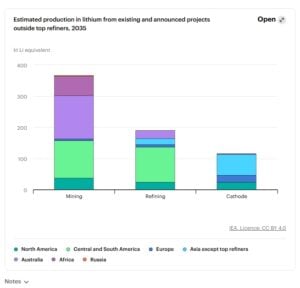
The country is also expanding its project pipeline. Better infrastructure could help new lithium operations reach export markets and connect more efficiently with international battery supply chains.
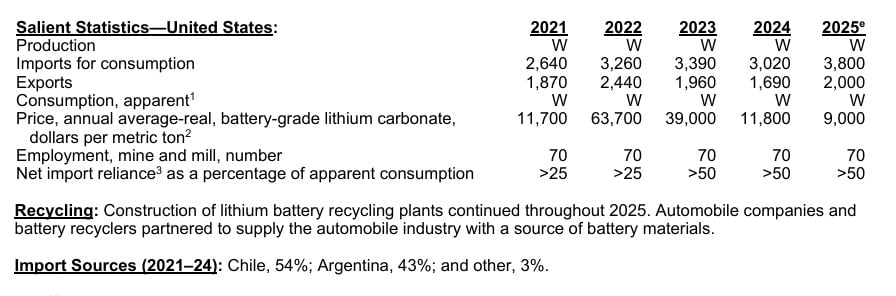
This is relevant to the U.S. because domestic lithium production remains limited. The 2026 USGS Mineral Commodity Summaries report said U.S. lithium production increased in 2025, but the agency withheld the exact production figure because of proprietary data concerns.
The United States therefore has an interest in developing additional reliable sources of lithium outside its borders while also expanding domestic production.
US Lithium data
Copper Adds Another Supply-Chain Link
Copper is just as important to the broader energy transition.
Electricity grids, electric vehicles, charging networks, renewable power projects and data centers all require copper. As electricity demand rises, access to new copper supplies is becoming an important part of infrastructure planning.
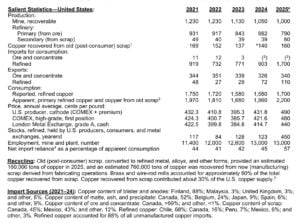
The U.S. produced approximately 1 million metric tons of recoverable copper in 2025, according to USGS data.
- However, the United States still relies on imports to meet part of its copper needs.
Here’s the complete data on US copper:
Argentina could provide another source.
The country has several large copper projects in the Andes, including projects that could eventually add significant new supply to global markets. Connecting these deposits to railways, ports, and reliable power could help move projects closer to commercial development.
The Andes-Atlantic Corridor specifically identifies copper and lithium among the critical minerals it aims to support.
Rare Earths Highlight the Processing Challenge
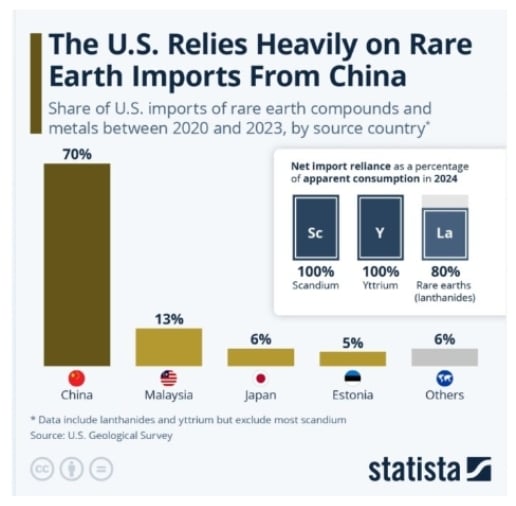
The U.S. is also trying to build more rare-earth capacity, which is used in permanent magnets, electric motors, electronics, defense systems, and other advanced technologies.
U.S. mines produced an estimated 51,000 metric tons of rare-earth-oxide equivalent in mineral concentrates in 2025, according to USGS. Production came mainly from Mountain Pass, California, while monazite was also recovered from mineral-sand operations in the Southeast.
But mining is only one part of the supply chain.
The United States is also working to expand processing and manufacturing capacity because critical minerals must be refined and converted into usable materials before they can support batteries, magnets, electronics, and other products.
This is why the EXIM agreement’s focus on development and processing is important. The framework is not limited to extracting minerals. It can also support infrastructure and technologies needed to move resources further through the supply chain.
- ALSO READ: USA Rare Earth (USAR) Stock Jumps 15% on $2.8B Brazil Rare Earth Acquisition, Giving Massive Boost to Western Supply Chains
- FURTHER READING: Texas-Based EnergyX’s Project Lonestar™ Signals a Turning Point for U.S. Lithium Supply
Energy Is a Major Part of the Corridor
The initiative extends beyond minerals.
Argentina’s Vaca Muerta shale formation is another major focus, with the corridor intended to improve infrastructure connecting the energy basin to export markets. The U.S. and Argentina are also looking at pipelines, power infrastructure and ports as part of the wider strategy.
EXIM separately signed a term sheet related to Argentina LNG, with up to $6 billion in potential financing under consideration for the project.
That makes the Andes-Atlantic Corridor both a minerals and energy infrastructure initiative.
For the clean energy economy, the mineral side is particularly important. Lithium supports battery storage and electric vehicles, while copper is essential for expanding electricity networks. At the same time, Argentina’s energy resources could provide additional economic activity and infrastructure investment.
From Mineral Resources to Supply Chains
The significance of the Andes-Atlantic Corridor goes beyond the headline $7 billion figure.
Argentina already has important mineral and energy resources. The challenge is connecting those resources to infrastructure, financing, and global customers.
The new U.S.-Argentina framework attempts to bring those pieces together.
In conclusion, the next test will be project execution. The two countries now need to move from the framework to actual financing, construction, mining, and processing projects.
And this could determine how quickly the Andes-Atlantic Corridor becomes a meaningful part of the Western Hemisphere’s critical mineral supply chain.