

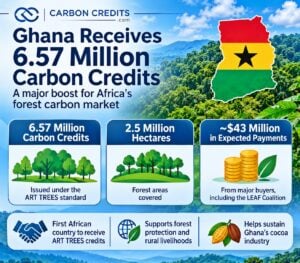
Ghana has received 6.57 million carbon credits for reducing emissions from deforestation and forest degradation, marking a major step for Africa’s forest carbon market. The credits were issued under the Architecture for REDD+ Transactions (ART) and its TREES standard, making Ghana the first African country to receive carbon credits through the program.
Announced on November 12, 2026, the issuance recognizes forest protection efforts across approximately 2.5 million hectares. This also marks the first issuance under ART’s TREES Crediting Level approach. It’s the first time TREES credits have received the Integrity Council for the Voluntary Carbon Market’s (ICVCM) Core Carbon Principles (CCP) Approved label.
The development could also bring significant funding to Ghana. Reports from COP31 in Türkiye expect initial forest carbon payments to be around $43 million, and major buyers include the LEAF Coalition.
The issuance gives Ghana a new opportunity to attract climate finance while protecting forests, supporting cocoa production, and improving rural livelihoods. It also highlights the growing role of jurisdictional REDD+ programs in global carbon markets.
Ghana Becomes First African Country to Receive ART TREES Credits
ART confirmed it issued 6.57 million TREES credits to the Government of Ghana. This followed an independent check of the country’s forest emissions reductions.
The credits recognize results from Ghana’s efforts to reduce deforestation and forest degradation. The program brings together government agencies, cocoa producers, private companies, and local communities to protect forests while supporting sustainable agriculture.
Ghana is now the third country to receive TREES credits. Guyana got credits from ART’s High Forest, Low Deforestation (HFLD) approach. Meanwhile, Costa Rica earned credits through ART’s forest restoration approach.
ART said 37 jurisdictions across Africa, Asia, and the Americas now participate in its program. Together, these areas cover more than 1 billion acres, or roughly one-quarter of the world’s tropical forests.
The Ghana issuance is especially important for Africa, where many countries are looking to use forest protection to attract international climate finance.
What the 6.57 Million Credits Represent
The credits cover verified emissions reductions achieved between 2017 and 2021. Ghana’s program aims to cut emissions from deforestation and forest degradation. It targets forest areas impacted by agricultural growth and other land-use pressures.
The initiative is closely linked to Ghana’s cocoa industry. Cocoa farming has contributed to forest loss as agricultural production expands into forest landscapes. Illegal mining and logging have also placed pressure on forest resources.
The Food and Agriculture Organization (FAO) has supported Ghana in improving its forest monitoring and reporting systems. These improvements helped the country meet ART’s requirements for measuring and verifying emissions reductions.
In a 2024 report, FAO said Ghana had submitted 11.9 million tonnes of CO₂e in TREES credits for the 2017–2021 period. About 90% of the reported reductions came from lower emissions due to deforestation and forest degradation. The other 10% resulted from increased removals through forest restoration.
ART has now issued 6.57 million credits. The public issuance announcement doesn’t clarify the full reconciliation. It leaves gaps between the earlier 11.9-million-tonne submission and the final issued volume. The two figures should therefore not be treated as equivalent.
The distinction matters because submitted emissions reductions are not the same as credits that have passed verification and been issued. Only the latter can be recorded as issued units in the carbon market.
CCP Approval Gives Ghana’s Forest Credits a Quality Milestone
One of the most important features of Ghana’s issuance is its CCP-Approved label. The ICVCM developed its Core Carbon Principles to set quality benchmarks for voluntary carbon credits. The principles cover areas such as:
- effective governance,
- transparent tracking,
- independent verification,
- additionality, and
- the protection of people and the environment.
ART’s TREES Crediting Level approach received CCP approval in 2024. Ghana’s issuance is the first batch of TREES credits to receive the label under this approach. This can help buyers identify credits that meet the ICVCM’s quality requirements. It may also support demand from companies seeking credits with stronger integrity standards.
However, the CCP label does not guarantee that every buyer will purchase the credits or that the units have already been sold, transferred, or retired. These are separate steps in the carbon market.
The label should not be confused with approval from the Paris Agreement’s Article 6 or eligibility under aviation’s CORSIA offsetting system. Each framework has its own requirements.
Ghana Looks to Unlock $43 Million in Forest Finance
The issuance could help Ghana secure more funding for forest protection. A report from Bird Story Agency, shared by AllAfrica, said the country expects around US$43 million in early forest carbon payments. The payments are linked to the newly issued credits and Ghana’s wider forest program.
This figure represents expected payments, not confirmed revenue already received. Public information on the final purchase volumes, transaction prices, and payment schedule remains limited.
Ghana has worked with the LEAF Coalition to develop a large-scale forest emissions reduction program. The coalition brings together governments and companies seeking to finance tropical forest protection through verified emissions reductions.
The country has also developed benefit-sharing arrangements for its Cocoa Forest REDD+ Program. According to FAO, 69% of emissions reduction payments under that program are directed to farmer groups and local communities.
This approach is important because forest protection can affect people who depend on land for farming and income. Sharing carbon revenue with local communities can help support participation and create incentives to protect forests over time.
Jurisdictional REDD+ Brings Forest Protection to Scale
Ghana’s achievement also highlights the growing importance of jurisdictional REDD+ programs. REDD+ means reducing emissions from deforestation and forest degradation. It also includes conservation, sustainable forest management, and boosting forest carbon stocks.
Unlike individual forest projects, jurisdictional programs measure emissions reductions across a larger government-defined area, such as a country or state. This approach can help address deforestation across entire landscapes rather than focusing on isolated project sites.
ART’s TREES standard provides rules for measuring, reporting, and verifying these results. It also includes rules for environmental and social safeguards. These protections align with the UNFCCC’s Cancun Safeguards.
The approach can help governments attract larger-scale finance and coordinate forest policies across different regions. It can also reduce the risk that forest protection in one project area simply shifts deforestation to another location within the same jurisdiction.
However, jurisdictional credits still face important challenges. Buyers need confidence that reported emissions reductions are real, that forests remain protected, and that local communities receive fair benefits. Strong monitoring and transparent revenue-sharing systems will therefore remain essential as Ghana expands its program.
African Countries Push for More Forest Climate Finance
Ghana’s issuance comes as African governments push for more investment in forest conservation and carbon markets at COP31. Gabon recently signed an agreement with Germany’s state-owned energy company SEFE covering about 6 million tonnes of forest carbon credits. The credits were issued under ART’s TREES standard, with first deliveries expected in early 2027.
Other countries are also seeking new sources of forest finance. At a forest summit in Antalya, leaders from the Democratic Republic of Congo, the Republic of Congo, Nigeria, and Ethiopia shared their plans. They aim to protect forests, restore damaged land, and draw in private investment.
The need for more funding remains significant. The Forest and Climate Leaders’ Partnership shows that forests get under 1% of global climate finance. This is surprising since forests help cut emissions and support biodiversity.
The Tropical Forest Forever Facility is another effort to provide long-term payments to countries that keep tropical forests standing. It could offer an additional source of funding alongside carbon credit markets.
Ghana’s Next Challenge Is Turning Credits Into Lasting Results
Ghana’s 6.57 million TREES credits mark an important step for jurisdictional carbon markets in Africa. The issuance confirms the results of forest protection and helps the country attract climate finance.
The CCP-Approved label may boost buyer confidence. Additionally, expected payments of around US$43 million could aid in protecting forests and supporting community programs.
But issuance is only one stage of the process. Ghana must still turn market interest into completed transactions, ensure transparent use of the revenue, and maintain forest protection over time.
The country’s experience could offer a useful example for other African nations seeking to finance forest conservation through carbon markets. Its long-term success will depend on the number of credits issued, and also on whether the funding delivers lasting benefits for forests and the people who depend on them.