

The 31st United Nations Climate Change Conference (COP31) opened in Antalya, Türkiye, on November 9, with carbon markets and climate finance among its key topics. Countries began formal talks on Article 6 of the Paris Agreement, while other sessions covered nature markets, methane, and industrial decarbonization.
The first day did not produce a major new carbon trading agreement or changes to Article 6 rules. Instead, discussions focused on how countries can put existing rules into practice, increase international carbon trading, and attract more funding for climate projects.
This reflects COP31’s wider goal of turning climate commitments into action. For carbon market participants, the main questions are how to increase credit transfers, improve market quality, and make climate finance more accessible to developing countries.
Article 6 Talks Lead COP31’s Carbon Market Agenda
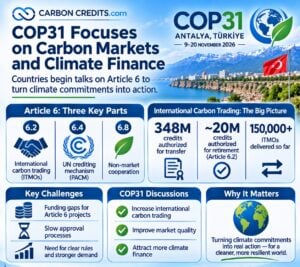
Article 6 of the Paris Agreement allows countries to work together to meet their climate targets. It covers international carbon trading, a UN-backed crediting system, and cooperation that does not involve trading credits.
On November 9, countries began informal consultations on all three parts:
- Article 6.2: Allows countries to trade internationally transferred mitigation outcomes (ITMOs) through bilateral or other agreements.
- Article 6.4: Establishes the Paris Agreement Crediting Mechanism (PACM), a UN-supervised system for issuing carbon credits.
- Article 6.8: Covers non-market approaches to climate cooperation that do not rely on carbon trading.
The first day also included the Article 6.2 Ambition Dialogue, a three-hour session on how countries can increase cooperation under the Paris Agreement. A key issue is how countries account for credits they transfer.
Article 6.2 requires corresponding adjustments to prevent two countries from counting the same emissions reduction toward their climate targets. These rules are important to buyers and sellers. They help ensure that a credit transferred to another country is not also counted by the country where the project took place.
However, COP31 is not expected to rewrite the Article 6 rulebook. Market analysis published by OPIS on November 9 said a formal review of the rules is not scheduled to begin until 2028. For now, the focus is on applying the existing rules and solving practical problems that slow down trading.
International Carbon Trading Still Faces Gaps
More countries are signing Article 6 agreements, but the number of credits actually transferred remains much smaller than the number authorized.
OPIS reported that 31 countries had authorized more than 348 million credits for international transfer. Yet, only about 20 million had been authorized for retirement by specific buyers under Article 6.2. Just over 150,000 ITMOs had been delivered. These figures show the gap between approval and actual market activity.
Authorizing credits does not guarantee that buyers will receive them. Countries must set up domestic rules, approve transfers, and apply the required accounting adjustments. Host countries also need to decide how many credits they can sell without making it harder to meet their own Nationally Determined Contributions (NDCs).
This is especially important for developing countries that need to attract foreign investment through carbon projects. They need clear approval processes, reliable registries, and the ability to track and report emissions reductions. COP31’s Article 6 talks will therefore focus on making international carbon trading easier to put into practice.
Funding and Slow Approvals Hold Back Article 6 Projects
Finance is another major issue. Article 6.2 and Article 6.4 both need funding for registries, technical systems, project reviews, and support for countries that lack the resources to take part.
The Article 6.2 Ambition Dialogue provided a forum to discuss how international cooperation can deliver stronger climate action. Building the skills and systems needed to authorize and track credits will be important, especially for developing countries.
- The UN’s Article 6.4 mechanism also faces delays in moving projects toward credit issuance.
OPIS reported that 415 projects were approved to move from the old Clean Development Mechanism (CDM) to the new Paris Agreement system. They met the June 30 deadline. However, none had received host-country credit authorizations at the time of its November 9 report.
The Article 6.4 Supervisory Body had also approved five methods for new projects. These methods explain how developers must measure and verify emissions reductions before credits can be issued.
The slow progress shows why clear procedures and enough funding are needed. Without them, the UN crediting system may struggle to attract projects and buyers at the scale expected.
Nature Markets and Carbon Finance Draw Attention
COP31’s first-day program also included sessions on how carbon finance can support nature protection and local communities. One event, Beyond Carbon Credits: What Makes Nature Markets Credible, Investable and Fair?, looked at the standards and safeguards needed to build trust in nature-based markets.
These projects remain a smaller share of international Article 6 authorizations. IETA data from OPIS showed that nature-based solutions, like REDD+ and afforestation, made up 8.1% of authorized credits.
Cookstove projects made up just over half of the authorizations. Methane reduction projects in energy and waste made up 21.6%. Water purification projects were 12.9%.
These figures show that international carbon trading has so far leaned on certain project types. More support for forest protection and other nature-based activities could broaden the market. However, buyers will still need strong evidence that projects deliver real climate benefits, protect stored carbon, and support local communities.
Another first-day event, The Hydro Blind Spot: Methane, Carbon Markets, and the Case for Free-Flowing Rivers, examined links between methane emissions, hydropower, and river protection.
A separate session focused on building high-integrity carbon markets in Africa. It highlighted work by the West African Alliance and its partners. These events illustrated how carbon finance can help with climate action. They also protect ecosystems and support community interests.
Carbon Markets Could Help Fund Industrial Emissions Cuts
COP31’s carbon market agenda also covers industries that are difficult to decarbonize. Sectors such as cement, steel, and chemicals need costly technology and major changes to reduce emissions. Carbon finance could help fund some of these projects and support the shift to cleaner production.
The United Nations Industrial Development Organization (UNIDO) is scheduled to hold a session on November 11 called Carbon Markets for Industrial Transformation. It will examine how high-integrity carbon markets can help finance industrial emissions cuts.
Private companies and financial institutions also have an important role. They can invest in projects that reduce or remove emissions, while carbon credit purchases can provide another source of funding. However, market growth will depend on reliable measurement, clear project information, and strict rules for approving and using credits.
What to Watch as COP31 Continues
COP31’s first day set the agenda for further carbon market discussions, but key outcomes are still ahead.
- Participants will watch for progress on Article 6.2, funding for the UN crediting mechanism, and support for countries entering international carbon markets.
- More bilateral agreements and announcements linked to the Carbon Offsetting and Reduction Scheme for International Aviation (CORSIA) may also emerge during the summit.
- The market will also look for steps to increase demand for high-integrity credits, especially those supporting forest protection, methane reduction, and industrial decarbonization.
The wider climate finance debate is crucial, too. On the opening day, countries discussed progress toward the previous goal of providing $100 billion in annual climate finance. Delegations disagreed over whether the target had been met in 2022, 2023, and 2024. Developing countries also called for better access to funding.
As COP31 continues through November 20, the focus will be on turning existing carbon market rules into a more active, transparent, and accessible source of climate finance.