

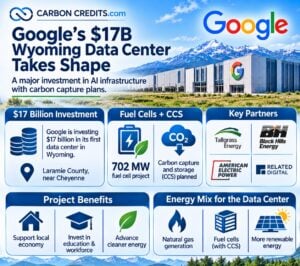
Google is investing $17 billion in its first data center in Wyoming, as the company expands its artificial intelligence (AI) infrastructure in the United States. The project will use a mix of natural gas generation and fuel cells, with carbon capture and storage (CCS) planned for part of its power supply.
The project will be built in Laramie County near Cheyenne. Google is working with energy companies Tallgrass Energy, Black Hills Energy, and American Electric Power (AEP), along with data center developer Related Digital.
A key part of the plan is a 702-megawatt (MW) fuel cell development that will run on natural gas and include CCS technology. Bloom Energy will provide the fuel cells. Captured carbon dioxide will go to an underground storage site run by Tallgrass.
The project highlights a growing challenge for technology companies. AI boosts the need for data centers and electricity. However, it’s tough to meet this demand and cut emissions at the same time.
Google’s $17B Wyoming Data Center Takes Shape
Google announced that the Wyoming project is a long-term investment. It aims to boost its data infrastructure and create economic opportunities in the state.
The company expects the development to generate hundreds of millions of dollars in local property taxes for Laramie County and School District 1. It also plans to support education, workforce training, and local business development. The project is being developed with four main partners:
- Tallgrass Energy: Supporting natural gas generation and carbon storage infrastructure.
- Black Hills Energy: Providing power generation and managing energy resources through a private microgrid.
- American Electric Power: Contracted to develop the 702 MW fuel cell project.
- Related Digital: Supporting the data center development.
Google has not disclosed the facility’s total power demand or final data center capacity. Earlier plans for the site described a large campus with several data halls and supporting buildings, while construction is expected to continue through 2031.
The development was previously associated with Crusoe under the name Project Jade. The tech giant later took over the project, which is now known as Project Tembo.
Natural Gas Fuel Cells Will Power Part of the Facility
The most notable energy feature is the planned 702 MW fuel cell development with carbon capture. Fuel cells generate electricity through an electrochemical reaction rather than burning fuel in the same way as conventional power plants. However, the system planned for Wyoming will still use natural gas, which produces carbon emissions.
Bloom Energy will supply the fuel cells, while AEP will own and operate the power facility. Google has contracted with AEP to use its electricity under a power purchase agreement.
AEP announced in October that it plans to invest about $4 billion in the fuel cell project. The company expects to begin construction in 2026 and bring the facility into full operation by the end of 2028.
The fuel cells will be connected to Tallgrass’s Eastern Wyoming Sequestration Hub. The CCS system captures most carbon emissions from fuel cell development and stores CO₂ safely underground for the long term.
Google stated in its announcement:
“The CCS technology will enable the capture and permanent geologic storage of a large majority of its carbon emissions at Tallgrass’s nearby Eastern Wyoming Sequestration Hub. This project builds on our first CCS project in the U.S. announced last fall, and brings our total contracted CCS capacity to nearly 1 gigawatt.”
However, Google has not provided a specific capture rate or a project-level emissions estimate. The final climate benefit depends on three factors: how much CO₂ the system captures, its reliability, and the emissions from natural gas supply and power generation.
More Natural Gas Generation Will Support Energy Demand
The fuel cell development is only one part of the data center’s energy supply. Google will also source electricity from natural gas generators operated by Tallgrass Energy and Black Hills Energy. It is studying whether Tallgrass’s combined-cycle gas turbines can be fitted with carbon capture technology.
Black Hills has already signed agreements to serve the planned data center. The company plans to offer up to 590 MW of grid-connected energy. It will also manage around 2.1 GW of third-party contracted resources via a private microgrid.
To support the project, Black Hills plans to invest $1.8 billion between 2027 and 2029 to build 564 MW of new natural gas generation. The company expects the data center to begin taking energy service in late 2027, with demand rising toward its peak by 2030.
These plans show the scale of the energy infrastructure needed to support the new campus. They also make clear that natural gas will remain an important part of its electricity supply, even as Google adds carbon capture to one major power source.
Google said it will pay for 100% of the electricity it uses and cover infrastructure costs directly caused by its growth. The arrangements aim to keep the project’s energy costs from falling on local utility customers.
AI Boom Drives Demand for More Data Center Electricity
The Wyoming investment comes as AI drives a sharp rise in electricity demand from data centers. The International Energy Agency (IEA) reported that global data center electricity use rose 17% in 2025. Power demand from AI-focused data centers grew even faster.
The agency’s 2026 analysis estimates that total data center electricity consumption could nearly double, from 485 terawatt-hours (TWh) in 2025 to about 950 TWh by 2030. Electricity use from AI-focused data centers could triple over the same period. The following chart shows where the power for data centers will be coming from by 2035.
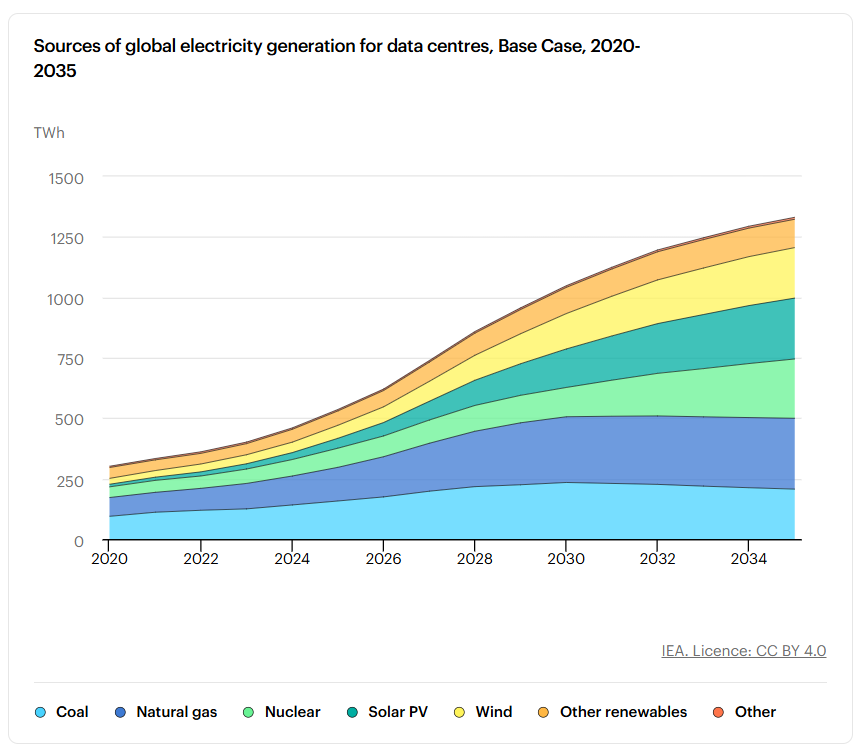
This growth is pushing technology companies to secure new sources of power. Renewable energy is key to their long-term plans, but natural gas is also becoming important. It can supply electricity when wind and solar power are low.
The IEA expects renewables to meet nearly half of the additional electricity demand from data centers through 2030. However, natural gas and coal together could supply more than 40% of that growth.
Google’s Wyoming project reflects this wider trend. The company is combining natural gas generation, fuel cells, and carbon capture to secure a large and steady power supply for its data infrastructure.
Carbon Capture Could Help, But Emissions Remain a Concern
CCS can reduce emissions from fossil fuel-based power generation by capturing CO₂ before it reaches the atmosphere and storing it underground.
The IEA says established power-sector capture systems have generally targeted rates of around 85% to 90%. Still, even at these levels, some emissions remain. A net-zero energy system would need to address these residual emissions through higher capture rates or other measures.
CCS also adds costs and uses some of the electricity generated by a power plant. The Congressional Budget Office says that adding CCS to a new power plant can significantly increase construction costs. It can also lower the amount of electricity available for sale.
For Google’s Wyoming project, the actual results will depend on the final design and performance of the capture and storage system. The company has not yet disclosed the expected volume of CO₂ captured each year or the emissions intensity of the electricity supplied to the data center.
Google’s wider climate record also provides important context. Its 2026 Environmental Report, covering 2025, said the company contracted more than 12 GW of new clean energy during the year. It also said its operations and supply chain cut over 58 million tonnes of CO₂ equivalent. This was done through energy procurement, hardware and software efficiency, and other actions.
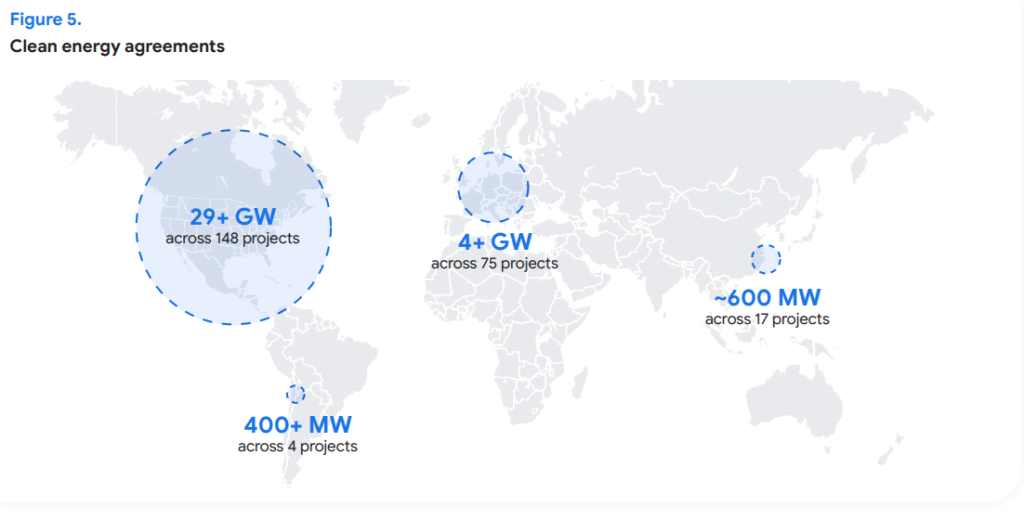
These figures reflect company-wide activities and should not be treated as emissions reductions from the Wyoming project.
Air Cooling Aims to Reduce the Data Center’s Water Footprint
Energy is not the only environmental issue facing large data centers. Their cooling systems can also put pressure on local water supplies.
The tech giant said the Wyoming facility will use air cooling to reduce its impact on local water resources. Unlike systems that rely heavily on evaporative cooling, air-cooled systems use air to remove heat from equipment.
The company also plans to work with local institutions on education, job training, and community investment. Google said it has met with more than 200 residents in Laramie County and is forming a Community Council with its project partners to discuss local concerns.
The development is expected to create jobs and increase local tax revenue. But its scale also raises questions about electricity supply, natural gas use, carbon storage, and the long-term environmental effects of AI infrastructure.
Google’s $17 billion investment shows how quickly the technology sector is building new energy-intensive facilities. Its Wyoming project will test whether carbon capture can help reduce the emissions linked to that growth. The answer will depend on how much carbon the system actually captures and stores once the facility begins operating.