

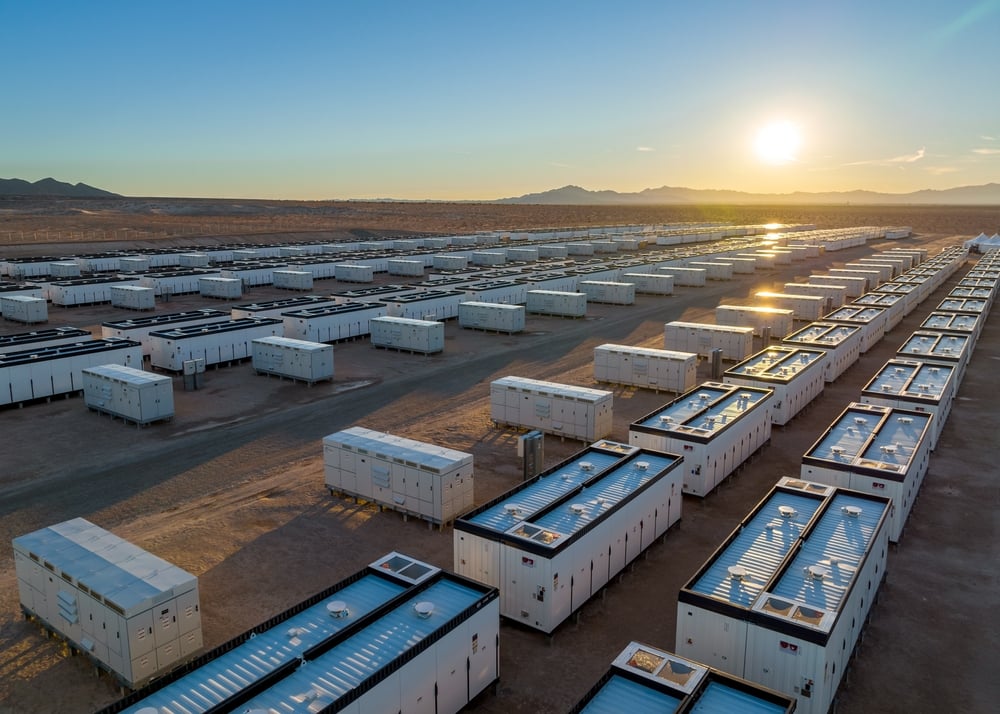
Global clean energy trade rebounded in 2025, despite rising tariffs and geopolitical tensions. BloombergNEF’s Energy Transition Supply Chains 2026 report found that shipments of clean-energy products, battery metals, and grid equipment reached $479 billion in 2025, a 1% rise from 2024.
This modest growth signals recovery after a 7% drop in volumes from 2023 to 2024. The rebound shows the growing need for clean technologies as countries seek better energy security.
Energy Security Fuels Clean-Tech Demand
In recent years, global supply chains have drawn attention from governments and businesses. Trade disputes and geopolitical conflicts have exposed weaknesses in fossil-fuel supply chains.
The ongoing conflict in the Middle East has added uncertainty. Tensions with Iran have driven up oil and gas prices, impacting energy-importing nations in Asia and Africa.
Countries are boosting investments in solar power, battery storage, and electric vehicles as fuel costs rise. BloombergNEF’s data shows that nations dependent on imported fuels often increase clean-tech imports when fossil-fuel prices spike.
Emerging economies are also adopting renewable technologies to reduce exposure to unstable fuel markets. Higher oil and gas prices strengthen the case for solar energy, batteries, and EVs. Demand for clean-energy equipment rises, even amid economic uncertainty.
BloombergNEF thinks that instability in fossil-fuel markets could raise global demand for renewable technologies. This is especially true in areas looking for energy independence.
“Many markets are doubling down on clean technology deployment to improve energy security,” said Antoine Vagneur-Jones, head of trade and supply chains at BloombergNEF.
Battery Storage Emerges as the Next Big Growth Story
Solar power has transformed electricity markets worldwide, but battery storage is now a crucial growth driver. In areas with high solar use, midday solar generation often lowers electricity prices. This challenges traditional power producers, as their revenues drop with increased solar output.
Instead of complex reforms, many countries are using battery storage to shift excess daytime solar generation to evening hours when demand peaks.
Battery systems are being deployed in utilities, businesses, and homes for better flexibility and grid stability.
The battery industry today resembles the solar industry from years ago. Manufacturing is competitive, products are standardizing, and prices continue to drop. This will lead to rapid battery deployment.
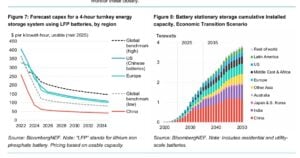
- BNEF’s New Energy Outlook data shows global storage capacity to rise from 223 gigawatts in 2025 to 3.8 terawatts by 2050, a seventeen-fold increase.
However, adoption rates will vary. China may rely more on pumped hydro and other solutions, while U.S. trade policies could limit access to low-cost batteries.
Manufacturing Glut Continues to Pressure Markets
Despite rising demand, overcapacity remains a major challenge for clean-energy supply chains.
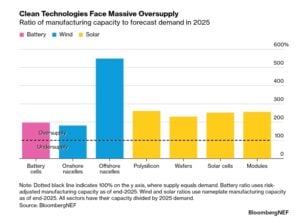
Global manufacturing capacity exceeds current demand by over 200% in many clean-tech sectors. Chinese investment drives much of this surplus, while new factories in India, Southeast Asia, Turkey, Egypt, and Ethiopia are adding to global production.
Meanwhile, the U.S. and Europe are unlikely to become major clean-tech exporters soon. While both regions have increased manufacturing capacity, growth has focused on assembly rather than complete supply chains.
Many announced projects face delays or cancellations due to changing policies, slower demand, and rising competition.
Equipment Prices Keep Falling, But More Slowly
Clean-energy equipment prices fell again in 2025, but the pace slowed compared to previous years. Similarly, solar module prices decreased, but higher silver prices limited further drops.
- Battery pack prices fell significantly from $118 per kilowatt-hour in 2024 to $108 in 2025. However, rising battery-metal costs slowed this decline.
Wind equipment prices increased slightly, as some turbine manufacturers sought to recover losses from fierce competition. The slowdown in price drops means future growth will rely more on tech advances, policy support, and financing, not just lower equipment costs.
The Solar Revolution Is Reshaping Global Electricity
A key finding is solar energy’s growing dominance. Annual solar installations jumped from 75 gigawatts in 2016 to 655 gigawatts in 2025. That’s a nearly ninefold increase in less than ten years.
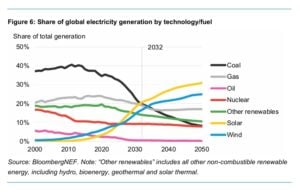
Today, solar stands alongside wind and nuclear as a major source of zero-carbon electricity. The report shows solar deployment to stay high through the decade. Under its Economic Transition Scenario, solar will become the largest source of zero-carbon power before 2030.
By 2032, solar is projected to surpass all other energy sources, becoming the world’s largest electricity source. While China leads in solar manufacturing, countries like India, Egypt, Ethiopia, and several Southeast Asian nations are rapidly expanding production capacity.
Trillions More Needed to Meet Climate Goals
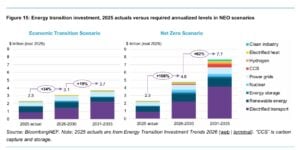
The global energy transition attracted a record $2.3 trillion in investment in 2025. This includes spending on renewable energy, batteries, electric vehicles, heat pumps, hydrogen, carbon capture, and related technologies.
- Current investments align with BloombergNEF’s Economic Transition Scenario. Annual spending is expected to average around $3.1 trillion from 2026 to 2030.
However, much larger investments are needed to meet global climate targets.
Under BNEF’s Net Zero Scenario:
- Annual low-carbon investment needs to average $4.8 trillion from 2026 to 2030. This is more than double the levels in 2025.
- From 2031 to 2035, annual investment will need to increase further to about $7.7 trillion.
Electrified transport represents the largest investment opportunity and the biggest funding gap. Emerging technologies, like carbon capture and storage, are set to grow quickly.
Here’s the chart to understand the investment:
Clean Energy Becomes a Strategic Necessity
The clean-energy sector began 2026 with strong momentum. Trade volumes are recovering. Battery storage is expanding quickly. Solar power will soon be the world’s largest electricity source.
Manufacturers are dealing with oversupply. Geopolitical tensions are shifting supply chains. Plus, trillions in investment are needed to reach climate goals.
A clear trend is emerging: clean energy is now about more than just the environment. Countries are focused on energy security, economic stability, and shielding themselves from fossil-fuel price spikes. Because of this, solar, batteries, and other clean technologies are essential for the global economy.