

Solar and wind energy are now the cheapest sources of new electricity in many parts of the world. Over the last decade, costs have dropped sharply, making renewable energy more affordable than coal and gas in several markets. However, the biggest challenge today is no longer just producing clean electricity. The real challenge is making sure renewable power is available all day and night, even when the sun is not shining or the wind is weak.
That is where battery storage and hybrid renewable systems come in.
A new report from the International Renewable Energy Agency, titled 24/7 Renewables: The Economics of Firm Solar and Wind, explains how solar, wind, and battery energy storage systems (BESS) can now provide reliable round-the-clock electricity at competitive prices. The report shows that in regions with strong renewable resources, clean energy systems can already compete with fossil fuels on both cost and reliability.
The Rise of “Firm” Renewable Power
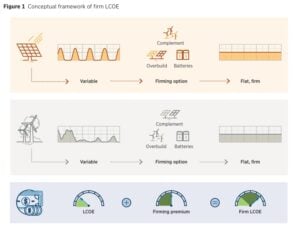
Solar and wind are variable energy sources. Solar panels only generate power during the day, while wind output changes depending on weather conditions. Because of this, renewable systems need support from storage or backup systems to provide continuous electricity.
This process is known as “firming.” It means transforming variable renewable electricity into a dependable power supply that can operate 24/7.
Battery storage plays a major role in this transition. Batteries store excess renewable electricity during periods of high generation and release it later when demand rises or renewable output falls. Developers also use larger renewable systems, called “generation overbuild,” to make sure enough electricity remains available during weaker weather conditions.
According to IRENA, the economics of these systems have improved dramatically because renewable and battery costs have fallen at record speed.
Renewable and Battery Costs Have Collapsed
Since 2010, the renewable energy industry has gone through a major cost revolution.
IRENA said:
- Solar installation costs declined by 87%
- Onshore wind costs dropped by 55%
- Battery storage costs plunged by 93%
These declines completely changed the economics of clean electricity.
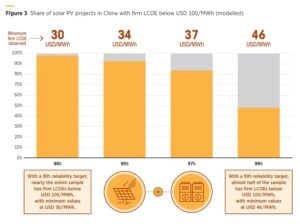
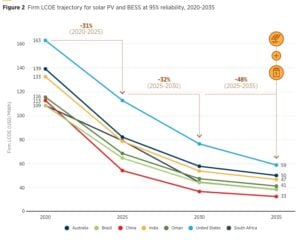
In 2020, firm solar-plus-storage systems often cost more than $100 per megawatt-hour (MWh). By 2025, costs in high-quality solar regions fell to around $54/MWh to $82/MWh.
That already places renewable electricity in direct competition with fossil fuels.
For comparison:
- New coal generation in China costs around $70/MWh to $85/MWh
- New gas-fired electricity globally often exceeds $100/MWh
IRENA expects costs to continue falling. The agency projects another 30% decline by 2030 and roughly 40% by 2035. At the best-performing renewable sites, firm renewable electricity could fall below $50/MWh.
Geography Determines Success
The report highlights that geography is one of the most important factors in renewable economics.
Regions with strong sunlight and stable wind conditions need less storage and less overbuilding. This lowers total system costs.
High-irradiance desert regions and strong wind corridors perform especially well because renewable generation remains more stable over time.
However, not every region has ideal renewable conditions.
Some locations experience long periods of weak wind and low sunlight simultaneously. These events are known in the energy sector as “Dunkelflaute” or “dark doldrums.” During these periods, renewable output can remain low for several days.
IRENA said these prolonged low-generation events have a bigger impact on costs than normal day-to-day variability.
In weaker renewable regions, firm renewable power becomes more expensive because systems require larger batteries and more backup generation capacity. In such cases, countries may need additional solutions like:
- Long-duration energy storage
- Geothermal energy
- Regional electricity interconnections
- Flexible grid systems
The report makes it clear that storage alone cannot solve every challenge if renewable resources are poor.
Wind Plus Storage Also Gains Momentum
The report also analyzed wind-plus-storage systems.
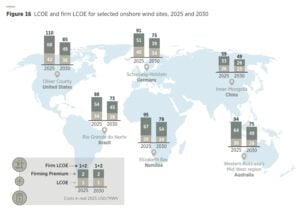
In 2025, firm wind-plus-storage costs ranged from:
- Around $59/MWh in Inner Mongolia
- Roughly $88/MWh to $94/MWh in Brazil, Germany, and Australia
IRENA projects costs could decline further to around $49/MWh to $75/MWh by 2030.
The agency also noted that combining wind and solar together improves economics even more. Because wind and solar often generate electricity at different times, hybrid systems reduce storage requirements and improve reliability.
This lowers total system costs while increasing overall energy availability.
The UAE’s Al Dhafra Project Shows What’s Possible
Large renewable projects are already proving that round-the-clock clean electricity is commercially viable. One major example is the Al Dhafra Solar PV project in the United Arab Emirates.
The project combines:
- 5.2 gigawatts (GW) of solar power
- 19 gigawatt-hours (GWh) of battery storage
Together, the system will deliver a firm 1 GW of continuous clean electricity. That output is similar to a large traditional thermal power plant.
IRENA estimates the project’s firm electricity cost at around $70/MWh.
This demonstrates that renewable systems can now provide services once considered possible only with coal or gas plants.
Data Centers and AI Could Drive Demand
The report says hybrid renewable systems are becoming increasingly attractive for industries that need uninterrupted electricity.
This includes:
- Artificial intelligence infrastructure
- Data centers
- Advanced manufacturing facilities
- Clean hydrogen production
These industries require constant, high-quality power. As electricity demand from AI and digital infrastructure grows rapidly, many companies are looking for reliable, clean energy solutions that reduce exposure to fossil fuel price volatility.
Battery-backed renewable systems also help companies stabilize long-term energy costs because they are not tied to fuel markets.
This advantage has become more important after recent geopolitical disruptions, including shipping tensions in the Strait of Hormuz, which affected global fossil fuel markets.
Clean Energy Standards Are Changing
Another major trend supporting firm renewable systems is the growing focus on hourly clean electricity matching.
Traditionally, companies could claim renewable electricity use through annual accounting systems. However, critics argued this approach ignored whether clean electricity was actually available at the time electricity was consumed.
Now, regulators and climate frameworks are moving toward stricter hourly and location-based accounting systems.
These changes are already appearing in:
- European renewable hydrogen certification rules
- Carbon Border Adjustment Mechanism (CBAM) policies
- Emerging granular certificate systems
These new frameworks reward flexible renewable systems with storage because they provide electricity exactly when it is needed.
Renewable Energy Is Becoming a Strategic Asset
IRENA Director-General Francesco La Camera said the long-standing argument that renewables are unreliable no longer holds true.
According to the agency, renewable energy is now offering more than environmental benefits. It is also becoming a tool for economic stability, energy security, and resilience.
Construction timelines for hybrid renewable projects are also relatively short. Many projects can now be completed within one to two years after securing permits and grid access.
That speed gives renewables another advantage over many conventional power projects.
The report ultimately shows that the energy transition is entering a new phase. The focus is no longer only on generating cheap renewable electricity. It is now about building systems that can deliver reliable, clean power every hour of every day.
And in many parts of the world, that future has already started.