


As climate change intensifies, governments, businesses, and investors are looking for ways to reduce greenhouse gas emissions. Tree planting is one approach that can remove carbon dioxide (CO₂) from the atmosphere while supporting biodiversity, restoring degraded land, and improving soil health.
Carbon credits can help finance these projects. Developers may earn credits by establishing new forests, restoring degraded forests, or improving forest management, provided their projects meet an approved carbon-crediting methodology and demonstrate measurable climate benefits.
However, planting trees does not automatically generate carbon credits. The amount of carbon a forest stores depends on its species, age, climate, soil, and growing conditions. Projects must also account for risks such as wildfires, drought, disease, and future deforestation.
This guide explains how tree-planting carbon credits work, how projects are financed and verified, what determines their costs, and what developers and investors should consider before entering the market.
In this article, we will discuss everything you need to know about planting trees for carbon credits. Let’s study in depth.
How Carbon Credits Are Generated Through Tree Planting
A carbon credit generally represents one metric ton of carbon dioxide equivalent (CO₂e) reduced or removed from the atmosphere. Tree-based projects can generate credits when they demonstrate eligible carbon removals or, under certain methodologies, emissions reductions from activities such as preventing forest loss.
Developers typically establish a project baseline, identify eligible land, estimate expected carbon removals, and follow an approved methodology. They then monitor tree growth and carbon stocks over time. Independent validation and verification help establish whether the project meets the required criteria before credits are issued.
Once issued, credits can be sold to companies, institutions, or other buyers. Revenue may help cover land preparation, seedlings, planting, maintenance, monitoring, verification, and community engagement.
Forest projects can also deliver benefits beyond carbon storage. Depending on their design and location, they may protect wildlife habitats, improve soil conditions, support water cycles, and create local employment.
The quality of these benefits depends on how a project is planned and managed. Buyers increasingly need to assess not just the number of credits generated but also the reliability of the carbon claims and the project’s wider environmental and social impacts
How Trees Absorb Carbon: The Science of Sequestration
MIT’s Climate Portal found that in 2021, the U.S. released 5.6 billion tons of CO2. To absorb that, over 30 million hectares of trees—about the size of New Mexico are needed. It estimated:
- A hectare of trees can absorb 50 tons of carbon, which equals about 180 tons of CO2 in the atmosphere.
Trees absorb and store carbon through photosynthesis. They take in carbon dioxide, use sunlight for energy, and store that energy as carbohydrates in their trunks, branches, leaves, and roots. As they grow, they lock away more carbon in their biomass.
Mature forests hold large amounts of carbon, but young forests absorb it more quickly as they grow. That’s why afforestation projects often plant fast-growing species to maximize carbon capture in the early years.

Trees also help store carbon in the soil. Their roots improve soil health, increasing organic matter and trapping even more carbon. This combination of tree growth and soil storage makes afforestation a powerful way to fight climate change.
In the first ten years, trees grow quickly and absorb a lot of CO₂. Young trees need plenty of energy to develop strong roots, trunks, and branches. This early growth stage is crucial for their health and long-term strength.

Source: U.S. Department of Energy Office of Biological and Environmental Research
However, not all trees are the same. Some forests store as little as 10 tons of carbon per hectare, while others store over 1,000. So, planting trees to offset emissions or generate carbon credits is more complicated than it seems.
Afforestation vs. Reforestation: What’s the Difference?
While afforestation and reforestation both involve planting trees, they address different environmental challenges and have distinct definitions:
Afforestation
Afforestation means planting forests in areas that have never had them. This process creates new ecosystems, often in degraded or dry lands. These projects work well in places where desertification or land damage has left the land barren. By adding trees, afforestation boosts land productivity and offers new homes for wildlife.
Reforestation
Reforestation is about restoring forests that have been cut down or damaged. This process aims to bring back the ecological balance in areas that once had forests. These areas may have lost trees due to logging, farming, or urban growth. Reforestation projects help rebuild ecosystems, enhance biodiversity, and reduce the impact of deforestation.
Afforestation and reforestation help with carbon sequestration. Afforestation is special because it increases global forest cover in new areas. Reforestation focuses on recovery and restoration, tackling the damage from deforestation.
Carbon credits are generated from afforestation and reforestation projects. These projects track how much CO2 the new trees absorb. Strict monitoring and verification confirm these claims. Once verified, the sequestered carbon turns into carbon credits, which can be sold in carbon markets.
The Role of Afforestation in the Carbon Credit Market
Afforestation and reforestation projects can attract carbon finance by selling verified credits to buyers seeking to compensate for residual emissions or support carbon removal.
Revenue from credit sales can help fund planting, maintenance, monitoring, and long-term forest protection. Some projects also combine carbon income with sustainable forestry, restoration grants, biodiversity finance, or other sources of funding.
The broader carbon market, however, should not be confused with the market for forest credits alone.
Companies buy certified credits to offset their emissions. The revenue from these credits supports more afforestation projects. This creates a self-sustaining cycle that benefits both the environment and project developers.
Aligning with the Paris Agreement
Afforestation projects align with global climate goals, such as the Paris Agreement. These goals emphasize nature-based solutions for net-zero emissions. By increasing forest cover, countries can meet their NDCs and promote global carbon neutrality.
- Sylvera’s Q3 2026 Carbon Market Data Snapshot reported that carbon-credit retirements reached 30.6 million in the quarter, down 9% from the same period in 2025.
The value of retired credits increased to $211.8 million from $190.6 million a year earlier. Across the first nine months of 2026, retirement market value reached $798 million, up 14% year over year.
- The average price per retired credit was $6.92 in Q3 2026, compared with $5.66 in Q3 2025.
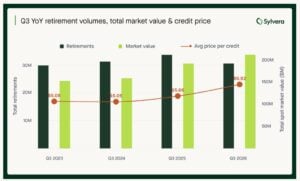
These figures cover the broader carbon-credit market, not tree-planting projects alone. They show that market value can rise even when retirement volumes decline, reflecting changes in prices and the mix of credits purchased.
For forest-project developers, the commercial opportunity depends on the project’s quality, methodology, delivery schedule, buyer demand, and ability to demonstrate credible climate benefits. A general market average should not be treated as the expected selling price for an individual project.

Challenges and Opportunities of Reducing CO2 Emissions with Trees
Tree planting can contribute to climate mitigation, but projects face practical, ecological, and financial challenges.
An MIT Report revealed that while planting trees could reduce CO2 emissions in about 10 years, deforestation continues at a rapid pace. It also highlighted that from 2015 to 2020, around 10 million hectares of forest were lost each year, with only 4 million hectares being restored.
This is because land is often used for farming, livestock, and mining, making it expensive to plant trees. As a result, not enough trees were planted to significantly reduce CO2 emissions.
- Trees need time to grow, and their survival is not guaranteed. Drought, wildfires, pests, disease, and extreme weather can reduce carbon stocks or destroy planted areas. Poor site selection and inadequate maintenance can also weaken a project’s long-term performance.
- Land availability creates another challenge. Agriculture, livestock production, mining, infrastructure, and other activities compete for land. Developers must assess land tenure, opportunity costs, local livelihoods, and the risk that planting could displace existing land uses.
- Forest loss remains a major concern. The Food and Agriculture Organization’s Global Forest Resources Assessment 2025 estimated that forests covered 4.14 billion hectares, or about 32% of global land area.
Annual deforestation averaged 10.9 million hectares during 2015–2025, while net forest loss averaged 4.12 million hectares per year over the same period.
Deforestation and net forest loss are different measures: deforestation tracks the conversion of forest to other land uses, while net forest loss also reflects gains in forest area. Both figures highlight the need to protect existing forests as well as restore degraded land.
Despite these challenges, several developments create opportunities for forest-carbon projects:
- Satellite imagery and remote sensing can help monitor changes in forest cover and estimate carbon stocks.
- Better carbon-accounting methods can improve the assessment of additionality and project performance.
- Partnerships among governments, companies, communities, and project developers can help share costs and support long-term maintenance.
- Carbon finance can provide an additional revenue stream for restoration projects that might otherwise struggle to attract funding.
Success depends on more than the number of seedlings planted. Projects need suitable land, long-term management, credible carbon accounting, and safeguards for local communities and ecosystems.

Choosing the right tree species is important. Planting non-native or fast-growing trees can harm local ecosystems and reduce biodiversity. To get the best environmental results, afforestation projects should use native species. They should also follow sustainable practices.
The United Nations Strategic Plan for Forests
The United Nations Strategic Plan for Forests 2017–2030 established six Global Forest Goals and 26 associated targets. Its objectives include expanding forest cover, promoting sustainable forest management, protecting forest-dependent communities, and increasing international cooperation and finance.
The Global Forest Goals Report 2026 provides an updated assessment of progress. Based on voluntary national reports from 48 countries and data from FAO’s 2025 forest assessment, the report found that seven of the 26 targets were broadly met, 17 were partially achieved, and two were off track.
The findings indicate that progress has been made, but current action remains insufficient to achieve all the targets by 2030. The report also highlights the need to strengthen forest protection, mobilize finance, and improve cooperation.
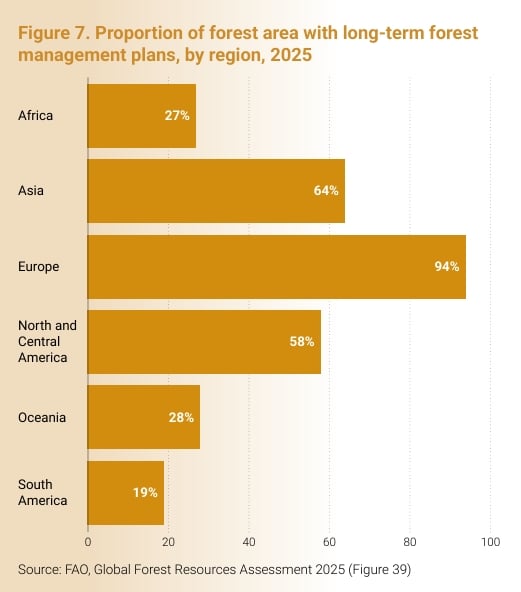
For carbon-credit developers, these goals provide important policy context. Projects that restore appropriate landscapes and support sustainable forest management can contribute to broader climate and biodiversity objectives. However, alignment with international goals does not automatically make a project eligible for carbon credits or guarantee demand from buyers.
Calculating the Carbon Value of a Tree
The amount of carbon stored in a tree depends on its species, diameter, height, age, growth conditions, and location. Estimating carbon storage therefore requires more than counting trees.
A project may use field measurements, species-specific equations, biomass models, remote sensing, or a combination of these methods. Diameter at breast height, commonly measured about 1.3 metres above the ground, is one of the inputs used in many tree-biomass equations.
A simplified assessment generally involves the following steps:
- Measure tree dimensions and identify the species or relevant species group.
- Apply an appropriate allometric equation or biomass model to estimate above-ground and, where required, below-ground biomass.
- Convert estimated biomass into carbon using an appropriate carbon fraction.
- Convert carbon mass into CO₂ equivalent by multiplying by approximately 3.67.
- Account for changes over time, relevant project emissions, baseline conditions, leakage, and uncertainty under the applicable methodology.
This is a simplified scientific calculation, not a substitute for an approved carbon-crediting methodology. Project-level credit issuance may require additional measurements, uncertainty deductions, monitoring procedures, and safeguards against reversal.
Accurately quantifying this capacity is essential for determining the corresponding carbon credits. Recent research has focused on developing methodologies to estimate CO₂ absorption by urban tree planting projects.
Scientists have also developed formulas to measure carbon absorption from urban greening projects. This shows that carbon credits are needed to support these initiatives for improved environmental results.
The Tree Carbon Calculator uses a formula that estimates the amount of carbon stored in a tree based on its diameter at breast height (DBH), species, and growth conditions. Here’s a simple technique snapshot for calculation.

Funding and Investment: Who Pays for Tree Planting?
Tree-planting initiatives can receive funding from governments, development institutions, nonprofit organizations, private investors, corporate buyers, and the voluntary carbon markets.
Carbon-credit revenue can help finance restoration where developers can demonstrate measurable and additional climate benefits. Some projects also rely on grants, land-management income, or long-term corporate offtake agreements, in which a buyer commits to purchase credits delivered in the future.
Corporate demand has supported large restoration projects in recent years. Microsoft, for example, expanded its partnership with Brazilian restoration company re.green in January 2025. Across two agreements signed in 2024, the companies committed to restoring more than 33,000 hectares of native forest in Brazil’s Amazon and Atlantic Forest regions. Re.green reports approximately 6.5 million contracted carbon removal units under the agreements and more than five million seedlings planted on its project page.
The partnership also targets ecological and social outcomes, including forest connectivity and local employment. These reported results are distinct from the total number of contracted carbon units, which are delivered under the agreements over time.
Microsoft also signed a separate 25-year offtake agreement with Chestnut Carbon in January 2025 for more than seven million carbon removal credits from afforestation, reforestation, and revegetation projects in the southeastern United States. Chestnut estimated that the project would restore about 60,000 acres through the planting of more than 35 million native trees.
These agreements illustrate how long-term corporate purchasing commitments can help restoration developers plan projects and secure financing. They do not establish a universal price for forest credits, and contracted volumes should not be confused with credits already delivered or retired.
Market Trends: The Demand for Carbon Credits from Tree Planting
The demand for carbon credits from tree planting is growing as more companies and governments focus on tackling climate change.
- Last year, a study from Nature.com found that well-planned reforestation projects could remove up to ten times more carbon at a lower cost than previously thought.
- Projects costing less than $20 per ton of CO₂ are considered affordable, making them an attractive option for businesses looking to offset emissions.
However, not all forest carbon offsets are reliable. Research shows that many projects fail to deliver the promised carbon removal, raising concerns about credibility.
Tree planting has strong economic potential, but success depends on accurate carbon valuation, diverse funding, and a solid understanding of the market. Ensuring strict monitoring and verification is key to maintaining trust and maximizing both environmental and financial benefits.
Cost of Planting Trees for CO2 Removal
The same MIT study further revealed how much it costs to remove CO2 by planting trees, considering South America as a case study. They created a “supply curve” to show the cost of removing one ton of CO2 based on how many trees are planted.
This helps us figure out the best places to plant trees, how many we can plant, and the cost involved.

- Point A (South America): Lowest cost: $23 per ton. Plentiful rainfall, low tree planting, and land opportunity costs
- Point B (Amazon Forest, Para, Brazil): Cost: $30 per ton. Plentiful rainfall, but higher tree planting costs
- Point C (Amazon Forest, Mato Grosso, Brazil): Cost: $40 per ton. Higher land opportunity costs
- Point D (Brazilian Cerrado): Highest cost: $90 per ton. Lower forestation potential, higher land opportunity costs
Key takeaway: Regional variations in forestation costs are significant, with costs rising as land opportunity and forestation potential decrease.
Practical Guide to Starting a Carbon Credit Tree Planting Project
Embarking on a carbon credit tree planting project involves careful planning, adherence to legal frameworks, and consideration of social and environmental impacts. This guide provides a comprehensive overview to assist in successfully initiating such a project.
Choosing the Right Location: Soil, Climate, and Biodiversity Considerations
Choosing the right site is key to a successful tree-planting project. The soil should be fertile and well-drained to support healthy growth. Climate factors like temperature and rainfall need to match the trees’ needs. Plus, choosing native species helps maintain biodiversity, keeping the ecosystem balanced and connected.
Selecting Tree Species for Maximum Carbon Sequestration
Choosing the right tree species is crucial for carbon storage. Fast-growing trees, like poplars and willows, absorb carbon quickly, while hardwoods, such as oaks and maples, store it longer. Additionally, selecting native species helps ensure resilience and sustainability. A diverse mix not only improves soil health but also supports wildlife habitats, making the ecosystem stronger.
Long-Term Maintenance and Monitoring of Tree Planting Projects
Keeping a tree planting project successful takes ongoing care and monitoring. Regular tasks like watering, mulching, pruning, and pest control keep trees healthy. Tracking growth and survival rates helps measure carbon storage. A strong monitoring plan ensures the project meets its goals and provides reliable data for verification.

Legal and Certification Framework for Tree-Based Carbon Credits
Navigating Through Carbon Credit Certification Processes
Getting certified for tree carbon credits requires recognition from the following standards. The Verified Carbon Standard (VCS) by Verra is the most widely used, providing frameworks for validation and verification. Verra’s VCS Program supports carbon reduction in Agriculture, Forestry, and Other Land Use (AFOLU), which includes:
- Afforestation, Reforestation, and Revegetation (ARR)
- Agricultural Land Management (ALM)
- Improved Forest Management (IFM)
- Reduced Emissions from Deforestation and Degradation (REDD)
- Avoided Conversion of Grasslands and Shrublands (ACoGS)
- Wetlands Restoration and Conservation (WRC)

The Role of Third-Party Verification in Carbon Credit Projects
Social and Environmental Impacts of Tree Planting Projects
Community Engagement and Local Benefits
Biodiversity and Ecosystem Advantages
Afforestation helps capture carbon and improves biodiversity. New forests provide homes for animals and increase species variety. They also help restore damaged ecosystems. Other benefits include cleaner water, better soils, and natural services like pollination and climate control. Focusing on healthy ecosystems boosts these benefits.
Addressing Potential Risks and Criticisms of Tree-Based Carbon Credits
Tree-based carbon credits face challenges. These include permanence, additionality, and social impacts. To store carbon long-term, we must protect forests from deforestation and disasters. Additionality means proving the project wouldn’t occur without carbon credit funding.
Therefore, social issues like displacement and unfair land use should be addressed to benefit the local communities. Notably, transparency and best practices help build trust and credibility.
Starting a carbon credit tree planting project needs careful planning concerning ecological, legal, and social factors. As these projects help combat climate change, they follow specific guidelines and involve stakeholders. Additionally, they offer lasting benefits for the environment and local communities.
Future Outlook and Trends in Tree Planting for Carbon Credits
Technological Advancements in Monitoring Tree Growth and Carbon Sequestration
New technologies like satellite imagery and AI-powered tools are transforming how tree growth and carbon capture are tracked. These innovations improve accuracy, lower costs, and enhance transparency, making it easier to verify carbon credits.
For example: Planet Labs PBC a leading provider of global, daily satellite imagery and geospatial solutions announced that they have signed a multi-year, seven-figure deal with Laconic, a company leading a global shift in climate finance, empowering governments to monetize natural carbon assets through its Sovereign Carbon securitization platform.
In this deal, Laconic can use Planet’s 3-meter Forest Carbon Monitoring product and 30-meter Forest Carbon product for the next three years.
- READ DETAILS: Laconic Teams Up with Planet to Revolutionize Forest Carbon Insights for Smarter Carbon Credits Trading
The Evolving Market: Predictions for Tree-Based Carbon Credits
As companies and governments push toward net-zero goals, demand for carbon credits is expected to rise. Tree-based credits will stay in demand due to their added ecological and social benefits. However, stricter regulations and increased scrutiny will require stronger verification standards.
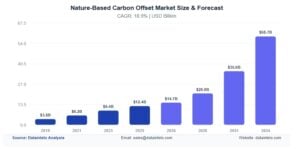
Reports say that the global nature-based carbon offset market was valued at $12.4 billion in 2025 and is projected to reach $58.7 billion by 2034, growing at a CAGR of 18.9% from 2026 to 2034. Growth is driven by corporate net-zero commitments, carbon pricing policies, and rising demand for ecosystem benefits.
- LATEST DEVELOPMENTS:
Companies like Microsoft and Meta are investing in forest carbon credits to reach their sustainability goals. Some recent developments include:
- Microsoft Signs Groundbreaking 7MT Carbon Credits Deal with U.S.-Based Chestnut Carbon
- Meta and WRI Unveiled AI-Powered Global Tree Canopy Map
The Role of Policy in Shaping Forest Carbon Finance
Government policy and international cooperation influence forest protection, restoration finance, and the development of carbon markets.
The UNFCCC’s REDD+ framework provides a system for developing countries to report results from activities that reduce emissions from deforestation and forest degradation, conserve and sustainably manage forests, and enhance forest carbon stocks.
According to the UNFCCC REDD+ Web Platform, 67 parties had submitted forest reference emission levels or forest reference levels. Twenty-five parties had reported REDD+ results representing an overall reduction of 14.69 gigatons of CO₂ equivalent, and 22 parties were eligible to receive results-based payments for reductions totaling 14.57 gigatons of CO₂ equivalent.
These are reported REDD+ results under the UNFCCC process. They should not be treated automatically as volumes of tradable voluntary carbon credits. Eligibility for results-based payments also requires the relevant national strategies, monitoring systems, safeguards information, and measurement, reporting, and verification procedures.
The UN’s Global Forest Goals Report 2026 also shows that most forest targets remain only partially achieved. This reinforces the need for stronger forest protection, reliable finance, and cooperation among governments, businesses, communities, and project developers
Tree Planting for Carbon Credits: Key Takeaways & Conclusion
Key Takeaways
- How It Works: Carbon credits offset emissions (1 ton CO₂ per credit); trees absorb CO₂, storing it in trunks, roots, and soil.
- Afforestation vs. Reforestation: Afforestation involves planting trees in non-forested areas, while reforestation restores lost forests; both generate carbon credits.
- Market & Investment: The voluntary carbon market was $2B in 2021 and is projected to reach $100B by 2030; Microsoft committed $200M for Amazon reforestation by 2025.
- Challenges & Opportunities: Challenges include deforestation risks, climate change, and verification issues, while opportunities lie in AI monitoring, corporate funding, and government incentives.
- Project Essentials: Success depends on site and tree selection, certification (e.g., Verified Carbon Standard), and ongoing maintenance.
- Future Trends: AI & satellites enhance tracking, stricter verification boosts trust, and corporate demand for high-quality carbon credits rises.
Conclusion
Tree planting for carbon credits offers a dual advantage: combating climate change and fostering environmental and social benefits. Adhering to certification standards, leveraging technological advancements, and engaging communities ensure project success and credibility.
As market demand grows and policies evolve, tree-based carbon credits will play a vital role in global decarbonization efforts. By addressing potential risks and embracing innovation, these projects can deliver impactful and lasting contributions to the planet’s future.