

Buyers can retire these credits to support climate claims or other environmental goals, subject to the rules and standards that apply to the claim.
How Big Is the Voluntary Carbon Market?
The voluntary carbon market has grown significantly over the past decade, but its size depends on how the market is measured. Credit issuance, credit retirements, market value, and investment in carbon projects represent different parts of the market. Looking at retirements and market value provides a clearer picture of actual buyer demand.
In 2025, buyers retired about 202 million tonnes of carbon credits, according to MSCI Carbon Markets. More than 10,200 projects were registered across the 18 major carbon credit registries tracked by MSCI at the end of the year. Those projects issued about 294 million tonnes of CO₂e credits in 2025.
MSCI estimates that the primary global carbon credit market was worth just over $1.4 billion in 2025, based on the volume of credits retired and the estimated price paid when they were purchased. The figure was broadly unchanged from the previous year and marked the fourth consecutive year at around this level.
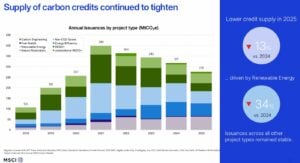
Credit quality is also becoming a stronger driver of market value. MSCI’s average global carbon credit price index fell to $3.50 per tonne of CO₂e in 2025 from $4.30 in 2024. At the same time, higher-rated credits performed better: the MSCI Rated BBB and Above Index rose from $5.60 to $6.80 per tonne.
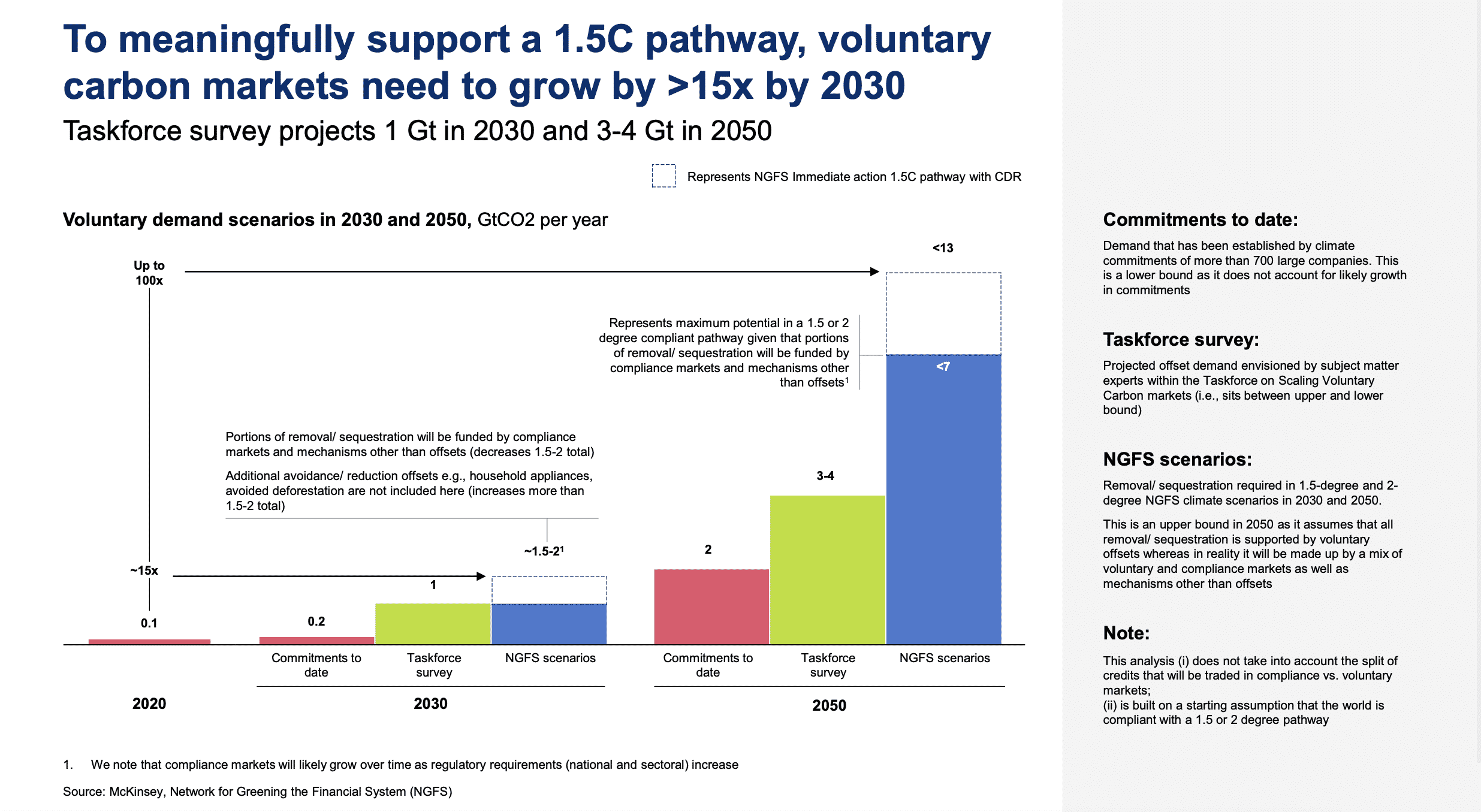
The market could expand significantly if demand broadens and buyers place greater value on high-integrity credits. MSCI’s modeling suggests the global voluntary carbon credit market could reach between $5 billion and $20 billion by 2030, measured in 2025 prices. The range reflects different assumptions about future demand and the availability of high-quality credits.
What is the Difference Between the Voluntary Carbon Market and the Compliance Market?
The compliance market is regulated by national, regional, or international carbon reduction regimes. These markets operate under a cap-and-trade system where only a certain amount of ‘allowances’ (basically a permit that ‘allows’ you to emit GHGs) are created. This then limits the amount of GHGs that a country or industry can emit. The cap represents a finite supply of allowances.
Compliance carbon markets can include emissions trading systems, where regulated entities trade allowances, as well as other forms of mandatory carbon pricing such as carbon taxes.
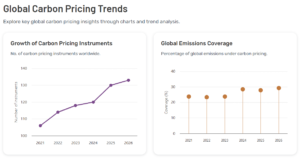
Emissions trading has expanded considerably in recent years. According to the International Carbon Action Partnership (ICAP), 41 emissions trading systems were in force worldwide in 2026, covering about 26% of global greenhouse gas emissions. Japan, India, and Vietnam also launched new national-level systems in 2026.
In an emissions trading system, the regulator determines the supply of allowances under the system’s rules. Regulated entities can trade those allowances to meet their obligations.
If an industry can achieve its mandated targets or, better yet, if they emit less than its allowance, it can sell the extra credits to someone else. The ability to trade surplus credits can financially motivate participants to reduce their overall emissions.
Examples of compliance carbon markets include the European Union emissions trading system, the California emissions trading system, the Australian emissions trading system, the British Columbia emissions trading system, and the New Zealand emissions trading system.
Looking beyond emissions trading, the World Bank reports that 87 direct carbon pricing policies were implemented worldwide in 2026. Together, these policies cover nearly 30% of global greenhouse gas emissions and generated more than $107 billion in public revenue in 2025.
The voluntary carbon market is driven primarily by voluntary demand rather than mandatory emissions obligations. However, voluntary and compliance carbon markets can increasingly interact through specific rules, crediting mechanisms, and international frameworks.
Instead of a cap-and-trade system, the VCM uses a project-based system in which there is no finite supply of allowances.
Within the VCM, more carbon credits can be created through the development of environmental projects. Companies can buy these credits to offset unavoidable emissions and reach their targets. The credits can come from a broad range of emissions-reduction and removal projects.
Voluntary vs. Compliance Market
| Voluntary Carbon Market | Compliance Carbon Market | |
|---|---|---|
| Why does it exist? | Buyers participate voluntarily to support climate action or make eligible environmental claims. | Covered entities participate because they face regulatory emissions obligations. |
| What is traded? | Carbon credits generated by qualifying projects or programs. | Allowances and, where permitted, eligible carbon credits or other compliance units. |
| Who sets the rules? | Carbon-crediting programs, standards, registries, market participants, and increasingly national regulators. | Governments, regulators, or supranational authorities. |
| Who participates? | Companies, organizations, governments, and other eligible buyers and sellers. | Regulated companies and other eligible market participants. |
| How is supply created? | Through qualifying emissions-reduction or carbon-removal projects and programs. | Allowance supply is established under the design of the relevant compliance system. |
| How are prices determined? | Prices vary widely by project type, quality, removal status, vintage, location, and buyer requirements. | Prices depend on the system’s allowance supply, demand, rules, and compliance requirements. |
| How are units traded? | Direct transactions, brokers, marketplaces, exchanges, and other channels. | Regulated exchanges and other approved trading channels. |
| Can credits be used for compliance? | Only when the relevant compliance system specifically allows eligible credits. | Depends on the rules of the individual system. |
Carbon Taxes and Emissions Trading Systems
Not all compliance carbon pricing works through emissions trading. Under a carbon tax, a government sets a price on greenhouse gas emissions or the carbon content of fuels.
Under an emissions trading system, regulators establish a system of tradable units and allow market participants to trade them. The two approaches can both put a price on emissions, but they use different policy designs.
The boundary between voluntary and compliance carbon markets is becoming more important as governments develop their own carbon-crediting systems and allow certain credits to interact with regulated markets. This does not mean that all voluntary credits are eligible for compliance use. Eligibility depends on the rules of the relevant jurisdiction or program.
International carbon market cooperation is also expanding under Article 6 of the Paris Agreement. It provides frameworks for countries to cooperate through internationally transferred mitigation outcomes and a UN-supervised crediting mechanism.
The simplest way to distinguish the two markets is this: voluntary carbon markets are primarily driven by voluntary buyer demand, while compliance markets are created by regulatory obligations.
But the two systems can overlap when governments allow specific carbon credits to be used within regulated frameworks. Understanding that distinction is essential because a carbon credit is not automatically equivalent to a compliance allowance.
What Type of Environmental Projects are Found in the VCM?
The VCM offers a wide variety of environmental projects to interested investors. The goal of all of these projects is to reduce or remove GHG emissions or carbon dioxide from the atmosphere.
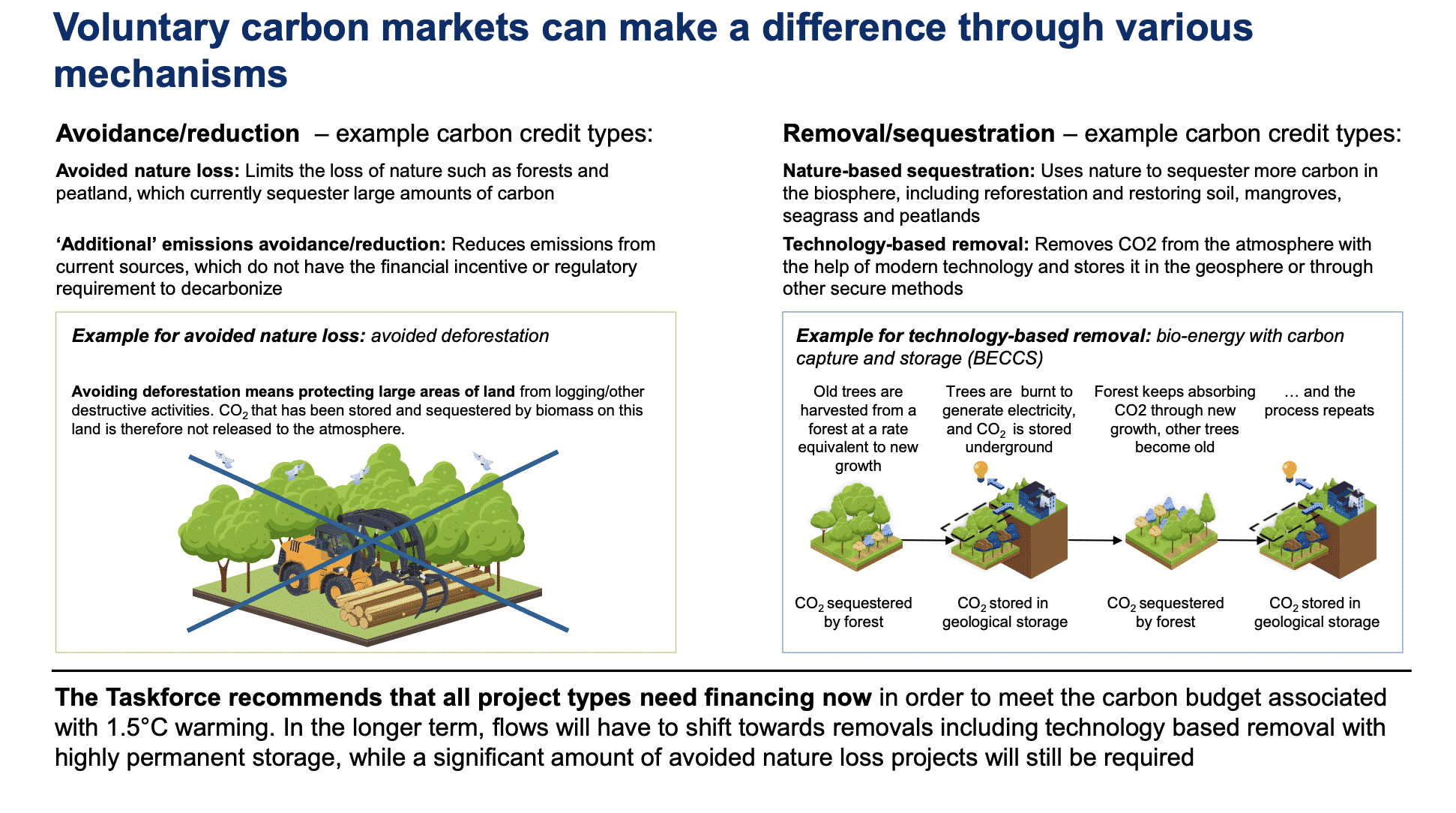
Voluntary carbon market projects can reduce greenhouse gas emissions, avoid emissions that might otherwise occur, or remove carbon dioxide from the atmosphere. Projects can include renewable energy, methane capture, clean cooking, forest conservation, reforestation, agricultural practices, biochar, and engineered carbon removal technologies.
The distinction between emissions reductions and carbon removals is increasingly important in today’s market. Reduction projects prevent or reduce greenhouse gas emissions, while removal projects take carbon dioxide from the atmosphere and store it in forests, soils, geological formations, or other long-term carbon sinks.
Community-based projects typically produce smaller volumes of carbon credits but also generate more additional socio-economic and environmental co-benefits.5
A co-benefit can include anything from saving endangered animals from extinction to improving local water quality or creating sustainable jobs. Project developers often align co-benefits with the UN’s Sustainable Development Goals (SDGs) as these co-benefits can help to increase the overall value of a credit.
Large industrial projects are capable of producing larger volumes of carbon credits but don’t always generate strong co-benefits. As a result, credits from these large projects may trade at a discount compared to the projects that achieve SDGs.
What Is Additionality?
Additionality is a key quality criterion used in many carbon-crediting methodologies. It asks whether the emissions reduction or removal would have happened without the incentive provided by the carbon-credit project. If an activity would have occurred anyway, issuing credits for it may not represent an additional climate benefit.
Additionality is only one part of carbon credit quality. Buyers should also consider how emissions reductions or removals are quantified, how long carbon is stored, whether emissions are displaced or leaked elsewhere, whether credits are independently verified, and whether the same climate benefit could be counted more than once.
What Is Permanence?
Permanence refers to how long a carbon removal or emissions reduction remains effective. This is especially important for projects that store carbon in forests, soils, or other biological systems, where carbon can be released again through wildfire, drought, disease, land-use change, or other events. High-integrity carbon-crediting systems need mechanisms to manage and compensate for these reversal risks.
What Is Leakage?
Leakage occurs when an emissions reduction in one location causes emissions to increase elsewhere. For example, protecting a forest in one area could shift deforestation activity to another area if the underlying drivers are not addressed. Carbon-credit methodologies use different approaches to identify and manage these risks.
Avoiding Double Counting
A carbon reduction or removal should not be counted more than once. Double counting can occur through multiple forms, including double issuance, double claiming, or double use of the same credit. Carbon credit registries and other tracking systems help identify and record credits so they can be traced from issuance through retirement.
The different types of projects can be grouped into these two major categories:
Emissions Reduction and Avoidance
- Renewable energy
- Methane capture
- Waste and landfill-gas management
- Clean cooking
- Energy efficiency
- Industrial emissions reduction
- Forest conservation and avoided deforestation
- Improved agricultural practices
Carbon Removal
- Afforestation and reforestation
- Soil and land-based carbon removal
- Biochar
- Direct air capture
- Mineralization
- Enhanced weathering
- Other engineered carbon-removal technologies
Carbon removals are still a relatively small part of the voluntary carbon market, but demand is increasing. MSCI estimates that about 10% of the carbon credits retired in 2025 were associated with emissions removals, while the remaining 90% came from emissions-reduction activities. Nearly all removal-based retirements were sourced from nature-based projects.
Nature-Based vs. Engineered Carbon Removal
Carbon removal projects can be broadly divided into nature-based and engineered approaches. Nature-based removals include activities such as reforestation, afforestation, improved land management, and other projects that increase biological carbon storage. Engineered approaches use technologies or industrial processes to capture carbon dioxide and store it in durable forms or geological formations.
The two categories differ in cost, measurement challenges, permanence, scalability, and risk of carbon reversal. Buyers should evaluate the specific project and methodology rather than assuming that one category is automatically higher quality than another.
Who Participates in the VCM?
The voluntary carbon market (VCM) includes a wide range of participants involved in developing, financing, verifying, selling, buying, and retiring carbon credits. These include project developers, investors, companies, governments, carbon-crediting programs, registries, verification bodies, brokers, marketplaces, data providers, and local communities.
Carbon Project Developers
Project developers design and operate projects that reduce greenhouse gas emissions or remove carbon dioxide from the atmosphere. Projects can include renewable energy, methane capture, clean cooking, forest conservation, reforestation, agriculture, biochar, and engineered carbon removal.
Developers are generally responsible for implementing projects, monitoring their performance, and preparing the documentation required for validation, verification, and credit issuance.
Project Financiers and Investors
Carbon projects often require capital before they can generate and sell credits. Investors, funds, banks, companies, and other financiers can provide this funding, sometimes in exchange for future carbon credits or project revenues.
MSCI estimates that about $22 billion in capital was committed and deployed into the carbon credit market in 2025, a 72% increase from 2024. Corporate deal activity accounted for about $11.4 billion of that total.
Corporate Buyers
Companies are major participants in the VCM. They may purchase credits to support emissions reduction and carbon removal projects, address eligible residual emissions as part of a broader climate strategy, or make climate claims under applicable standards and guidance. Companies can buy credits directly from project developers or through brokers, marketplaces, and other intermediaries.
The number of corporate participants is broad, but demand remains concentrated among a smaller group of large buyers. MSCI tracks more than 16,000 companies using carbon credits.
Governments and Other Participants
Governments can participate as regulators, project hosts, credit buyers, or developers of domestic carbon crediting systems. Other participants include carbon-crediting programs and standards that establish project requirements, methodologies, and issuance rules; registries that record the issuance, transfer, and retirement of credits; and independent validation and verification bodies that assess whether projects and reported climate benefits meet applicable requirements.
Brokers, marketplaces, exchanges, consultants, ratings providers, and data companies also support the market by connecting buyers and sellers, helping assess projects, providing market information, and facilitating transactions.
Local communities and Indigenous Peoples can also play important roles, particularly in forestry, agriculture, and other land-based projects. They may own or manage project areas, participate in project design and implementation, or receive project benefits.
High-integrity projects should include appropriate stakeholder engagement, safeguards, and benefit-sharing arrangements where relevant.
How the VCM Works
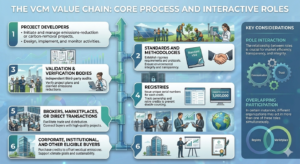
These roles can overlap. A company can finance a carbon project and later purchase its credits, while a developer can sell credits directly to buyers without using a broker. As the VCM develops, participants are increasingly involved across multiple stages of the carbon credit value chain.
What is the Pricing for VCM vs. the Compliance Markets?
Carbon prices vary widely across voluntary and compliance markets. There is no single global price because values depend on the type and quality of the unit, project characteristics, supply and demand, and market rules.
VCM Carbon Credit Prices
Voluntary carbon market prices vary significantly by project type and quality. In 2025, the MSCI Global Carbon Credit Price Index averaged $3.50 per metric ton of CO₂ equivalent (tCO₂e), down from $4.30 in 2024. Higher-quality credits rated BBB or above averaged $6.80/tCO₂e, up from $5.60 in 2024.
Prices ranged from below $1/tCO₂e to nearly $50/tCO₂e for many project types, while engineered carbon-removal credits could exceed $1,000/tCO₂e. The growing premium for higher-quality credits shows that buyers are increasingly willing to pay more for projects with stronger climate-impact and integrity characteristics.
Compliance Carbon Prices
Compliance carbon prices also vary widely because each emissions trading system (ETS) and carbon tax has different rules and market conditions. The World Bank reported an average direct carbon price of nearly $21/tCO₂e in 2026, covering implemented carbon taxes and ETSs worldwide.
Individual markets can be much higher or lower than this average. Prices vary based on allowance supply, emissions levels, regulatory requirements, and the cost of compliance.
Why Do the Prices Differ?
VCM credits represent emissions reductions or carbon removals from specific projects, so their prices depend heavily on project type, quality, location, vintage, and buyer preferences. Compliance units, such as ETS allowances, are created within regulated systems, with prices driven mainly by policy rules, supply and demand, and compliance costs.
Therefore, VCM and compliance prices should not be directly compared as if they were the same type of carbon unit. A voluntary credit can cost less than $1 per tonne, while premium removal credits can cost more than $1,000. Compliance prices also vary significantly between jurisdictions.
You can follow live carbon prices right here.
What Determines the Price of a Carbon Credit?
Several factors can affect the price of a VCM credit:
- Project type: Carbon removals and some nature-based projects can command premiums over lower-cost emissions-reduction projects.
- Credit quality: Credits perceived to have stronger additionality, permanence, measurement, and other integrity characteristics can command higher prices.
- Location: Credits from some regions trade at premiums because of differences in project quality, supply, demand, and buyer preferences.
- Vintage: The year in which a credit’s underlying emissions reduction or removal occurred can affect its value.
- Eligibility: Credits that qualify for specific compliance programs or international schemes can receive additional demand.
- Co-benefits: Projects that provide measurable biodiversity, community, or other environmental benefits may attract buyers willing to pay more.
- Supply and demand: Scarcity of certain project types or strong demand from buyers can push prices higher.
MSCI’s 2025 analysis found that prices for credits from the same project and vintage could still vary by an average of 11%, highlighting the lack of a single standardized price in the VCM. Nearly 90% of trades observed by MSCI in the first quarter of 2025 were over-the-counter or bilateral transactions, rather than exchange-based trades.
Voluntary Carbon Market |
Compliance Carbon Market |
|
|---|---|---|
| What is priced? | Carbon credits representing verified emissions reductions or removals | Allowances, compliance credits, or other eligible units |
| Who creates the demand? | Companies, institutions, governments, and other voluntary buyers | Regulated entities with legal emissions obligations |
| How is price determined? | Project quality, type, location, vintage, eligibility, supply and demand | Regulatory rules, allowance supply, emissions demand, market expectations, and compliance costs |
| Typical pricing | Highly variable, from below $1 to tens or hundreds of dollars per tonne; engineered removals can exceed $1,000/tCO₂e | Highly variable across jurisdictions; the World Bank’s 2026 average direct carbon price was nearly $21/tCO₂e |
| Is there one global price? | No | No |
| Can prices be directly compared? | Generally not | Generally not |
Where do These Credits Trade?
Voluntary carbon credits can be traded through direct transactions, brokers, marketplaces, and exchanges. Unlike stocks or commodities, the VCM does not have one central global exchange or trading venue.
Many transactions take place over the counter (OTC), where buyers and sellers negotiate prices and terms directly or through an intermediary. MSCI found that nearly 90% of observed carbon-credit trades in the first quarter of 2025 were OTC or bilateral transactions, highlighting the continued importance of private deals.
Carbon credits can also be traded through specialized marketplaces and exchanges, which allow buyers to compare and purchase credits from different projects. These platforms can improve price transparency and access, but the level of liquidity and standardization varies across the market.
After a buyer purchases a credit, it is typically retired through the relevant carbon registry. Retirement permanently removes the credit from circulation and prevents it from being sold or used again.
Key Trading Channels:
Direct or bilateral transactions: Buyers purchase credits directly from project developers or other sellers.
Brokers: Intermediaries connect buyers and sellers and can help negotiate transactions.
Marketplaces and exchanges: Platforms provide access to credits from multiple projects and suppliers.
Registries: Track the issuance, transfer, and retirement of individual credits rather than functioning as conventional trading exchanges.
Most VCM trading still happens through negotiated or bilateral transactions, while marketplaces and exchanges provide additional channels for discovering and purchasing credits.
Who Verifies the Variable Carbon Market Credits?
Carbon projects are generally assessed by independent validation and verification bodies (VVBs). These organizations check whether a project follows the requirements of the applicable carbon crediting program and whether its reported emissions reductions or removals have been properly measured.
Validation typically examines whether a project’s design meets the relevant methodology and program requirements. Verification assesses the project’s reported emissions reductions or removals after the project has been implemented and monitored.
VVBs do not create or sell carbon credits. Instead, they provide independent assessments that support the issuance of credits by the relevant carbon crediting program or registry. The most widely used standards include:
- Verra (The Verified Carbon Standard)
- Plan Vivo
- The Gold Standard
- The American Carbon Registry
- Climate Action Reserve
Why Is Independent Verification Important?
Verification helps ensure that the number of credits issued reflects the project’s measured climate impact. A robust process also helps identify problems such as inaccurate emissions calculations, weak monitoring, or failure to follow project requirements.
However, verification alone does not guarantee that every carbon credit is high quality. Buyers should also consider additionality, permanence, leakage, measurement methods, safeguards, and other integrity factors when assessing credits.
Click here to read more details on who verifies carbon credits.
Can Individuals Invest in Voluntary Carbon Credits?
Individuals can participate in the voluntary carbon market by purchasing and retiring carbon credits, although the market is still dominated by corporate and institutional buyers. Consumers may buy credits to support emissions-reduction or carbon-removal projects or to address eligible emissions as part of a broader climate strategy. Airlines, travel companies, and other businesses may also offer customers opportunities to purchase credits associated with their activities.
However, buying a carbon credit does not automatically make an individual, flight, product, or company carbon neutral or net-zero. Those claims depend on the quality and use of the credits, the emissions-reduction actions taken, and the applicable climate-claims rules.
The Bottom Line
The voluntary carbon market has evolved from a relatively simple market for carbon offsets into a broader ecosystem involving project developers, investors, companies, governments, standards, registries, and other participants.
Carbon credits can support emissions reductions and carbon removals, but their quality and value vary widely. Buyers should look beyond price and assess factors such as additionality, permanence, measurement, verification, safeguards, and the risk of double counting.
As the market develops, demand is increasingly shifting toward higher-quality credits and durable carbon removals. The VCM can play a role in climate strategies, but it works best alongside direct emissions reductions rather than as a substitute for them.