

Carbon capture and storage (CCS) is moving from early-stage pilots into large-scale infrastructure deals. One of the latest signals comes from Eni and BlackRock’s Global Infrastructure Partners (GIP), which secured more than $670 million in financing for their joint carbon capture and storage platform. The funding came from a consortium of 13 international lenders, and demand exceeded the original target.
The deal strengthens one of Europe’s largest CCS platforms, which includes projects in the United Kingdom, the Netherlands, and Italy. It also reflects rising investor confidence in carbon transport and storage networks, especially in regions with strong carbon pricing systems and government-backed industrial decarbonization plans.
At the center of this platform is the HyNet industrial cluster, which is emerging as one of Europe’s most advanced CCS systems.
HyNet Emerges as Europe’s Flagship Carbon Storage Megaproject
The flagship project within the platform is the Liverpool Bay CCS system, which forms the backbone of the UK’s HyNet cluster. The project is designed to:
- Capture CO₂ from heavy industry in northwest England and North Wales.
- Transport CO₂ through new and repurposed pipelines.
- Store CO₂ in depleted offshore gas fields under Liverpool Bay.
The system could store 4.5 million tonnes of CO₂ per year in its first phase, scaling up to 10 million tonnes per year in the 2030s.
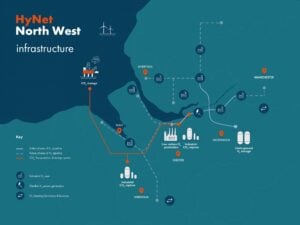
Construction is already advanced, with more than 30% completed, and first operations are planned for 2028. The infrastructure also includes around 149 km of existing pipeline repurposed and 35 km of new pipelines to connect industrial emitters to the transport system.
The HyNet cluster is not a single project. It is a regional industrial system covering:
- Cement production,
- Chemicals,
- Energy-from-waste plants, and
- Hydrogen production.
UK authorities estimate CCS could support tens of thousands of jobs across industrial regions while helping cut emissions from some of the hardest-to-decarbonize sectors.
Big Money Flows Into Carbon Capture Infrastructure Networks
The $670 million financing package was raised from 13 lenders, including major global banks such as BNP Paribas, ING, NatWest, MUFG, and UniCredit. The oversubscribed financing round reflects growing financial sector interest in CCS-linked infrastructure assets.
The transaction follows key milestones in the platform’s development:
- GIP acquired a 49.99% stake in Eni CCUS Holding in 2025.
- The platform now includes CCS assets in the UK, the Netherlands, and Italy.
- Additional projects such as Bacton CCS (UK) and L10-CCS (Netherlands) are already included in the portfolio.
This structure reflects a shift in CCS financing. Instead of standalone pilot projects, investors are now funding multi-country CCS networks that combine capture, transport, and storage assets under a single platform.
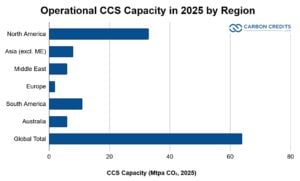
Globally, CCS is expanding rapidly but remains far below the required climate pathways. The International Energy Agency (IEA) estimates the world currently has more than 600 million tonnes per year of CO₂ capture capacity in development pipelines, but only a small fraction is operational today.
Britain Bets £21.7 Billion on Industrial Carbon Capture Expansion
The Liverpool Bay project is part of the UK government’s broader CCS strategy.
In 2024, the UK committed up to £21.7 billion (around $28 billion) in public funding to support CCS development across industrial clusters. This is one of the largest national CCS funding programs globally.
The HyNet cluster alone is expected to reduce emissions across one of the UK’s most industrialized regions, while also supporting hydrogen production and low-carbon fuels.
The UK’s approach is based on “cluster sequencing,” where multiple industries share a single CO₂ transport and storage backbone. This reduces costs by spreading infrastructure across multiple emitters instead of building separate systems for each facility.
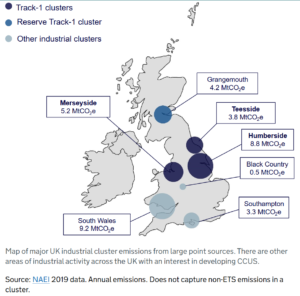
Major UK industrial cluster emissions
Similar cluster-based CCS models are now being developed in other countries:
- Netherlands (Rotterdam CCS systems),
- Norway (Northern Lights project), and
- United States (Gulf Coast CCS hubs).
This shows CCS is evolving into a network infrastructure industry, not just a climate technology.
Eni Builds CCS Into a Multi-Billion Dollar Transition Platform
For Eni, CCS is becoming a core part of its transition strategy. The company operates through a “satellite model,” where low-carbon businesses are separated into independent platforms to attract external capital.
Eni’s CCUS Holding now includes Liverpool Bay CCS (UK), Bacton CCS (UK), L10 CCS (Netherlands), and the rights to acquire Ravenna CCS (Italy). The goal is to build a scalable carbon management business that can serve industrial emitters across Europe.
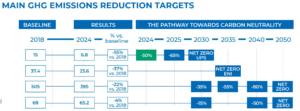
The energy major has also set broader climate targets:
- Net-zero Scope 1 and 2 emissions by 2035, and
- Net-zero lifecycle emissions by 2050.
CCS is positioned as essential for “hard-to-abate” sectors such as cement and chemicals, where direct electrification is limited.
Carbon Capture Scales Up as Questions Over Long-Term Costs Persist
Carbon capture and storage is growing faster as more projects move from planning into financing and construction. Supporters say it’s a vital tool for reducing emissions in heavy industries. This includes cement, chemicals, and refining, where electrification is hard.
The IEA sees CCS as key to reaching net-zero goals. It helps manage residual emissions from industries. However, the long-term economics remain uncertain.
Most CCS projects still depend on carbon pricing, government subsidies, or regulated revenue support to stay viable. Costs for capture, transport, and storage infrastructure remain high, and development timelines often stretch across 5 to 10 years.
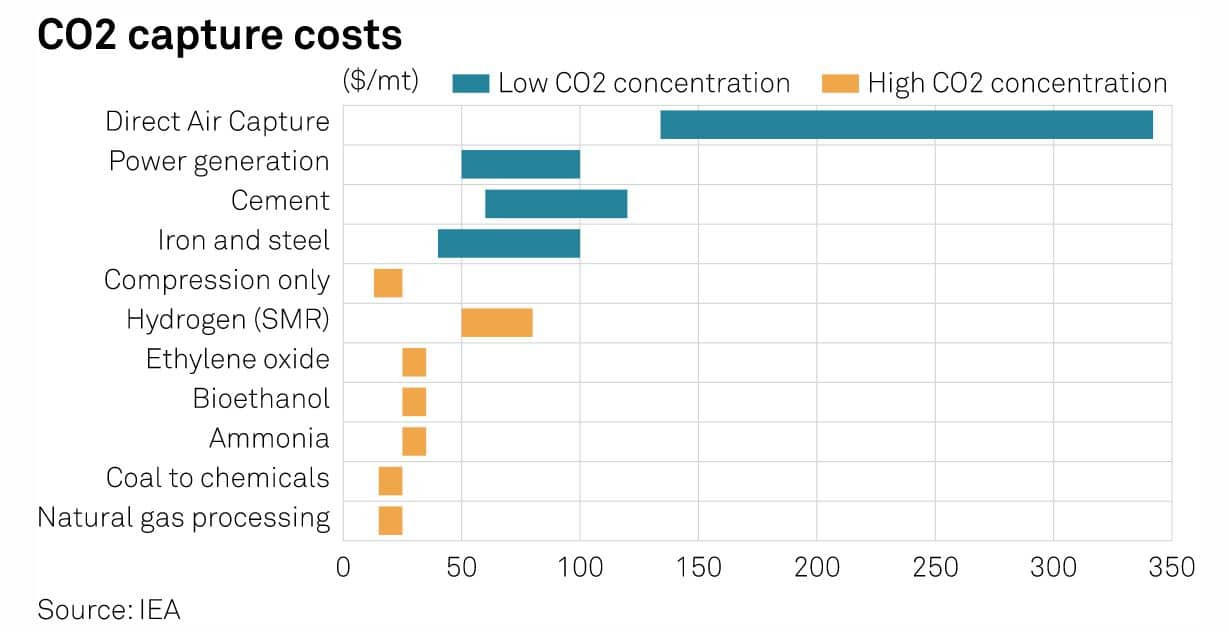
Meanwhile, global emissions are still above 37 billion tonnes of CO₂ per year, showing how far CCS must scale to have a material global impact. This gap between current deployment and climate needs remains one of the main challenges for the sector.
CCS Is Scaling Into Infrastructure, Not Just Climate Technology
The Eni–BlackRock financing deal marks another step in the shift toward industrial-scale carbon capture systems.
With $670 million in new funding, the HyNet cluster is setting a benchmark for carbon transport and storage. It aims to store between 4.5 and 10 million tonnes of CO₂, and it has strong support from the UK’s £21.7 billion CCS program.
At the same time, global CCS deployment is still limited compared to climate needs. The sector now faces a clear challenge: scaling from early infrastructure clusters into a global system capable of handling gigaton-scale emissions.
For now, CCS is moving forward as a financeable infrastructure asset class. But its long-term role in global decarbonization will depend on how quickly it can expand beyond early clusters like HyNet.