

The U.S. natural gas industry is entering another year of strong growth. Domestic production is reaching record highs, liquefied natural gas (LNG) exports continue to expand, and electricity demand is climbing as artificial intelligence (AI), data centers, and electrification reshape the country’s energy needs.
Natural gas remains the largest source of U.S. electricity generation, helping balance renewable energy while replacing coal in many regions. At the same time, the fuel remains under increasing scrutiny because of its carbon dioxide (CO₂) emissions and methane leaks, which are major contributors to climate change.
With prices stabilizing after years of volatility, the market is entering a new phase where demand growth and export opportunities are likely to keep natural gas at the center of the U.S. energy mix.
US Natural Gas Production Hits New Highs
The United States remains the world’s largest producer of natural gas.
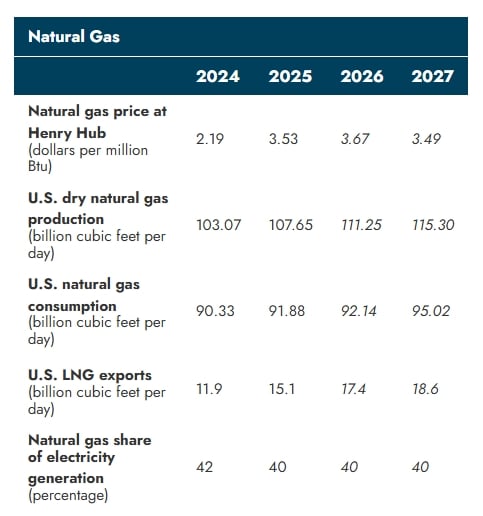
According to the latest U.S. Energy Information Administration (EIA) Short-Term Energy Outlook, U.S. dry natural gas production is expected to average 111 billion cubic feet per day (Bcf/d) in 2026, up from 107.65 Bcf/d in 2025. Production is forecast to increase further to 113.6 Bcf/d in 2027.
The growth is largely driven by:
- Higher associated gas production from the Permian Basin
- Increased drilling in the Haynesville shale
- Expanding LNG export capacity along the Gulf Coast
- Rising electricity demand
The EIA also reported that U.S. marketed natural gas production averaged 120.2 Bcf/d during the first quarter of 2026, about 4% higher than the same period last year.
Strong production has kept storage levels healthy and prevented significant price spikes despite increasing consumption.
Demand Continues to Grow
Natural gas consumption remains robust across several sectors.
The EIA forecasts U.S. natural gas consumption to average 92.14 Bcf/d in 2026, increasing to nearly 95 Bcf/d in 2027.
Power generation remains the biggest source of demand.
Growing electricity use from AI data centers, cryptocurrency facilities, manufacturing, and electrification is increasing the need for reliable baseload and flexible generation.
For the Electric Power Sector
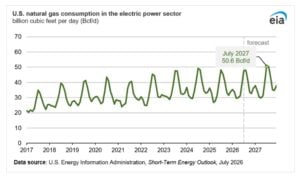
Natural gas consumption by the electric power sector is expected to reach a record 38.1 Bcf/d in 2026, with monthly demand potentially exceeding 50 Bcf/d during peak summer periods.
Electricity demand itself is also setting new records.
The EIA projects total U.S. electricity consumption will rise to 4,269 billion kilowatt-hours (kWh) in 2026 and 4,399 billion kWh in 2027, driven largely by commercial customers and energy-intensive AI infrastructure.
LNG Exports Are Supporting the Market
The United States has become one of the world’s largest LNG exporters, and overseas demand continues to strengthen domestic natural gas markets.
- LNG exports to increase from 15.1 Bcf/d in 2025 to 17.2 Bcf/d in 2026, reaching 18.6 Bcf/d in 2027.
New export terminals along the Gulf Coast are creating additional demand for U.S. shale gas while helping supply Europe and Asia as many countries diversify away from Russian gas.
Higher exports also provide producers with more stable long-term markets, even when domestic demand fluctuates.
Natural Gas Prices Have Stabilized
After several years of sharp swings caused by weather, geopolitical tensions, and storage changes, natural gas prices have become relatively stable.
- Henry Hub natural gas prices are expected to average around $3.60 per million British thermal units (MMBtu) in 2026, slightly above 2025 levels, according to the EIA.
- In recent trading, NYMEX natural gas futures have remained close to $3.25 per MMBtu, supported by strong summer electricity demand while abundant production continues to limit major price increases.
Analysts say prices are likely to remain moderate unless extreme weather significantly reduces storage or major supply disruptions occur.
- CHECK: LIVE NATURAL GAS PRICES
Natural Gas Still Dominates US Power Generation
Despite rapid renewable energy growth, natural gas continues to be the backbone of the U.S. electricity system. This sector can potentially generate approximately 40% of U.S. electricity through 2027, while coal’s share continues to decline.
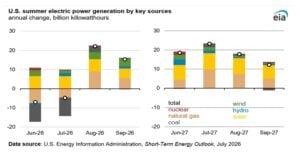
Renewables are projected to supply 27% of electricity generation, with nuclear contributing about 18%.
Natural gas plants remain valuable because they can quickly adjust output when wind and solar generation changes, supporting grid reliability during periods of high demand.
What About US Emissions?
Natural gas emits less carbon dioxide than coal when burned, which has helped reduce emissions from the U.S. power sector over the past two decades.
However, it remains a fossil fuel.
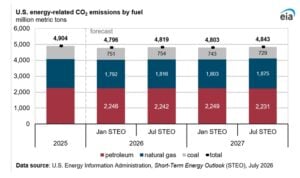
The EIA said U.S. energy-related CO₂ emissions are projected to decline by 1.7% in 2026 compared with 2025 before edging up by 0.5% in 2027.
- In the near term, they are expected to remain around 4.8 billion metric tons annually. However, emissions intensity continues to decline as renewable energy expands and coal generation falls.
Methane emissions present another challenge.
Methane is the primary component of natural gas and has a much stronger warming effect than carbon dioxide over the short term. Leaks during production, processing, and transportation significantly increase the climate impact of natural gas.
Reducing methane emissions through improved monitoring, leak detection, and tighter regulations remains one of the fastest ways to lower greenhouse gas emissions from the industry.
AI Is Creating a New Source of Gas Demand
One of the biggest changes in the U.S. energy market is the rapid growth of AI infrastructure.
Large data centers require enormous amounts of electricity, and utilities are increasingly relying on natural gas plants to provide reliable power while renewable generation and transmission projects are built.
The EIA expects commercial electricity demand to exceed residential demand for the first time in U.S. history, reflecting rapid expansion of AI and digital infrastructure.
However, environmental groups warn that relying heavily on gas-fired generation for AI could increase greenhouse gas emissions if renewable deployment does not keep pace. Recent research suggests dozens of proposed gas plants dedicated to data centers could substantially increase emissions over the coming decades.
Can Natural Gas Support the Energy Transition?
Supporters argue that it provides reliable, affordable electricity while enabling higher levels of wind and solar generation. It also strengthens energy security and supports economic growth through exports and manufacturing.
Critics point to continued carbon emissions, methane leakage, and the risk of locking in long-term fossil fuel infrastructure that could delay deeper decarbonization.
The future role of natural gas will likely depend on several factors:
- Growth of renewable energy and battery storage
- Carbon capture and storage deployment
- Methane emission reductions
- LNG export demand
- AI-driven electricity consumption
- Federal and state climate policies
Outlook
The U.S. natural gas market remains fundamentally strong.
Production continues to reach new records, LNG exports are expanding, and electricity demand from AI, industry, and electrification is creating new growth opportunities. At the same time, abundant supply is keeping prices relatively stable for consumers and businesses.
Yet natural gas also sits at the center of America’s climate challenge. While it has helped replace coal and lower emissions in the power sector, meeting long-term climate goals will require substantial reductions in methane leaks and carbon emissions.
For now, natural gas is expected to remain the dominant fuel in the U.S. energy system—supporting grid reliability, economic growth, and global energy exports while the country continues its transition toward a lower-carbon future.