


However, the rapid growth of AI workloads and data centers poses challenges, raising concerns about the effectiveness of these strategies.
AI’s Growing Carbon Cost: Can Microsoft Keep Up?
The rise of generative AI has dramatically increased demand for data centers, the backbone of AI model training and deployment. These facilities are energy-intensive, housing thousands of servers that consume vast amounts of electricity.
Microsoft’s emissions have surged nearly 30% since 2020, largely due to indirect emissions from constructing and outfitting new data centers. These emissions, also known as Scope 3, represent more than 96% of the big tech’s total footprint.
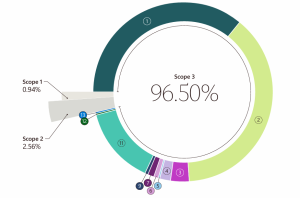
The company’s $80 billion investment in infrastructure expansion this year alone underscores the scale of AI-driven growth.
This trend is not unique to Microsoft. A study by Morgan Stanley estimates that global greenhouse gas (GHG) emissions from data centers will triple by 2030 due to generative AI.
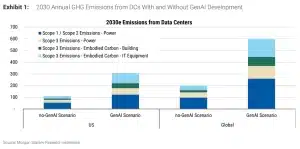
Powering AI queries, which can consume 10x more energy than traditional queries, is straining energy grids and pushing tech giants’ sustainability promises out of reach.
Morgan Stanley projects that these energy-hungry facilities will emit 2.5 billion metric tons of CO₂ equivalent gases by 2030. U.S. data center expansion could increase emissions by 200 million metric tons annually, accounting for over half the global build-out.
Globally, a 200% growth in data centers may lead to an additional 400 million metric tons of CO₂ emissions. This highlights the environmental challenge of AI’s accelerating energy demands, pressuring tech companies like Microsoft to tackle it effectively.
Re.green Partnership: Restoring Forests, Offsetting Emissions
In its quest to offset emissions, Microsoft has leaned heavily on carbon credits. One notable initiative is its partnership with Brazilian company Re.green, aimed at restoring degraded land by replanting native species.
- RELATED: Shell and Microsoft Are The Biggest Carbon Credit Buyers in 2024: What Projects Do They Support?
Their latest agreement, signed in 2025, secures 3.5 million tons of carbon removal credits over 25 years. This deal builds on a 2024 agreement for 3 million tons of credits over 15 years. Combined, these contracts involve replanting 10.7 million seedlings across 16,000 hectares in Brazil.
Re.green specializes in ecological restoration and high-quality carbon offsets. Its partnership with Microsoft focuses on restoring 33,000 hectares across the Amazon and Atlantic forests. Since their collaboration began in May 2024, they’ve planted over 4.4 million native seedlings, covering 80 species, on 11,000 hectares of degraded land.
The recent initiative targets western Maranhão and eastern Pará in the Amazon, along with southern Bahia and Vale do Paraíba in the Atlantic Forest. It aims to enhance ecological balance by improving landscape connectivity, supporting species flow, genetic diversity, and processes like seed dispersal and pollination.
Re.green CEO Thiago Picolo hailed the collaboration as proof of the growing carbon credit market, stating,
“This collaboration serves as tangible evidence that this market not only exists but has significant potential for growth in Brazil.”
Notably, the Financial Times estimates the deal’s value at $200 million based on recent market analysis.
Carbon Credits and the Greenwashing Claims
While carbon credits are a popular tool for offsetting emissions, they have faced criticism. Detractors argue that such credits allow companies to continue emitting GHGs while outsourcing the responsibility of reduction.
Critics label this practice as “greenwashing,” a sentiment amplified by reports that Microsoft’s AI and cloud services have been marketed to fossil fuel industries to aid resource exploration.
Microsoft is not alone in this scrutiny. A report highlights how major cloud providers, including Microsoft, Amazon, and Google, lack transparency in their carbon emissions data.
Emissions from data centers are often underestimated and could be much higher than officially reported by big tech.
From 2020 to 2022, Google, Microsoft, Meta, and Apple’s company-owned data center emissions were likely 7.62 times higher than reported, according to a Guardian analysis. This discrepancy stems from using renewable energy certificates (RECs), which allow companies to claim renewable energy use even if the energy isn’t consumed onsite.
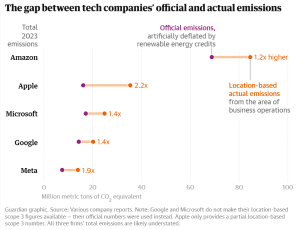
RECs enable firms to report “market-based” emissions, which are significantly lower than “location-based” emissions—those directly produced at data centers.
Without RECs or carbon offset credits, Microsoft’s and other tech giants’ true emissions reveal a troubling trend. If these big tech companies were a single country, their combined 2022 emissions would rank 33rd globally, between the Philippines and Algeria. This highlights the environmental impact of growing data center demands and raises concerns about transparency in emissions reporting.
Balancing Innovation with Sustainability: Microsoft’s Challenge
Microsoft’s dual focus on AI innovation and sustainability highlights the tension between technological advancement and environmental responsibility. The company’s significant investments in infrastructure and carbon credits underscore its commitment to addressing these challenges.
However, the rapid pace of AI development risks outstripping these efforts, making it difficult to achieve carbon-negative goals by 2030. While initiatives like carbon credits and renewable energy investments are steps in the right direction, the rising energy demands of AI underscore the need for systemic change.
Achieving climate goals will require not only financial investments but also a commitment to transparency and accountability. As Microsoft navigates this complex landscape, its approach will shape the future of sustainable innovation in technology.