


The expansion of data centers, driven by the rise of artificial intelligence (AI), cloud computing, and data storage, is one of the largest contributors to increased electricity demand. To address this issue, Google has teamed up with Intersect Power, a clean energy developer, and TPG Rise Climate, a private equity firm, to launch a $20 billion partnership that promises to transform the way data centers are powered.
This collaboration aims to co-locate renewable energy sources with Google’s data centers, ensuring that new facilities are powered by clean energy. The deal, which involves the development of massive energy parks, will integrate renewable energy generation—such as solar power—with energy storage solutions in industrial parks that house data centers.
The first phase of the project is expected to be operational by 2026, with full completion anticipated in 2027.
What Are Energy Parks and Why Are They Important?
The core idea behind Google and Intersect Power’s collaboration is the development of energy parks. They are large-scale, co-located renewable energy facilities designed to serve the dual purpose of powering data centers and contributing to the broader power grid.
These energy parks will combine solar power generation with storage solutions, enabling Google’s data centers to operate on clean energy. More importantly, the energy parks can also feed excess electricity into the grid, helping to stabilize the energy supply and provide power for other needs.
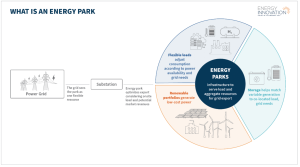
Energy parks offer several significant benefits over traditional energy-sourcing models:
- They reduce the reliance on external, non-renewable energy grids, which are often fueled by fossil fuels and can contribute to environmental degradation.
- They provide financial benefits, such as cost savings from bulk energy purchases, leveraging tax credits, and creating local economic development opportunities.
- They will also help speed up the integration of renewable energy into the energy market.
As these facilities are developed to serve large, energy-intensive loads like data centers, they can quickly connect to the grid. As such, they provide a faster alternative to waiting for new grid-connected resources to come online.
Google’s Commitment to Sustainability and Clean Energy
The tech giant’s partnership with Intersect Power aligns with Google’s longstanding commitment to sustainability. Over the years, the tech company has made significant progress in reducing its carbon footprint and increasing the use of renewable energy in its operations.
However, as the demand for data and computing power increases—especially with the proliferation of AI and machine learning—Google has found it increasingly difficult to keep pace with its energy needs using traditional renewable energy sources alone.
In 2023, Google reported a 13% increase in emissions, due to the growing energy consumption of its expanding data centers. This prompted the company to seek innovative solutions, such as the creation of energy parks, which integrate renewable energy production directly into the data center ecosystem.
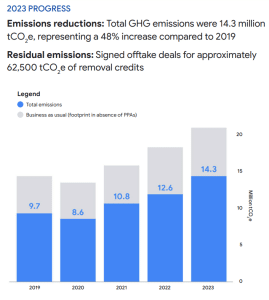
The $20 billion partnership with Intersect Power is an ambitious effort to meet Google’s energy needs as well as help reduce the environmental impact of the tech industry’s rapid growth.
The Role of TPG Rise Climate and Intersect Power in Scaling the Effort
TPG Rise Climate, part of the private equity firm TPG, plays a key role in this collaboration by providing funding to help scale the renewable energy infrastructure. It led the $800 million funding round for Intersect Power.
With its focus on climate solutions, TPG Rise Climate is committed to driving investments that reduce carbon emissions and support the global transition to clean energy.
Intersect Power also brings valuable experience to the table, having developed and managed renewable energy assets across North America. The company has over 2.2 gigawatts (GW) of solar energy and 2.4 gigawatt-hours (GWh) of battery storage already in operation or under construction. With this, the company has demonstrated its ability to deliver large-scale energy solutions.
The partnership with Google is set to further expand its renewable energy footprint, as it looks to break ground on 4 GW of solar and 10 GWh of battery storage in the near future.
Meeting the Soaring Energy Demands of Data Centers: Challenges and Solutions
The rapidly growing demand for data centers is not unique to Google’s operations. In Virginia, for example, the state faces a daunting challenge in meeting the energy needs of its data center industry.
According to a recent study by the Joint Legislative Audit and Review Commission (JLARC), the state’s energy demand, which had remained relatively flat for years, is projected to double over the next decade. This is driven primarily by the expansion of data centers.
Virginia’s largest data center market, located in Northern Virginia, is home to about 13% of global data center capacity. This creates a massive strain on the state’s power grid.
The JLARC report highlighted the need for significant investments in new infrastructure, including solar and wind generation, natural gas plants, and upgraded transmission capacity.
Virginia has set ambitious goals to achieve 100% renewable energy by 2045. However, the state’s existing infrastructure is struggling to keep pace with demand.
A Sustainable Model for the Future
As Google and other tech giants like Meta expand their operations, solutions like energy parks could become essential for alleviating this pressure while ensuring that data centers are powered by clean, reliable energy.
Speaking of, the world’s largest AI data center will be built in Alberta, Canada, with an estimated $70 billion investment. Known as Wonder Valley, this data center will be powered by 7.5 GW of low-cost, renewable energy, with an emphasis on scalability to meet the growing demand of hyperscalers—large-scale data centers that can dynamically adjust to varying workloads.
The project, led by O’Leary Ventures, is to be located in a heavy eco-industrial district in the Greenview area. It will begin generating 1.4 GW of power in its first phase by 2026. Then it aims to add another 1 GW each subsequent year.
Wonder Valley’s integration of renewable energy sources and its focus on AI-driven computing make it a key player in the future of sustainable data infrastructure. This massive project will also position Alberta to be a major hub for clean energy and data processing.
All in all, the partnership between Google, Intersect Power, and TPG Rise Climate represents a new frontier in the intersection of digital infrastructure and clean, renewable energy. By combining the scale of data center growth with renewable energy generation, this collaboration sets a precedent for how large tech companies can address their environmental impact while meeting the energy demands of the digital age.