

Global electricity generation is set to more than double over the next 35 years as renewable energy expands, electric vehicles replace gasoline-powered cars, and demand from artificial intelligence (AI) and data centers increases. However, building enough power generation, transmission lines, and energy storage to support this growth will be a major challenge.
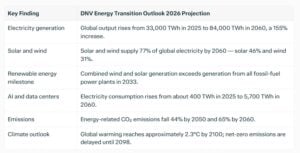
According to DNV’s Energy Transition Outlook 2026, global electricity generation will rise from 33,000 terawatt-hours (TWh) in 2025 to 84,000 TWh by 2060, an increase of 155%. Solar and wind power will drive much of this expansion, gradually replacing fossil fuels in electricity generation.
Yet the transition will not automatically deliver the emissions cuts needed to meet global climate goals. DNV forecasts that the world will experience 2.3°C of warming by 2100 under its most likely energy transition pathway.
The report highlights a central challenge for the global energy market: the world must generate far more electricity while making the energy system cleaner, more reliable and affordable.
Key Findings From DNV’s Energy Transition Outlook 2026
Electricity Demand Will Surge as Economies Electrify
Electricity is becoming central to the global energy transition. Transport, buildings and industrial facilities are increasingly switching from direct fossil-fuel use to electric alternatives.
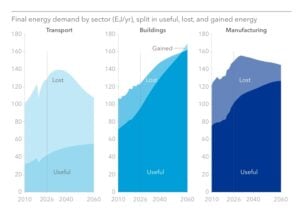
DNV forecasts that electricity demand will grow by 80% by 2050.
- The increase will come from several sources, including electric vehicle charging, space cooling, data centers, and the production of low-carbon fuels such as hydrogen.
- Buildings will also contribute significantly to this growth. Rising populations, urbanization, and higher living standards will increase building electricity consumption by 75% by 2060, excluding data centers.
- Meanwhile, the global vehicle fleet is projected to be 84% electric by 2060. As more cars and commercial vehicles use electricity instead of gasoline or diesel, transport will become increasingly dependent on reliable power supplies.
Electricity generation must grow even faster than demand alone might suggest. DNV explains that a power system with a larger share of variable renewable energy also needs additional generation to support storage, system flexibility, and transmission losses.
As a result, the expansion of electricity supply will require investment not only in new power plants but also in the infrastructure needed to deliver electricity reliably.
Solar and Wind Will Dominate Global Power Generation
Solar and wind are expected to account for most of the growth in electricity generation through 2060.
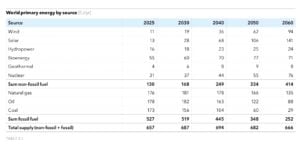
DNV forecasts that solar power will supply 46% of global electricity by 2060, while wind will contribute 31%. Together, they will generate more than three-quarters of the world’s electricity.
The shift is expected to accelerate during the next decade. DNV projects that combined solar and wind generation will exceed output from all fossil-fuel power plants in 2033.
The forecast reflects the growing competitiveness of renewable energy and the increasing importance of energy security. Countries that depend on imported oil and gas are expanding domestic renewable power to reduce exposure to fuel price swings and supply disruptions.
Grid Investment Must Keep Pace
DNV reports that annual global spending on renewables increased from $860 billion in 2021 to $1.77 trillion in 2026. The report expects investment in renewable power, electricity grids and storage to triple by 2040.
However, adding renewable capacity is only part of the challenge. Solar and wind output changes with weather conditions and time of day, making grid flexibility and storage increasingly important.
Battery Storage Gains Momentum
Battery storage is expanding rapidly. DNV says installed utility-scale battery storage capacity increased 14-fold over the five years covered by its latest assessment, while twice as much utility battery storage was installed in 2026 as in 2025.
Even so, the report warns that transmission capacity and demand flexibility are not growing fast enough. Without faster infrastructure development, electricity networks could struggle to accommodate the growing volume of renewable power.
AI and Data Centers Add to Power Demand
The rapid expansion of AI is creating another source of electricity demand. Data centers need substantial amounts of power to operate servers, cooling systems, and computing equipment.
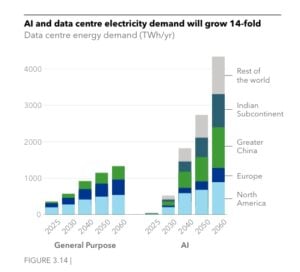
DNV estimates that global data centers consumed approximately 400 TWh of electricity in 2025, equivalent to 1.2% of global electricity supply.
The report forecasts that consumption will increase to:
- 1,100 TWh in 2030.
- 2,700 TWh in 2040.
- 5,700 TWh in 2060.
By 2060, data centers will account for 6.8% of global electricity consumption, according to DNV.
The growth creates opportunities for renewable energy developers, battery storage providers and electricity infrastructure companies. Technology companies will also need reliable power supplies to support expanding computing operations.
However, DNV cautions that access to dependable electricity could become a constraint on data center development. Grid connections, cooling infrastructure, and the availability of firm power will influence how quickly new facilities can be built.
AI demand also remains uncertain. Improvements in computing efficiency could reduce electricity use per task, while greater AI adoption and more intensive computing could push consumption higher.
Fossil Fuels Will Decline, but Emissions Remain a Challenge
The shift toward renewable electricity will reduce the role of fossil fuels, but it will not eliminate them quickly.
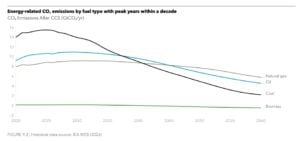
DNV forecasts that fossil fuels will account for 51% of global primary energy supply in 2050, down from around 80% historically. Oil demand is expected to decline over the longer term, while natural gas demand is projected to peak around 2035. Coal demand will resume its decline in 2027 and fall by 82% to 2060.
The power sector will deliver substantial emissions reductions as renewable generation replaces fossil-fuel plants. DNV forecasts that energy-related CO₂ emissions will decline 44% from approximately 39 gigatonnes today to 22 gigatonnes in 2050.
- By 2060, energy-related emissions are projected to fall 65% to 12 gigatonnes annually.
However, some industries will be harder to decarbonize. Cement manufacturing, for example, releases CO₂ through chemical reactions involved in production. Switching to renewable electricity cannot eliminate these process emissions on its own.
DNV expects process emissions to decline by only 14% by 2060, compared with a 65% reduction in energy-related emissions. Carbon capture and storage, alternative industrial processes and carbon dioxide removal could help address some of these remaining emissions.
The report forecasts that direct air capture will remove 0.4 gigatonnes of CO₂ annually by 2060, increasing to 3 gigatonnes by 2100. However, the technology must scale considerably to play this role.
Can the Energy Transition Meet Climate Goals?
- DNV expects global net-zero emissions to be reached around 2098, with warming reaching 2.3°C by 2100. Its forecast suggests that the world will exceed the remaining carbon budget for limiting warming to 2°C by approximately 420 gigatonnes of CO₂.
For investors, the outlook points to long-term opportunities in renewable generation, battery storage, transmission infrastructure, electrification and industrial decarbonization. It also highlights the need for carbon capture and removal technologies to address emissions that are difficult to eliminate.
Ultimately, generating 84,000 TWh of electricity will require a major expansion of the global power system. The challenge is ensuring that this growth comes with cleaner generation, stronger grids and faster emissions reductions.
The energy transition is gaining momentum, but DNV’s forecast shows that expanding clean electricity alone will not be enough to meet global climate targets.