

TotalEnergies and investment firm KKR are expanding their U.S. renewable energy partnership with a solar portfolio valued at $1.2 billion. The deal adds 700 megawatts (MW) of solar capacity to their joint venture, increasing its total renewable energy portfolio from 1.4 gigawatts (GW) to 2.1 GW.
Announced on October 12, 2026, the agreement covers three large solar projects in Texas and Ohio. The assets are expected to begin commercial operations by the first quarter of 2027. TotalEnergies will continue to operate them after the deal closes, which is expected in 2026, subject to customary conditions.
The agreement builds on a partnership formed in 2025. TotalEnergies’ strategy focuses on sharing renewable energy assets with financial investors. They still manage operations and sell the electricity produced.
For KKR, the deal adds more large-scale solar assets to its energy transition investments. For TotalEnergies, it provides another way to expand its electricity business while sharing the cost and financial risks of owning renewable projects.
A $1.2 Billion Deal Adds 700 MW of Solar Power
The new portfolio includes three utility-scale solar projects in Texas and Ohio. Utility-scale projects are large facilities that generate electricity for the power grid or major customers.
The portfolio has an enterprise value of $1.2 billion. Enterprise value measures the value of a business or asset portfolio, taking debt and cash into account. It should not be treated as the cash payment made by KKR alone.
The new assets will join the 50/50 joint venture that TotalEnergies and KKR established in 2025. Before this latest agreement, the venture held 1.4 GW of renewable energy capacity. The additional 700 MW will bring its total to 2.1 GW.
The electricity produced by the three projects is already sold to third parties or will be marketed by TotalEnergies. These arrangements can help connect the projects’ output with customers and provide a route to market for the electricity.
TotalEnergies will continue operating the assets after the transaction closes. The companies have not disclosed the full payment structure for the latest deal.
The projects are expected to reach commercial operation by the first quarter of 2027. This means the assets are moving toward the stage when they can supply electricity as planned, rather than simply being part of a future development pipeline.
Why TotalEnergies Is Sharing Ownership
The latest agreement comes after a deal from September 2025. At that time, TotalEnergies sold a 50% stake in a North American solar portfolio to KKR-managed investment vehicles and accounts.
That earlier portfolio had an enterprise value of $1.25 billion. It included six large solar projects with a combined capacity of 1.3 GW and 41 smaller distributed-generation assets totaling 140 MW.
TotalEnergies said the earlier transaction, together with planned refinancing, was expected to bring it about $950 million at closing. The company retained a 50% stake and continued operating the assets.
This approach is part of the company’s wider business model. TotalEnergies can develop renewable projects, bring in a financial partner, and sell part of its ownership once the assets reach operation and their risks are lower.
Selling a stake can release capital for other investments. Keeping ownership and operating roles lets the company stay connected to the assets and their electricity sales.
In its 2025 announcement, TotalEnergies said it aims for a 12% profitability target for its Integrated Power business. Its strategy includes selling up to 50% of renewable assets after they begin operating and their risks have been reduced.
The latest deal continues that approach. It gives KKR a larger share of U.S. renewable infrastructure while allowing TotalEnergies to remain involved in day-to-day operations.
- RELATED: TotalEnergies Pushes $1.2B Kazakhstan Wind Bet Amid Legal Storms and Energy Transition Pressure
U.S. Solar Capacity Set for a Major Expansion in 2026
The agreement comes as the United States prepares to add more electricity generation capacity, with solar power expected to account for a large share of new projects.
The U.S. Energy Information Administration (EIA) reported in February 2026 that developers aimed to add 86 GW of new utility-scale electricity capacity this year. Solar was expected to account for 51% of those planned additions, followed by battery storage at 28% and wind at 14%.
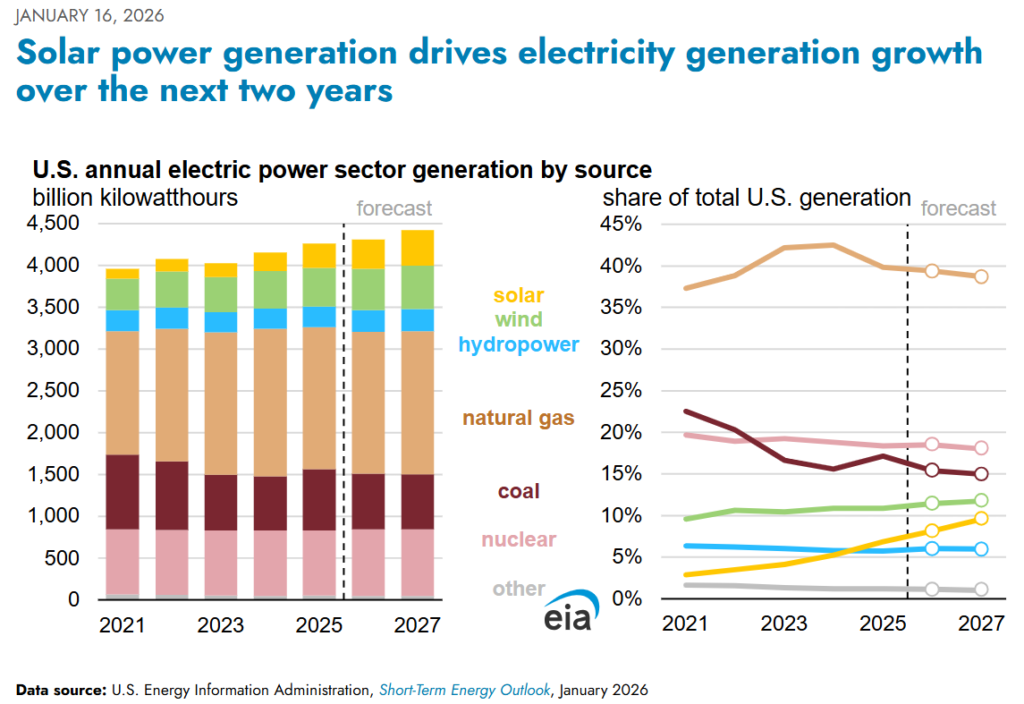
The EIA projected 43.4 GW of new utility-scale solar capacity for 2026, which would be a 60% increase from 2025 if all planned projects were completed. Texas was expected to account for 40% of the planned solar additions. These are forecasts, not confirmed final installations.
The agency also expects electricity demand to keep growing. In its September 2026 outlook, the EIA forecast U.S. electricity sales of 4,135 billion kilowatt-hours in 2026 and 4,211 billion kilowatt-hours in 2027. It pointed to data center development and increased manufacturing activity as factors behind rising demand.
This creates an important market for new generation projects. Solar can supply electricity during daylight hours, while battery storage can help shift some power to later periods. However, the value of each project depends on local grid conditions, customer contracts, financing costs, and the timing of electricity supply.
The TotalEnergies-KKR portfolio boosts this growing market. However, the companies haven’t shared the expected yearly electricity output for the three projects.
TotalEnergies Builds Its Electricity Business
TotalEnergies is a global energy company with operations in oil, natural gas, biofuels, low-carbon hydrogen, renewable power, and electricity.
Its renewable energy portfolio has grown as the company seeks to build a larger electricity business alongside its traditional energy operations. By the end of June 2026, TotalEnergies reported more than 37 GW of gross renewable power generation capacity worldwide. It aims to produce more than 100 terawatt-hours (TWh) of net electricity annually by 2030.
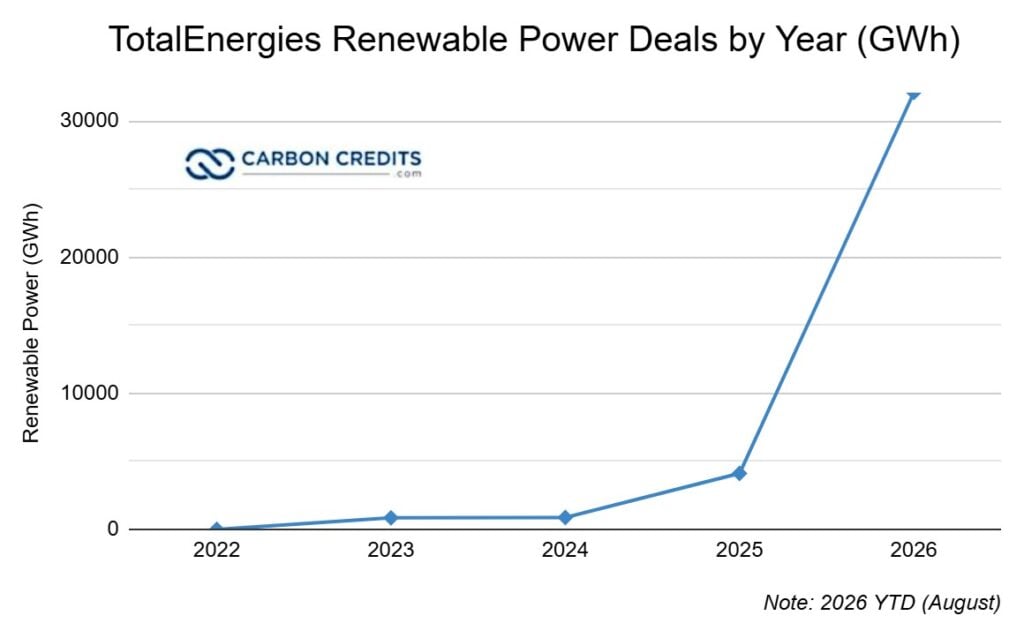
In the United States, the company reported about 10 GW of installed renewable power capacity at the end of 2025, including solar, wind, and battery storage. Around 5 GW of that portfolio was in Texas. It also operates flexible power generation assets that can help balance changes in renewable output.
The company’s strategy is not limited to building solar farms. It aims to mix renewable energy with flexible power and trading. This way, it can provide customers with power when and where they need it.
The KKR partnership supports this approach by allowing TotalEnergies to keep operating assets while sharing ownership with an investor. It also gives the company a way to manage the capital needed for its wider portfolio.
What the Deal Means for KKR and the Energy Market
KKR is a global investment firm that invests across areas including private equity, credit, infrastructure, and real assets. Its investment in the joint venture gives it exposure to large-scale renewable energy projects with existing or planned routes to sell electricity.
The latest agreement increases the venture’s portfolio to 2.1 GW, strengthening its position in the U.S. solar market. For investors like KKR, owning renewable assets offers a way to tap into long-term electricity demand. However, returns rely on costs, contracts, project performance, and market conditions.
For TotalEnergies, the deal helps balance growth with capital discipline. The company can retain operational responsibility without keeping full ownership of every asset it develops or acquires.

The climate benefits will depend on how much electricity the solar projects deliver and which power sources that electricity replaces. Solar panels produce electricity without burning fossil fuels. However, their total lifecycle emissions come from manufacturing, construction, and transporting equipment.
The transaction itself does not guarantee a specific amount of emissions reduction. The companies have not announced a project-level emissions forecast for the three assets.
A Growing Partnership in U.S. Clean Power
The $1.2 billion portfolio deal marks another step in the expansion of the TotalEnergies-KKR joint venture. Adding 700 MW will lift its renewable capacity to 2.1 GW, with the three solar projects expected to reach commercial operation by early 2027.
The agreement also shows how energy companies and financial investors can work together to fund large renewable assets. TotalEnergies retains an operating role and can market electricity, while KKR shares ownership and investment exposure.
As U.S. electricity demand grows and more solar capacity enters the market, such partnerships could remain an important way to finance renewable power. Their long-term success will depend on project delivery, reliable electricity sales, and returns that justify the capital invested.