

Disseminated on behalf of Sierra Madre Gold & Silver Ltd.
Silver has posted five consecutive annual market deficits, but the bigger challenge may be how slowly mine supply can respond. With most silver produced as a byproduct of other metals, new primary production is difficult to bring online quickly. Sierra Madre Gold & Silver is taking a different route, expanding an existing Mexican operation while advancing another past-producing mine.
Silver’s supply problem is becoming increasingly hard to ignore.
Global mine production rose 3% to 846.6 million ounces in 2025, according to the World Silver Survey 2026. Recycling added another 197.6 million ounces, lifting total supply by 7%. Yet, total demand still reached 1.13 billion ounces, leaving the market with a 40.3-million-ounce deficit.
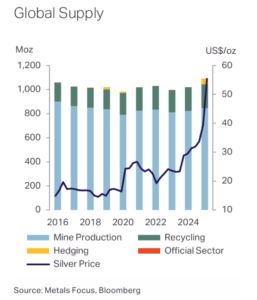
It was the fifth consecutive annual deficit. The Silver Institute and Metals Focus expect mine production to remain broadly flat in 2026, with the structural deficit widening to 46.3 million ounces.
The numbers point to a problem that cannot be solved simply by higher prices.
Silver production is unusually dependent on other metals. Roughly three-quarters of mine supply comes from byproduct production, meaning silver is recovered from mines primarily targeting copper, lead, zinc, or gold.
That limits how quickly the industry can respond when silver demand exceeds mine output.
For Sierra Madre, this creates a relevant backdrop. Rather than relying on a completely new mine to add future ounces, the company is expanding La Guitarra, an established Mexican operation, while advancing Del Toro, a past-producing silver complex.
The strategy highlights one potential part of the supply response: getting more production from assets that already have mining and processing infrastructure.
Silver Prices Can Rise Faster Than Mine Supply
The supply constraint is not simply a question of whether silver is valuable enough to mine. The industry needs time to translate higher prices into additional production.
The Silver Institute reported that the average silver price increased 42% in 2025, while mine production grew only 3%. Much of that mine-supply increase came from higher byproduct output from copper operations in Peru and the ramp-up of Polymetal JSC’s Prognoz mine in Russia.
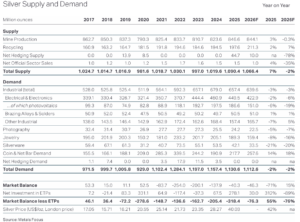
That relationship is important. A higher silver price can improve the economics of primary silver projects, but it does not automatically cause copper, lead, or zinc mines to increase production. Their output decisions are driven primarily by the economics of their main metals.
New primary silver mines face another hurdle: development timelines.
Exploration must lead to a resource, followed by engineering, permitting, financing, construction, and commissioning. Even after construction, a mine needs sufficient grades and throughput to sustain commercial production.
That makes existing operations and past-producing assets relevant to the near-term supply picture. Sierra Madre’s La Guitarra complex is an example of that model.
La Guitarra Shows the Brownfield Approach
The company restarted commercial production at La Guitarra in January 2025, using an existing 500-tonnes-per-day mill. The property is fully permitted and includes underground mining operations in Mexico’s historic Silver Belt.
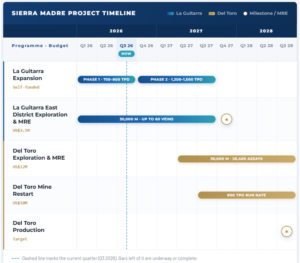
The company is now increasing capacity rather than building an entirely new processing operation. Its first expansion phase targets 750–800 tpd, while the second phase targets 1,200–1,500 tpd by Q3 2027.
The expansion is already moving beyond the original configuration.
Sierra Madre reported in August that modifications to the existing mill and larger-capacity pumps had lifted daily throughput to as much as 672 tpd, a 34% increase over the previous 500-tpd level.
The company subsequently announced on September 28 that the plant had achieved throughput of up to 720 tpd on a steady basis as development at the Guitarra and Nazareno mines accelerated.
Those figures represent progress at an existing mine rather than supply from a newly constructed greenfield operation.
Greg Liller, Chief Operating Officer and Executive Chairman, commented,
“We continue to advance our Phase 1 and Phase 2 expansions at Guitarra. With the new ball mill now installed, Sierra Madre has also accelerated underground development. We have started groundworks for the permitted dry stack tailings facility expansion, a key component of our Phase 2 plan to increase throughputs to 1,200 tpd to 1,500 tpd. We look forward to updating the market as we advance towards Phase 2 expansion.”
More Mill Capacity Requires More Mine Development
Expanding a processing plant is only one part of increasing silver supply. The mine must also deliver enough ore to keep that capacity utilized.
Sierra Madre is therefore advancing underground development alongside the mill expansion. Its recent work has focused on the Guitarra and Nazareno mines, with the company also developing the Coloso area.
The operating strategy is effectively being built from both ends: increase processing capacity while developing the underground workings needed to supply it. That distinction is important when assessing potential new supply.
A larger mill does not automatically mean proportionally more silver production. Actual output depends on ore availability, grades, recoveries, throughput, and operating performance.
For Sierra Madre, the objective is to turn existing infrastructure and underground resources into a larger operating base over time.
Del Toro Provides a Second Existing Asset
Sierra Madre is pursuing the same broad development philosophy with its second Mexican silver asset.
The company completed its acquisition of the Del Toro Silver Mine in Zacatecas on June 22, 2026, acquiring 100% of the operation from First Majestic Silver for consideration of up to US$60 million.
Del Toro is a past-producing underground silver-lead-zinc complex that First Majestic operated from 2013 to 2019. The property contains three underground mines, more than 62.5 kilometers of existing underground development and a 3,000-tpd processing facility.
Sierra Madre also describes Del Toro as fully permitted, with access to power, water, roads, and an experienced local workforce. Those existing assets do not make a restart automatic.
Del Toro is currently on care and maintenance, and Sierra Madre still needs to complete additional exploration, resource work, mine planning, and restart activities before production can resume. But the starting point is different from a greenfield project.
The company is working with an established mining complex rather than developing an entirely new operation and processing plant.
Historical Production Gives Del Toro a Starting Point
Del Toro also has an operating history that provides context for its potential. First Majestic operated the complex between 2013 and 2019. Sierra Madre’s acquisition materials cite historical production averaging approximately 2.54 million silver-equivalent ounces per year between 2015 and 2018.
Sierra Madre’s initial plan is to restart Del Toro at approximately 800 tpd, with potential to increase throughput to 1,600 tpd. The company has targeted the start of the restart process for mid-2027, with production currently slated for mid-2028. These are company targets and remain subject to the work required to restart the operation.
Sierra Madre’s approach also includes additional exploration and resource modelling. Del Toro has an exploration database containing 631 drill holes totaling more than 137,000 metres, according to the company.
That existing geological information could help guide future work, although any new resource estimate will need to be established through additional technical work.
Why the Supply Structure Matters
The persistent deficit makes this distinction increasingly relevant.
The 2025 market was short 40.3 million ounces even after recycling contributed nearly 198 million ounces of supply. The Silver Institute expects mine production to remain broadly flat in 2026, with the deficit potentially reaching 46.3 million ounces.
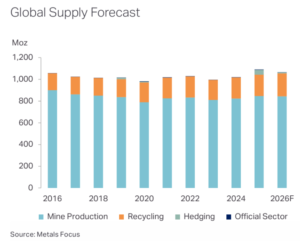
At the same time, the industry’s dependence on byproduct production means that higher silver prices cannot necessarily produce an immediate wave of new mine supply. That leaves several potential sources of additional ounces:
- Expansion of existing producing mines
- Restart of past-producing operations
- Development of advanced projects
- New greenfield discoveries
- Higher recycling
Each has different timelines and risks.
For the near term, established assets can potentially move through the development cycle faster than completely new discoveries because some of the required infrastructure and permitting framework may already exist.
La Guitarra and Del Toro fit into that category.
Sierra Madre Is Building Supply From Existing Assets
Sierra Madre is not large enough to change the global silver balance on its own. The significance of its strategy is different.
La Guitarra demonstrates how an existing mine can be restarted and expanded. Its processing capacity has moved from a historical 500 tpd configuration toward a planned 1,200–1,500 tpd operation, with throughput already reaching 720 tpd.
Del Toro provides another established asset, with three underground mines, more than 62.5 kilometers of development and a 3,000-tpd processing facility.
The broader silver market needs many such projects to advance if mine supply is to close the gap with demand. That is the central supply challenge.
Silver can move quickly in financial markets, but physical production moves much more slowly.
For Sierra Madre, the next stage is therefore about converting existing infrastructure into sustained additional output. For the wider market, the question is whether enough expansions, restarts and new projects can arrive quickly enough to narrow a deficit that has persisted for five consecutive years.
DISCLAIMER
New Era Publishing Inc. and/or CarbonCredits.com (“We” or “Us”) are not securities dealers or brokers, investment advisers, or financial advisers, and you should not rely on the information herein as investment advice. Sierra Madre Gold and Silver Ltd. (“Company”) made a one-time payment of $25,000 to provide marketing services for a term of one month. None of the owners, members, directors, or employees of New Era Publishing Inc. and/or CarbonCredits.com currently hold, or have any beneficial ownership in, any shares, stocks, or options of the companies mentioned.
This article is informational only and is solely for use by prospective investors in determining whether to seek additional information. It does not constitute an offer to sell or a solicitation of an offer to buy any securities. Examples that we provide of share price increases pertaining to a particular issuer from one referenced date to another represent arbitrarily chosen time periods and are no indication whatsoever of future stock prices for that issuer and are of no predictive value.
Our stock profiles are intended to highlight certain companies for your further investigation; they are not stock recommendations or an offer or sale of the referenced securities. The securities issued by the companies we profile should be considered high-risk; if you do invest despite these warnings, you may lose your entire investment. Please do your own research before investing, including reviewing the companies’ SEDAR+ and SEC filings, press releases, and risk disclosures.
It is our policy that information contained in this profile was provided by the company, extracted from SEDAR+ and SEC filings, company websites, and other publicly available sources. We believe the sources and information are accurate and reliable but we cannot guarantee them.
CAUTIONARY STATEMENT AND FORWARD-LOOKING INFORMATION
Certain statements contained in this news release may constitute “forward-looking information” within the meaning of applicable securities laws. Forward-looking information generally can be identified by words such as “anticipate,” “expect,” “estimate,” “forecast,” “plan,” and similar expressions suggesting future outcomes or events. Forward-looking information is based on current expectations of management; however, it is subject to known and unknown risks, uncertainties, and other factors that may cause actual results to differ materially from those anticipated.
These factors include, without limitation, statements relating to the Company’s exploration and development plans, the potential of its mineral projects, financing activities, regulatory approvals, market conditions, and future objectives. Forward-looking information involves numerous risks and uncertainties and actual results might differ materially from results suggested in any forward-looking information. These risks and uncertainties include, among other things, market volatility, the state of financial markets for the Company’s securities, fluctuations in commodity prices, operational challenges, and changes in business plans.
Forward-looking information is based on several key expectations and assumptions, including, without limitation, that the Company will continue with its stated business objectives and will be able to raise additional capital as required. Although management of the Company has attempted to identify important factors that could cause actual results to differ materially, there may be other factors that cause results not to be as anticipated, estimated, or intended.
There can be no assurance that such forward-looking information will prove to be accurate, as actual results and future events could differ materially. Accordingly, readers should not place undue reliance on forward-looking information. Additional information about risks and uncertainties is contained in the Company’s management’s discussion and analysis and annual information form for the year ended December 31, 2025, copies of which are available on SEDAR+ at www.sedarplus.ca.
The forward-looking information contained herein is expressly qualified in its entirety by this cautionary statement. Forward-looking information reflects management’s current beliefs and is based on information currently available to the Company. The forward-looking information is made as of the date of this news release, and the Company assumes no obligation to update or revise such information to reflect new events or circumstances except as may be required by applicable law.
For more information on the Company, investors should review the Company’s continuous disclosure filings available on SEDAR+ at www.sedarplus.ca.
Disclosure: Owners, members, directors, and employees of carboncredits.com have/may have stock or option positions in any of the companies mentioned: None.
Carboncredits.com receives compensation for this publication and has a business relationship with any company whose stock(s) is/are mentioned in this article.
Additional disclosure: This communication serves the sole purpose of adding value to the research process and is for information only. Please do your own due diligence. Every investment in securities mentioned in publications of carboncredits.com involves risks that could lead to a total loss of the invested capital.