


Energy Exploration Technologies, Inc or EnergyX, has signed a 10-year lithium supply agreement with global commodities trader Trafigura, securing a long-term buyer for products from its planned lithium projects in Chile and the United States.
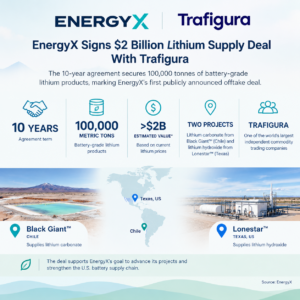
The binding agreement covers 100,000 metric tons of battery-grade lithium products. Based on current lithium prices of approximately $20,000 per metric ton, EnergyX estimates the contract could generate more than $2 billion in revenue over its 10-year term.
Announced on October 13, 2026, the deal marks EnergyX’s first publicly disclosed commercial offtake agreement. It also gives the company a potential source of long-term sales revenue as it seeks financing to develop its lithium production facilities.
The agreement comes as demand for lithium-ion batteries expands beyond electric vehicles (EVs) to include grid-scale energy storage. However, EnergyX must still complete project development, secure sufficient financing, and bring its facilities into commercial production before it can fulfill the contract.
EnergyX to Supply Lithium From Chile and Texas
Under the agreement, EnergyX will supply battery-grade lithium carbonate from Project Black Giant in Chile and lithium hydroxide from Project Lonestar in Texas.
The contract follows a take-or-pay structure, under which Trafigura commits to purchasing agreed volumes under the terms of the contract. The arrangement provides a commercial framework for future sales, although the estimated $2 billion value depends on lithium prices and the contract’s pricing terms.
Trafigura will purchase an average of 10,000 metric tons of lithium products annually over the contract period, according to Reuters. This includes 5,000 metric tons each of lithium carbonate and lithium hydroxide per year.
The agreement also allocates a significant share of the projects’ planned initial production to Trafigura.
- Project Black Giant, Chile: Trafigura will take 66% of the project’s Phase 1 output. EnergyX plans to produce 7,500 metric tons of lithium carbonate annually, with production targeted to begin in 2028.
- Project Lonestar, Texas: Trafigura will purchase 30% of Phase 1 output. EnergyX plans to produce 15,000 metric tons of lithium hydroxide annually in Texas, with commercial production targeted for 2029.
The company is pursuing additional offtake agreements as it works toward securing commitments for 80% of planned production. Such agreements can help developers demonstrate market demand and strengthen their case when approaching lenders and investors.
Here’s the infographic that explains the key highlights of the deal:
- CHECK: LIVE LITHIUM PRICES
$690 Million US EXIM Financing in Focus
The Trafigura agreement could support EnergyX’s efforts to secure financing for its commercial lithium projects.
EnergyX has received a $690 million letter of intent from the US Export-Import Bank (EXIM Bank) for potential debt financing associated with Project Black Giant. An offtake agreement can help lenders assess future sales prospects, although it does not guarantee loan approval or the release of funds.
Additionally, the company has also secured a $225 million strategic investment from Italian energy company Eni for Project Black Giant, according to its announcement.
Together, the commercial agreement and financing initiatives are intended to advance EnergyX’s plans to develop lithium production capacity in the Americas.
“Offtake agreements are among the most important steps in taking a lithium project from development to production,” said Teague Egan, Founder and CEO of EnergyX. “A long-term purchase commitment from a counterparty of Trafigura’s scale and credit quality shows that the market wants EnergyX’s product. It also gives lenders and investors the revenue visibility they need before committing capital to commercial construction.”
The agreement is an important commercial milestone, but EnergyX still needs to fund, build, and commission its planned facilities. The timing and scale of future production will therefore be important to its ability to meet the contract.
Lithium Demand Forecast Points to Long-Term Growth
The deal comes amid changing demand patterns in the global lithium market. EV batteries remain a major source of consumption, while battery storage systems are becoming an increasingly important source of demand.
The International Energy Agency’s (IEA) Global Critical Minerals Outlook 2026 projects that lithium demand will more than triple by 2040 under its Stated Policies Scenario. Electric vehicles, battery storage, renewable energy, and electricity networks are major drivers of demand for critical minerals.
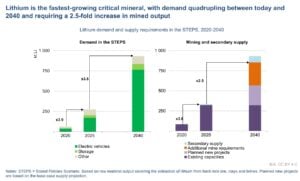
Battery storage is gaining importance as electricity grids accommodate more renewable power and data centers require additional electricity infrastructure.
- Reuters reported in January 2026 that lithium demand from energy storage was expected to rise by 55% during the year, following growth of 71% in 2025, based on UBS data.
The report also highlighted forecasts of a potentially tighter lithium market in 2026, although analysts differed on the expected balance between supply and demand.
These trends could support long-term demand for battery-grade lithium chemicals. However, the market remains sensitive to EV sales, battery technology changes, new production capacity, and fluctuations in lithium prices.
Global Lithium Supply and Processing Capacity
Despite the demand outlook, the lithium industry has faced periods of oversupply and falling prices as new production has outpaced consumption. The market’s future balance will depend on how quickly demand grows relative to mine output, refining capacity, and recycling.
The IEA’s 2026 outlook suggests that the supply outlook for lithium has improved compared with earlier assessments as more projects enter the development pipeline. However, it also highlights an ongoing challenge: mining and refining capacity do not always develop at the same pace.
This distinction matters because lithium extracted from brines or mined from hard-rock deposits must be processed into chemicals that meet battery manufacturers’ specifications. Producing battery-grade lithium consistently at commercial scale can be more demanding than producing lower-grade material.
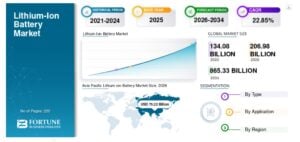
China remains central to this processing chain. Its established refining infrastructure gives it a major role in supplying lithium chemicals to battery manufacturers, while companies in the United States and other regions seek to develop alternative sources.
EnergyX aims to address part of this challenge through its direct lithium extraction (DLE) technology. The process is designed to extract lithium from brine without relying solely on conventional evaporation ponds. Its commercial performance will depend on factors such as recovery rates, operating costs, brine chemistry, and the ability to scale production reliably.
EnergyX Advances Direct Lithium Extraction Technology
Founded in 2018 by Teague Egan, EnergyX is developing lithium projects across North and South America. Its technology platform, GET-Lit, combines direct lithium extraction and refining processes intended to support lithium production from brine resources.
- The company commissioned its Project Lonestar demonstration facility in Texas in 2026. The facility is designed to test its extraction technology using locally sourced brine from the Smackover formation, which extends across parts of the southern United States.
- EnergyX is also advancing Project Black Giant in Chile, a planned 52,500-ton-per-year lithium project, according to the company’s announcement. Its other US operations include brine resources in Texas and Arkansas.
Commercial-scale production remains the next major step. Demonstration facilities can show whether a process works under operating conditions, but developers must still prove that the technology can deliver consistent output at the required scale and cost.
Daniel von Arx, Head of Battery Metals at Trafigura, said,
“We are pleased to support EnergyX as it develops its lithium projects in Chile and the US. Long-term offtake is an important step in moving projects into production, and this agreement reflects our ability to help bring strategic critical minerals projects online and build secure, diversified supply chains.
Drawing on our logistics network and market expertise, we look forward to supplying these battery-grade lithium products to customers, supporting supply chains for the US automotive and energy storage industries.”
What the Agreement Means for the Lithium Market
For EnergyX, the Trafigura deal provides a defined commercial route for future lithium production and may strengthen its efforts to secure project financing. For Trafigura, it offers access to planned lithium supplies from projects in two countries, with potential links to expanding battery and energy storage markets.
The agreement also reflects a broader effort to diversify lithium supply chains beyond established processing hubs. However, bringing new capacity online requires capital, reliable technology, regulatory approvals, and competitive production costs.
As battery demand expands, the market will need both additional lithium resources and enough processing capacity to convert them into battery-grade products. EnergyX’s progress will depend on whether it can translate its offtake commitment and technology development into commercially viable production.