


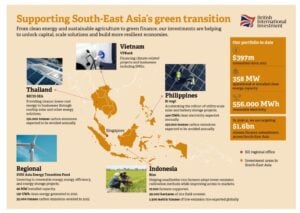
British International Investment (BII), the UK’s development finance institution, plans to commit $1.6 billion to climate finance in Southeast Asia over the next five years. The investment aims to help countries reduce their reliance on fossil fuels, expand renewable energy, and build more climate-resilient economies.
The announcement marks the fifth anniversary of BII’s Asian headquarters in Singapore. It also signals a bigger push to bring private investors into the region’s clean energy transition.
BII will invest in developing economies, including Vietnam, Indonesia, the Philippines, Malaysia and Thailand. These countries face growing energy demand and still rely on fossil fuels for a significant share of their electricity.
To support the transition, BII plans to combine its own funding with private investment. Of the $1.6 billion commitment, approximately $800 million will come from BII, while the remaining amount is expected to come from private investors.
The goal is to make more money available for renewable energy and other climate-related projects across the region.
BII Targets $1.6 Billion in Climate Finance
The new commitment builds on BII’s existing investments in Southeast Asia. Between 2023 and 2025, the institution committed nearly $400 million in climate finance in the region.
Now, it plans to scale up that investment over the next five years.
A significant share of the new funding will flow through British Climate Partners (BCP), a climate finance initiative launched by BII earlier this year. BCP focuses on fast-growing Asian economies with high carbon emissions, where investment can help cut pollution while supporting economic growth.
Moreover, BII plans to use its funding to attract private capital into projects that need substantial upfront investment. This approach could help renewable energy developers and infrastructure companies secure the financing needed to expand their operations.
The UK Foreign Secretary, Ed Miliband, said:
“The climate crisis is a national security issue that demands urgent attention. That is why this government has a world leading agenda on tackling the climate crisis at home and internationally.
“I am proud that BII, the UK’s development finance institution, is taking action to help countries across South-East Asia build cleaner, more resilient economies. BII is central to the UK’s efforts to unlock much more private investment to deliver on our climate and development goals.”
- FURTHER READING: How Standard Chartered’s €1 Billion Green Bond Is Scaling Climate Finance in Emerging Markets
Renewable Energy and Infrastructure Take Center Stage
BII will focus on sectors that can reduce emissions, improve energy access, and help countries prepare for climate risks.
Its investment priorities include:
- Renewable energy: Expanding clean electricity generation to reduce dependence on fossil fuels.
- Power transmission: Supporting infrastructure that moves electricity from power plants to homes and businesses.
- Electric vehicle infrastructure: Developing the infrastructure needed to support the shift toward electric transport.
- Waste management: Funding projects that improve waste treatment and resource recovery.
- Water infrastructure: Helping communities and businesses manage water-related climate risks.
Together, these investments are expected to add around 1.8 gigawatts (GW) of clean energy capacity and avoid nearly 1.7 million tonnes of carbon emissions.
BII has already backed several companies and funds working across the region’s clean energy sector.
These include renewable energy developer ib vogt, clean energy company Skye Renewables, and Indonesian solar company Xurya. BII has also invested in Vietnam-based lenders VPBank and HDBank, as well as the Asian Development Bank.
In addition, its fund investments include Pentagreen Capital’s Green Investment Partnership, Gresham House’s SUSI Asia Energy Transition Fund and 100×100 Impact Fund I.
- BII’s existing infrastructure and climate portfolio in Southeast Asia has supported approximately 358 megawatts (MW) of operational or installed clean energy capacity.
- The portfolio has also generated more than 556,000 megawatt-hours (MWh) of renewable electricity and reported around 368,000 tonnes of avoided carbon emissions.
These projects have also supported more than 2,000 direct, operational and temporary construction jobs. Therefore, the investment strategy aims to deliver economic benefits alongside emissions reductions.
BII’s Climate Strategy Extends Beyond Clean Energy
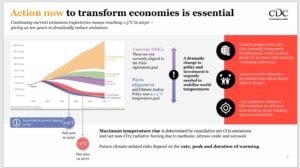
The $1.6 billion commitment also supports BII’s wider climate strategy, which aims to align its investments with the Paris Agreement.
The institution’s approach rests on three main priorities:
- Net zero by 2050: Support the shift to a low-carbon economy through investments that help reduce emissions over time.
- A just transition: Promote decent jobs and skills development as countries move away from fossil fuels.
- Climate adaptation and resilience: Help businesses, communities and essential infrastructure prepare for the effects of climate change.
BII has also pledged to direct at least 30% of its total new commitments toward climate finance over the next five years. Separately, it aims to bring its portfolio of more than 1,500 companies to net-zero emissions at the portfolio level by 2050 at the latest.
For Southeast Asia, these goals come at a time when countries need to expand electricity supplies while managing emissions and climate risks. Investment in renewable power, electricity networks and supporting infrastructure will be important to meeting that challenge.
Leslie Maasdorp, Chief Executive Officer of BII, said:
“Our singular focus for the South-East Asia region is to fund climate finance projects that will contribute to the region’s clean and sustainable economic future. The global challenge of the climate emergency knows no borders. That’s why we are committed to powering economic growth in the region, while driving emissions down and delivering a return for the UK taxpayer.”
Srini Nagarajan, Managing Director and Head of Asia at BII, added:
“BII has established itself in South-East Asia as a provider of capital focused on accelerating the development of key climate finance projects in the region. The next five years will see us commit a significantly greater level of capital to widen the pipeline of climate finance opportunities and turbocharge the pace of the green transition.”
Southeast Asia’s Renewable Energy Capacity Set to Surge 3x by 2035
Southeast Asia’s renewable energy market is poised for rapid growth as electricity demand rises. According to the International Energy Agency (IEA), the region had 120 gigawatts (GW) of renewable energy capacity in 2024. Under current policies, capacity could nearly triple by 2035, while meeting announced targets could increase it fivefold.
The IEA also projects that:
- Rising electricity demand: Electricity demand could increase by around 70% by 2035 from 2024 levels under the announced pledges scenario.
- Solar and wind growth: Solar generation could exceed 450 terawatt-hours (TWh) by 2035, while wind generation could surpass 270 TWh.
- Cleaner power mix: Low-emissions sources could supply just over 50% of Southeast Asia’s electricity generation by 2035 if governments meet their announced pledges.
- Grid investment: Annual investment in electricity grids and storage would need to reach $50 billion by 2050, up from around $13 billion today, under the same scenario.
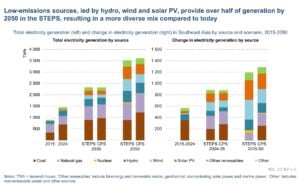
However, achieving these targets will require more funding for renewable energy projects, electricity networks and energy storage. This creates opportunities for development finance institutions such as BII to attract private capital and support the region’s clean energy transition.
Can BII’s Investment Attract More Private Capital?
BII’s $1.6 billion commitment aims to do more than fund individual climate projects. By mobilizing a similar amount from private investors, the institution hopes to increase the capital available for Southeast Asia’s energy transition.
However, the results will depend on how quickly the funding reaches projects, how much private investment it attracts and how effectively those investments reduce emissions.
If successful, the initiative could help expand clean energy capacity, improve infrastructure and create jobs while supporting economic growth across Southeast Asia.
For climate investors, the commitment also highlights the growing role of development finance institutions in funding the transition to cleaner energy in emerging markets.