

Singapore and Laos have signed a new agreement to collaborate on carbon credits under Article 6 of the Paris Agreement, creating a legal framework for the development and international transfer of high-integrity carbon credits.
As per reports, the Implementation Agreement was signed virtually on September 4 by Singapore’s Minister for Sustainability and the Environment and Minister in charge of Trade Relations, Grace Fu, and Lao PDR’s Minister of Agriculture and Environment, Dr. Linkham Douangsavanh.
The deal marks Singapore’s 12th bilateral Implementation Agreement on carbon credits and its fourth with an ASEAN member state.
The agreement could help channel new carbon finance into emissions-reduction projects in Laos while giving Singapore access to additional high-quality carbon credits.
Grace Fu further noted,
“Singapore and Lao PDR share a strong and longstanding partnership. As fellow ASEAN Member States, we are committed
to working together on regional and bilateral initiatives. The signing of the Implementation Agreement is an important milestone in our bilateral partnership and unlocks new opportunities in carbon markets for businesses and local communities. By working together, ASEAN can lead the way in building a low-carbon future that delivers tangible benefits across the region.”
Singapore and Laos Build Article 6 Carbon Market Framework
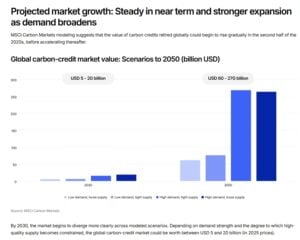
Carbon markets are becoming a central tool in global climate policy despite ongoing concerns over credit quality and transparency. As per MSCI, the global carbon-credit market is projected to grow modestly by 2030, reaching USD 5–20 billion, but could expand sharply by 2050 to USD 60–270 billion as demand strengthens and high-quality supply becomes more constrained.
The image below explains the growth in detail:
This agreement establishes a legally binding framework for carbon mitigation projects that comply with the Article 6 rulebook.
Under the framework, project developers in Laos can develop eligible emissions-reduction projects and seek authorization to transfer their carbon credits internationally.
The credits must undergo corresponding adjustments before they can be transferred for eligible international uses. This mechanism is designed to prevent the same emissions reduction from being counted toward both countries’ climate targets.
Singapore and Laos will set out the procedures for project authorization and corresponding adjustments. Singapore will publish details on eligible carbon-crediting methodologies and the authorization process through its Article 6 platform.
The framework therefore provides project developers with a clearer path to participate in the growing international carbon market.
- READ MORE: Singapore and World Bank Launch New Carbon Markets Programme to Scale High-Integrity Climate Finance
Carbon Finance to Support Laos’ Climate Goals
Beyond creating a carbon trading framework, the agreement is designed to direct climate finance toward emissions-reduction opportunities in Lao PDR.
- Singapore has committed to channel 5% of the proceeds from authorized carbon credits under the agreement toward climate adaptation measures in Laos.
- The agreement also includes a separate contribution toward global emissions reduction. Singapore will cancel 2% of the correspondingly adjusted carbon credits at first issuance.
These cancelled credits cannot be sold, traded, or counted toward the emissions targets of any country. Together, these provisions are intended to ensure that the carbon market generates benefits beyond the sale and transfer of credits.
Projects authorized under the agreement are also expected to support sustainable development in Laos, including job creation and reductions in environmental pollution.
Singapore Expands Its International Carbon Market Strategy
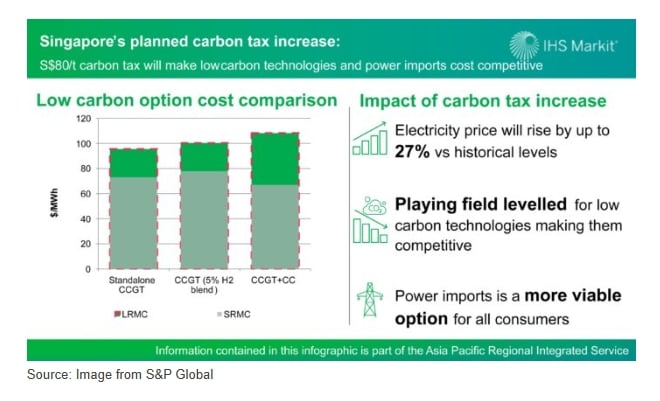
The agreement fits into Singapore’s broader strategy of using international carbon markets alongside domestic climate policies. Notably, the country introduced Southeast Asia’s first national carbon tax in 2019. The tax applies to large industrial facilities emitting at least 25,000 tonnes of greenhouse gases annually.
The country is also raising its carbon price. Singapore’s carbon tax is set to increase from S$25 per tonne currently to S$50-S$80 per tonne by 2030.
To help companies manage some of the cost, Singapore allows covered facilities to use eligible international carbon credits to offset up to 5% of their taxable emissions under its International Carbon Credits framework.
As a result, access to high-quality international credits is becoming increasingly important for companies operating under Singapore’s carbon pricing system.
Singapore Expands Article 6 Partnerships
The partnership also strengthens Singapore’s position as a regional hub for carbon trading and climate finance. The city-state already hosts major carbon market and climate finance businesses, including Climate Impact X.
More broadly, the agreement shows how Article 6 is moving from an international rulebook toward practical bilateral carbon market arrangements.
- Singapore has now signed similar Implementation Agreements with Bhutan, Chile, Ghana, Mongolia, Paraguay, Papua New Guinea, Peru, Rwanda, Thailand, the Philippines, and Vietnam.
Why the Laos Deal Matters for the Carbon Market
The agreement gives Laos a new pathway to attract international climate finance for emissions-reduction and sustainable development projects. At the same time, it expands Singapore’s pipeline of high-integrity carbon credits and strengthens its role as a regional hub for carbon trading and climate finance.
More importantly, the deal shows how Article 6 is moving from global rules into practical bilateral carbon market partnerships. With 12 implementation agreements now signed, including four with ASEAN member states, Singapore is building a network that could support greater cross-border investment in climate action while helping countries meet their emissions goals.