

Carbon credit prices have been under pressure for several years, but the long-term outlook for the voluntary carbon market (VCM) could be very different.
Patch’s A Buyer’s Guide to Carbon Credits points to a potential turning point. The report argues that demand for high-quality carbon credits could eventually outpace available supply, creating upward pressure on prices as companies move closer to net-zero targets.
The market has already experienced a major correction. But the forces that could drive the next phase are beginning to look different.
For buyers, the question may soon shift from how cheaply they can purchase carbon credits to whether they can secure enough high-quality credits at all.
Why Carbon Credit Prices Collapsed After the VCM Boom
The voluntary carbon market experienced explosive growth in 2021. According to Patch, the market quadrupled year over year that year, reaching about $2 billion. At the time, forecasts suggested the VCM could grow to between $10 billion and $40 billion by 2030.
Instead, demand weakened sharply.
- Carbon credit purchases and retirements fell to around 155 million credits in 2022 from 161 million in 2021, a decline of roughly 4%.
Unlocking the Triggers
Concerns over credit quality were a major factor. High-profile investigations into some Verra REDD+ projects raised questions about whether certain credits delivered the climate benefits claimed by project developers.
The collapse of the crypto market added another layer of pressure. Crypto investors had poured significant capital into carbon credits during the market’s boom, and their retreat contributed to weaker demand.
Nature-based credits were especially vulnerable. Patch noted that the supply of REDD+ credits fell by 32%, yet buyers remained hesitant. Average prices for nature-based credits subsequently dropped below $2.
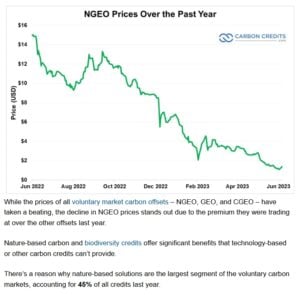
Note: In this market, three primary types of offsets are traded – NGEO, GEO (General Emissions Offsets), and CGEO (Certified Global Emissions Offsets).
The correction exposed a fundamental weakness in the VCM. Much of the demand was behavioral and highly sensitive to price, market sentiment, and concerns over corporate climate claims.
But Patch argues that this is unlikely to define the market forever.
- FIND: LIVE CARBON PRICES
Carbon Credit Supply Could Fall Behind Future Demand
One of the most important findings in Patch’s report is the growing gap between investment in future carbon-credit supply and current market sales.
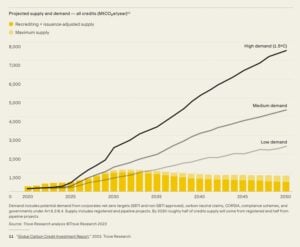
The report cites Trove Research, which estimated that capital investment in carbon-credit projects was about five times greater than overall carbon-credit sales.
In 2022, the primary market, based on retired credits, was worth approximately $1.5 billion. Capital investment in projects, meanwhile, reached around $7.5 billion.
That imbalance is significant.
It suggests that investors and project developers were committing substantial capital to creating future carbon-credit supply despite relatively weak demand at the time.
The bigger question is whether that future supply will be enough.
Patch cited Trove Research projections showing that demand could exceed supply by 2030 even under lower-demand scenarios. Under a pathway consistent with limiting warming to 1.5°C, the imbalance could emerge earlier.
This could create a very different market environment from the one that produced today’s low prices.
If demand accelerates faster than new projects can deliver credible credits, buyers could find themselves competing for a limited supply.
Carbon Credit Demand Could Become Less Price-Sensitive
Patch separates carbon-credit demand into two broad categories: behavioral demand and fundamental demand.
Behavioral demand tends to respond quickly to market conditions. Companies may reduce purchases when credit prices rise, economic conditions deteriorate, or concerns about the credibility of offsets increase.
Fundamental demand is more structural.
It comes from companies that have made public climate commitments and eventually need to address emissions that cannot be eliminated through internal reductions alone.
That distinction could become increasingly important as corporate net-zero deadlines approach.
The cost of eliminating the final portion of emissions can be considerably higher than reducing emissions through easier efficiency or clean-energy measures. This is particularly relevant for difficult-to-abate sectors such as aviation, shipping and heavy industry.
As a result, carbon credits could become less discretionary.
Could Carbon Credit Prices Reach $150 by 2035?
Companies may eventually have fewer options for addressing residual emissions, making their demand less sensitive to price.
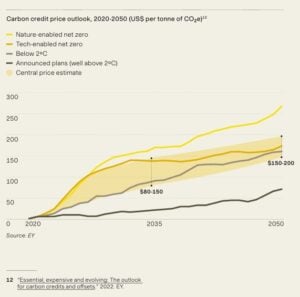
Patch cited EY Net Zero Centre projections that put carbon prices between $80 and $150 by 2035 across different climate scenarios.
That is far above the prices currently seen across much of the voluntary market.
The key point is not that every carbon credit will reach those levels. Rather, it illustrates how dramatically prices could change if structural climate demand begins to outweigh short-term buyer sentiment.
High-Quality Carbon Credits Are Already Commanding a Premium
Recent data from Sylvera offers an important update to Patch’s longer-term outlook.
The latest figures suggest that buyers are already becoming more selective about where they spend their carbon budgets.
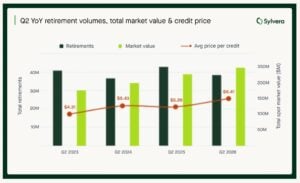
- In Q2 2026, carbon credit retirements reached 38.55 million, down 10% from the same quarter a year earlier. First-half retirements stood at 89.27 million, also below the previous year’s level.
On the surface, declining retirement volumes could suggest that demand remains weak.
However, pricing tells a more complicated story.
- MUST READ: Carbon Credit Prices Reward Quality More Than Ever, but MIT Study Questions Market Pricing
Buyers Are Shifting Toward Better Credits
Sylvera’s Q1 2026 data showed that average carbon credit prices increased to $5.69 from $5.60 despite an 8% decline in retirement volumes. Investment-grade BBB+ credits commanded an average price of $20.10, up from $18.10.
The pattern is important because it shows that the market is not moving uniformly.
Buyers may be purchasing fewer credits overall while allocating more money toward credits they consider higher quality.
Sylvera’s 2025 data reinforces the trend. Carbon credit retirements declined 4.5% to 168 million, but the market’s total value increased 6% to $1.04 billion.
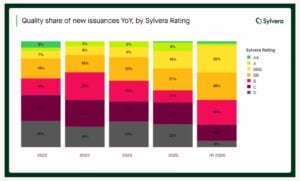
High-quality BB+ credits also increased their share of retirements from 44% to 50% and accounted for 70% of total spending.
The market is therefore becoming increasingly differentiated.
Lower-quality or oversupplied credits can remain cheap, while scarce credits that meet stronger integrity expectations can command substantial premiums.
Why Buyers May Need to Lock In Carbon Credits Early
Patch’s analysis makes a strong case for buyers to think beyond today’s spot prices.
Long-term carbon-credit purchase agreements can provide companies with greater certainty around future volumes and pricing. At the same time, they give project developers the revenue visibility needed to secure financing and expand their operations.
This could be particularly important for carbon removal.
New removal projects often require significant upfront investment and can take years to develop. If corporate demand accelerates before enough projects reach commercial scale, buyers could face a shortage of available supply.
Early purchasing can therefore serve two purposes.
It can protect buyers from potential future price increases while also helping developers build the supply needed to meet future demand.
However, locking in supply does not mean simply buying the cheapest credits available.
The market’s experience over the past several years has demonstrated why quality matters. Questions around additionality, permanence, measurement, verification, and project-level risks can significantly affect the long-term value of a credit.
The objective should be to secure credible supply at a price that remains attractive against potentially higher future costs.
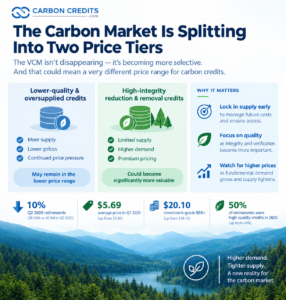
The Carbon Market Is Splitting Into Two Price Tiers
Patch’s report was produced during a period when the VCM was dealing with a major credibility and demand crisis. The latest market data suggests that the market is not disappearing. Instead, it is becoming more selective.
Overall demand remains uneven, but spending is increasingly concentrated in higher-quality credits.
That could eventually produce a two-tier market.
Lower-quality and oversupplied credits could continue trading at relatively low prices. Meanwhile, high-integrity reduction and removal credits could become increasingly expensive as buyers compete for limited supply.
This distinction is critical for companies planning long-term climate strategies.
Patch’s central argument remains compelling: companies that wait until carbon-credit demand becomes urgent could face tighter availability and higher prices.
Those that secure credible long-term supply earlier may have greater control over both cost and access.
The voluntary carbon market has already shown how quickly prices and buyer sentiment can change.
The next major shift could come from the opposite direction. As corporate climate commitments become more difficult to defer and emissions reductions become increasingly expensive at the margin, fundamental demand could begin to dominate behavioral demand.
The bottom line is, if that happens, the biggest risk for carbon-credit buyers may no longer be paying too much.
It could be not having enough high-quality credits to buy.