


The voluntary carbon market (VCM) shows mixed signals in 2026. Fewer carbon credits are being retired and issued compared to last year. However, buyers are paying more for the credits they choose. Higher-quality projects are earning larger price premiums, indicating a more selective market.
A new study from MIT Sloan School of Management highlights a key challenge. It reveals that carbon credit prices are influenced more by who buys the credits than by their actual climate impact.
Sylvera’s Carbon Market Data Snapshot Q2 2026 and the MIT study reflect a market improving in quality but needing better transparency and efficient pricing.
Carbon Credit Volumes Drop While Market Value Grows
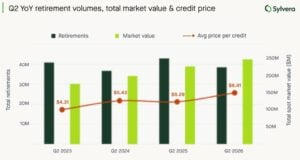
According to Sylvera, carbon credit retirements reached 38.55 million in Q2 2026, a 10% drop from 42.9 million in the same quarter of 2025. In the first half of the year, retirements totaled 89.27 million credits, down 9% from 98.27 million in H1 2025.
Despite fewer credits, market value increased. The total value of retired credits reached $247 million in Q2 2026, up from $227 million a year earlier. For the first half of 2026, retirement value rose to $548 million, compared to $524.2 million in H1 2025.
This trend shows buyers are purchasing fewer credits but paying higher prices.
- The average retirement price climbed to $6.41 per credit in Q2 2026, up from $5.29 in Q2 2025. Over the first six months, the average price rose to $6.13, compared to $5.33 a year earlier.
Higher-Quality Credits Continue to Command Premium Prices
Sylvera’s data indicates buyers value independently rated, high-quality carbon credits more highly.
Credits rated BBB or higher made up only 27% of rated retirement volume in Q2 2026 but generated 51% of the rated market value. This shows buyers are willing to pay more for projects with stronger quality ratings.
The premium is especially evident in Afforestation, Reforestation, and Revegetation (ARR) projects. BBB+ rated ARR credits averaged $28.55 during H1 2026, compared to $9.12 for lower-rated ARR credits.
Improved Forest Management (IFM)
IFM projects also experienced a growing quality gap. BBB+ IFM credits rose from $16.34 to $18.65, while lower-rated IFM credits fell from $15.02 to $13.06, widening the premium to $5.59.
REDD+ Projects
They also followed a similar trend. Higher-rated REDD+ credits climbed 71% year over year to $8.40, while lower-rated credits dropped 26% to $1.82. The price difference between high- and low-quality REDD+ projects expanded from $2.47 to $6.58, showing buyers are becoming more selective.
The quality of newly issued credits is also improving. Investment-grade issuances rose from 13- 16% between 2022 and 2024 to 25% in 2025 and 29% in the first half of the year. Meanwhile, the share of the lowest-rated C and D credits dropped sharply from 43% to 22%, indicating stronger project development.
MIT Study Questions How Carbon Credits Are Priced
While Sylvera’s report suggests quality is gaining importance, the MIT study argues that buyer identity is the main driver of carbon credit prices.
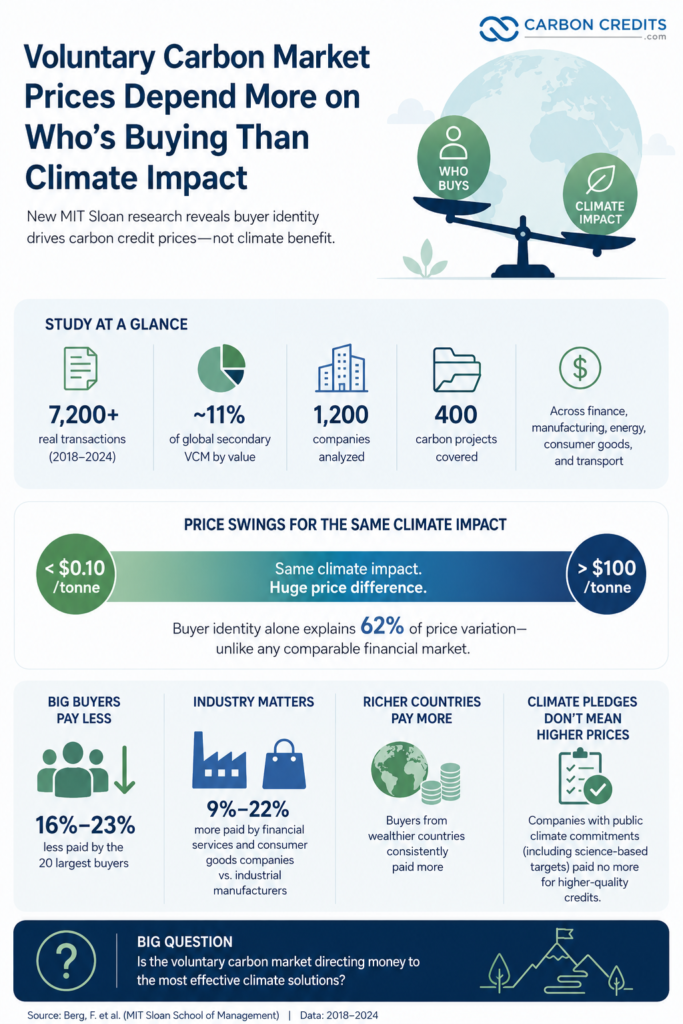
Researchers analyzed over 7,200 voluntary carbon market transactions from 2018 to 2024, covering about 11% of the global secondary market by value. The study included purchases by 1,200 companies across 400 carbon projects.
Instead of acting like a typical commodity market, where similar products have similar prices, the researchers found huge price differences. Credits with the same emissions reductions sold for a few cents to over $100 per tonne.
The study found that buyer identity explained 62% of the price variation.
- The top 20 buyers paid 16% to 23% less than others, while financial services and consumer goods companies typically paid 9% to 22% more than industrial manufacturers. Companies in wealthier countries also consistently paid higher prices.
Surprisingly, companies with public climate commitments—including science-based targets—did not always pay more for higher-quality credits.
The researchers also noted that some lower-rated project types, like forest protection and cookstove projects, often sold for 2 or 4x more than industrial efficiency and waste management projects, which many consider more reliable for emissions reductions.
MIT researchers argue that the market needs better transparency, including public price benchmarks, to ensure funding goes to projects that provide the greatest climate benefits.
The summary of the MIT study is in the infographic below:
MSCI Carbon Credit Prices Analysis
MSCI’s latest carbon market analysis shows the voluntary carbon market (VCM) is becoming increasingly selective. While overall carbon credit prices remain relatively low, buyers are paying significantly more for credits with stronger quality ratings, creating a widening gap between premium and lower-quality projects.
Key Takeaways
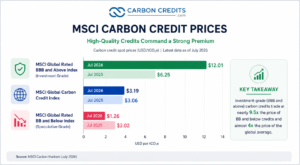
- MSCI Global Carbon Credit Price Index averaged $3.5/tCO₂e in 2025, reflecting continued weakness in the broader market.
- In contrast, the MSCI Rated BBB and Above Index rose from $5.6 to $6.8/tCO₂e, an increase of more than 20%, showing buyers are increasingly willing to pay for higher-integrity credits.
- The price gap between high-quality (BBB+) and lower-quality (BB and below) credits widened significantly. The average spread increased from $2.9 in 2024 to $5.1 in 2025 and exceeded $7/tCO₂e by the end of the year—equivalent to roughly a 360% premium for higher-quality credits.
Rewarding Quality Over Volume
MSCI expects this quality-focused trend to continue as voluntary carbon markets mature. The firm projects the market could grow from roughly $1.4 billion today to $5–20 billion by 2030, and eventually reach $60–270 billion by 2050, if demand for credible, high-integrity carbon credits continues to strengthen.
The Bottom Line: Sylvera, MSCI, and MIT Offer Three Views of Carbon Credit Pricing
Insights from Sylvera, MSCI, and MIT show both progress and challenges in today’s voluntary carbon market. Sylvera’s data reveals that buyers are investing more in higher-quality carbon credits. Investment-grade projects are increasing their market share, even with lower trading volumes.
MSCI’s carbon credit indexes support this, showing that BBB-rated and higher credits trade at a notable premium compared to lower-rated ones. This indicates a growing demand for projects with better environmental integrity.
However, MIT’s research reveals the market is not fully efficient. The study found that carbon credit prices depend more on buyer traits, like company size, industry, and location, rather than just climate performance. So, while quality is becoming important for pricing, it isn’t the main factor yet.
These findings show the voluntary carbon market is improving, but there’s more to do. To align prices with real climate impact, we should increase price transparency. We also need to expand independent quality ratings and use standardized pricing benchmarks. This approach would build market confidence and direct more funds to projects with the greatest environmental benefits.