

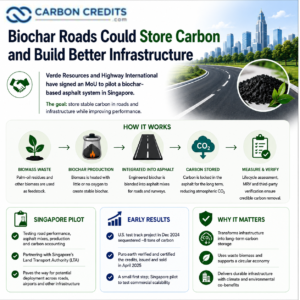
U.S. biochar company Verde Resources and Singapore asphalt producer Highway International have signed a memorandum of understanding (MoU) to test a biochar-based system for roads and other infrastructure.
The companies plan to start a pilot in Singapore to test road performance, asphalt mixes, production, and carbon accounting. The project will also test how the system could work on a larger scale.
The partnership could create a new market for biochar carbon removal by storing stable carbon inside roads, airfield pavements, and other long-lasting infrastructure. Yet, the project remains in the testing stage. The companies must first prove that the material works and that they can measure and verify the carbon stored in finished roads.
Singapore Roads Become a Carbon Removal Test Bed
Verde and Highway plan to work on an initial pilot with Singapore’s Land Transport Authority (LTA). The pilot will test technical performance, pavement mixes, production readiness and the system for measuring stored carbon. It will also test the project’s monitoring, reporting and verification (MRV) process.
If the pilot succeeds and LTA approves the approach, the companies plan to discuss a wider licensing deal. Highway could become Verde’s Singapore licensee for its Net Zero Blueprint. The planned use could cover roads, airport runways and other infrastructure.
However, the MoU does not guarantee commercial rollout. The companies still need successful testing, LTA approval, regulatory approvals, due diligence and final commercial agreements.
How Biochar Could Store Carbon in Roads
Biochar is made by heating biomass with little oxygen. The process creates a stable form of carbon that can remain stored for a long time.
Verde plans to use biomass waste, including palm-oil residues, to make engineered biochar for asphalt. Instead of allowing the carbon in the biomass to return to the atmosphere through decay, the company wants to lock it into road materials.
The idea turns infrastructure into a potential carbon storage site.
Verde’s system combines engineered biochar with asphalt technology and carbon accounting. It also includes lifecycle assessment (LCA), environmental product declarations (EPDs), and digital project-data tracking.
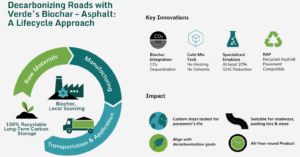
The actual amount of carbon stored will vary by project. Developers must also count emissions from making, transporting, and processing the biochar when calculating the net removal.
Verde Has Early Carbon Removal Results
The Singapore pilot builds on earlier testing in the United States. In December 2024, Verde and C-Twelve tested cold-mix biochar asphalt at the National Center for Asphalt Technology (NCAT) test track in Auburn, Alabama.
Verde’s latest SEC filing says the test sequestered about 8 tons of carbon. Puro.earth verified and certified the related carbon removal credits, which Verde says it issued and sold in April 2025. Verde describes the project as the world’s first to generate carbon removal credits from asphalt production and installation.
The volume was small, however. The Singapore pilot will test whether the method can move from a demonstration to larger commercial projects.
Isometric Adds Another Verification Route
Verde is also working with Isometric to develop a carbon credit pathway for its engineered biochar. The companies announced their collaboration in April 2026. Isometric says its biochar protocol includes lifecycle accounting, feedstock rules, and durability measurements, including uses such as asphalt.
Verde is therefore working with more than one carbon market platform. Its SEC filing says Puro.earth has registered Verde as a carbon removal credit supplier. The company is also working with Isometric on certification and verification.
Strong carbon accounting will remain important. A road can generate credible removal credits only if developers can prove how much carbon the biochar stores and how long that carbon stays locked away.
Biochar Supply Will Matter at Scale
Commercial growth will require a steady supply of qualifying biochar. In March 2026, Verde signed a supply agreement with Biochar Solutions LLC for up to 38,500 U.S. tons of engineered biochar per year.
At least 50% of that supply must qualify for carbon removal credit generation. The agreement also covers revenue sharing from credits generated when the biochar goes into Verde’s products.
The deal shows that Verde is preparing for larger production. But the Singapore pilot will still need to prove that biochar can meet road performance standards while keeping its carbon storage benefits.
Global Biochar Market Gains Momentum
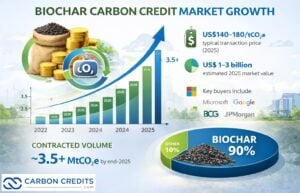
The global biochar market is growing as demand for durable carbon removal increases. The American Biochar Institute found that the U.S. biochar industry reached about $157 million in 2025, nearly three times its 2023 value of $52 million. U.S. production topped 97,000 metric tonnes, while installed capacity exceeded 400,000 tonnes a year.
Globally, biochar supplied more than 90% of durable carbon removal credits delivered in 2025, according to CDR.fyi. Strong corporate demand and new production projects are helping the sector expand, while buyers increasingly seek credits backed by clear carbon accounting and durable storage.
SEE MORE: U.S. Biochar Industry Triples to $157 Million as Carbon Removal Market Sparks Record Growth
Why Singapore Is a Strategic Test Market
Singapore provides a useful test market because it has a large infrastructure system but limited land for renewable energy projects. The country aims to reach net-zero emissions by 2050. It also targets emissions of 45 million to 50 million tonnes of CO2e by 2035, compared with about 60 million tonnes in 2030.
Singapore is using several tools to cut emissions, including a carbon tax and international carbon markets. Its carbon tax rose to S$45 per tonne in 2026 and 2027, with a target of S$50 to S$80 per tonne by 2030. Covered facilities can use eligible international carbon credits to offset up to 5% of taxable emissions.
That does not mean Verde’s road credits automatically qualify for Singapore’s compliance market. They would need to meet the country’s rules on Article 6, additionality, and double counting.
For now, the project should be viewed as a carbon removal development rather than an approved Singapore compliance credit program.
Credit Quality Must Keep Pace With the Technology
The carbon market side is just as important as road performance. Verde’s earlier NCAT test produced about 8 tons of verified carbon removal, but that result does not prove every future road project will achieve the same level of storage.
The Singapore pilot will help answer those questions. Developers will need to measure the amount of biochar used, its carbon content, emissions from production and transport, and the carbon that remains stored in the finished road.
That makes the LCA and MRV systems especially important. A road product can create a new carbon-removal market only if independent systems can confirm the actual net removal.
Could Roads Become the Next Carbon Sink?
The Verde-Highway MoU brings biochar and road construction into the same carbon removal strategy. The pilot will test whether engineered biochar can meet road standards while storing carbon in long-lived infrastructure. It will also test how developers can measure and verify those removals.
The project remains at an early stage. The MoU does not guarantee a final licensing deal or a specific volume of carbon removals from Singapore.
Still, Verde already has an early U.S. demonstration, a 38,500-ton annual biochar supply agreement, an Isometric partnership and a Singapore subsidiary focused on regional growth.
If the Singapore pilot succeeds, roads could become a new application for durable biochar carbon removal. For the biochar market, the key question is whether carbon stored in everyday infrastructure can become measurable, verifiable, and scalable enough to support a new class of carbon removal credits.