

Carbon credits can come from many different types of projects, but they all have one basic purpose: to reduce greenhouse gas emissions or remove carbon dioxide (CO₂) from the atmosphere.
A single carbon credit generally represents one metric ton of CO₂ equivalent (tCO₂e) reduced or removed by a project. For example, a project that captures methane from a landfill may generate credits by preventing that methane from entering the atmosphere. A reforestation project can generate credits by storing additional carbon in growing trees.
The voluntary carbon market (VCM) supports projects across energy, waste, agriculture, forestry, and carbon-removal technologies. Verra’s Verified Carbon Standard (VCS), one of the major carbon crediting programs, currently recognizes project activities across 18 sectoral scopes, ranging from energy and waste to agriculture, forestry, geological carbon storage, engineered removals, and marine resources.
But not all carbon projects work in the same way. The most important distinction is between emissions reduction projects and carbon removal projects.
Emissions Reduction and Avoidance Projects
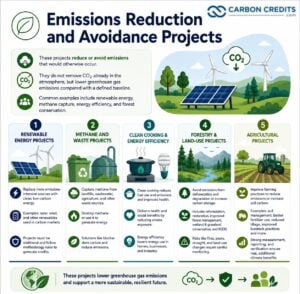
Many carbon credits come from projects that reduce or avoid emissions that would otherwise occur.
These projects do not necessarily remove CO₂ that is already in the atmosphere. Instead, they reduce the amount of greenhouse gases released compared with a defined baseline.
Common examples include renewable energy, methane capture, energy efficiency, and forest conservation.
Renewable Energy Projects
Renewable energy projects can generate carbon credits when they replace more emissions-intensive sources of electricity or energy.
Solar, wind, and some other renewable energy projects have historically been used in carbon markets. The basic idea is that generating electricity from a low-carbon source can reduce emissions compared with a higher-emitting alternative.
However, whether a renewable energy project can generate credits depends on the applicable methodology and whether the emissions reduction is considered additional. In other words, the project must meet the relevant rules for demonstrating that the carbon market incentive contributes to the claimed climate benefit.
Methane and Waste Projects
Waste projects are another important source of carbon credits. Landfills, wastewater treatment facilities, agriculture, and other waste-related activities can release methane, a powerful greenhouse gas. Projects can capture methane and either destroy it or use it to generate energy.
Other waste projects can also generate credits by changing how organic waste is treated. Biochar, for example, can be produced from biomass and used in ways that store carbon while also potentially reducing emissions from conventional waste management.
Carbon crediting programs such as Verra include waste handling and disposal among their recognized project categories.
Clean Cooking and Energy Efficiency
Carbon credits can also support technologies that reduce energy use or replace more polluting fuels. Clean cooking projects are one example. Improved cooking technologies can reduce the amount of fuel needed and, depending on the technology and methodology, reduce greenhouse gas emissions.
These projects can also produce health and social benefits by reducing household exposure to harmful cooking smoke.
Clean cooking remains an important carbon market project type. In 2025, the Integrity Council for the Voluntary Carbon Market (ICVCM) confirmed that several Gold Standard clean cooking methodologies were eligible under its Core Carbon Principles (CCP), reflecting the continued role of the sector in the voluntary market.
Other energy efficiency projects can include more efficient lighting, heating, appliances, and industrial processes. The Gold Standard, for example, recognizes renewable energy and end-use energy efficiency projects among its eligible activities.
Forestry and Land-Use Projects
Forestry and land-use projects are among the best-known categories in the carbon market. These projects can either avoid emissions or remove and store carbon.
Forest conservation projects, including REDD-related activities, aim to reduce emissions associated with deforestation and forest degradation. Other projects focus on planting trees, restoring forests, improving forest management, or protecting wetlands.
Verra’s Agriculture, Forestry and Other Land Use (AFOLU) category includes afforestation, reforestation and revegetation, agricultural land management, improved forest management, REDD, grassland conservation, and wetland restoration.
The climate benefit comes from either preventing carbon that is already stored in ecosystems from being released or increasing the amount of carbon stored in vegetation, soils, or other natural systems.
However, these projects also face risks that can affect the durability of their carbon benefits. Forests can be damaged by wildfire, pests, drought, storms, or future changes in land use. This makes careful monitoring and appropriate accounting especially important.
Agricultural Projects
Agriculture can generate carbon credits through changes in farming practices that reduce emissions or increase carbon storage.
Examples include improved soil management, changes in fertilizer use, better water management, reduced tillage, improved livestock practices, and other techniques that can lower greenhouse gas emissions or increase soil carbon.
Agricultural projects can be more complex to measure because carbon levels can vary across fields and over time. As a result, strong measurement, reporting, and verification systems are important for determining how much additional climate benefit a project actually creates.
Agriculture is a recognized carbon project category under major standards, including Verra’s VCS.
Carbon Removal Projects
The second major category is carbon removal. Unlike an emissions-reduction project, a carbon removal project takes CO₂ from the atmosphere and stores it in a carbon reservoir.
There are several ways to achieve this, ranging from natural approaches such as reforestation to engineered technologies such as direct air capture.
Reforestation and Other Natural Removals
Trees and plants naturally absorb CO₂ as they grow. Reforestation, afforestation, improved forest management, and some agricultural practices can therefore remove carbon from the atmosphere and store it in biomass and soils.
Other natural carbon removal projects include wetland restoration and blue carbon projects, which protect or restore carbon-rich coastal and marine ecosystems.
These approaches can provide additional benefits such as biodiversity protection, improved soil health, water management, and support for local communities. However, the stored carbon can be vulnerable to fires, droughts, storms, land-use changes, and other risks.
Biochar
Biochar is another carbon removal approach. It is produced by heating biomass under controlled conditions with little or no oxygen. The resulting material can then be used in soil or other applications.
When biomass absorbs CO₂ as it grows and is subsequently converted into stable biochar, some of that carbon can remain stored for a long period.
Biochar has attracted growing attention because it combines carbon removal with the potential to put agricultural and organic waste to productive use.
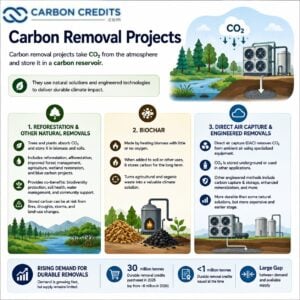
Direct Air Capture and Engineered Removals
Some carbon removal projects use technology to capture CO₂ directly from the atmosphere. Direct air capture (DAC) uses specialized equipment to extract CO₂ from ambient air. The captured carbon can then be stored underground or used in other applications, depending on the project.
Other engineered approaches include carbon capture and storage, enhanced mineralization, and other technologies designed to permanently or durably store atmospheric CO₂.
These technologies can offer more durable storage than some nature-based approaches, but they are generally more expensive and remain at an earlier stage of deployment.
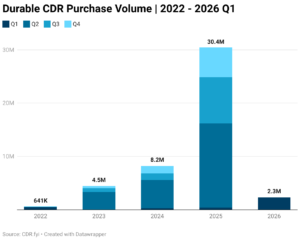
Demand for durable carbon removals has increased sharply in recent years. In 2025, buyers purchased an estimated 30 million tonnes of durable carbon removal credits, up from about 8 million tonnes in 2024, according to CDR.fyi data. Yet, fewer than 1 million tonnes of durable removal credits had been issued at the time, highlighting the gap between demand and available supply.
Why Does the Project Type Matter?
The type of project matters because each approach has different costs, risks, climate benefits, and measurement challenges.
A methane capture project may prevent a powerful greenhouse gas from reaching the atmosphere. A forest project may protect existing carbon stocks or increase biological carbon storage. A DAC facility physically removes CO₂ from the atmosphere and can store it for very long periods.
These differences also affect carbon credit prices. Lower-cost emissions-reduction projects can generate relatively inexpensive credits, while newer carbon-removal technologies can cost substantially more. But a higher price does not automatically mean a better credit.
Buyers should examine whether the claimed emissions reduction or removal is real, measurable, additional, durable, and independently verified. They should also consider risks such as leakage, reversal, and double counting.
The Bottom Line
Carbon credits can be generated by a wide range of projects, from renewable energy and methane capture to forest conservation, clean cooking, agriculture, biochar, and direct air capture.
The key distinction is whether a project reduces or avoids emissions or removes CO₂ from the atmosphere. Both can play a role in climate action, but they have different costs, risks, and methods for measuring their impact.
As the carbon market develops, demand is increasingly shifting toward projects that can demonstrate strong and durable climate benefits. Understanding where a carbon credit comes from is therefore just as important as knowing its price.