

Businesses and governments are turning to cutting-edge technologies to help meet climate goals as the global push for decarbonization intensifies. One company at the forefront of this transformation is D-Wave Quantum Inc. (NYSE: QBTS), a pioneer in commercial quantum computing based in Canada, with offices in California.
D-Wave uses a unique method to tackle tough optimization problems. So far, it has helped reduce emissions, integrate clean energy, and promote sustainable operations. Let’s discover how this company and its technology help decarbonize industries and businesses.
What Makes Quantum Computing Different?
Quantum computers are different from traditional ones. They use qubits instead of bits. While bits can only be 0 or 1, qubits can be in many states at once.
This key difference allows quantum systems to consider many possible solutions at the same time, making them great for solving optimization problems. These include route planning, supply chain logistics, energy grid balancing, and materials simulation. All these factors help reduce carbon emissions.
D-Wave focuses on quantum annealing. This type of quantum computing is great at finding the best solutions from many options. It is this capability that makes D-Wave’s technology so promising for climate-focused applications.
How It Works: Quantum Annealing
Quantum annealing is D-Wave’s signature method of computing. It is great at finding the best solutions for problems with many variables. For example, it can balance loads in a power grid or find the most fuel-efficient delivery routes.
D-Wave uses quantum annealing to model situations in real-time. This enables them to adjust strategies based on live data. It’s a key feature for changing systems like city traffic and renewable energy grids.
Real-World Impact: From Grid Efficiency to Cleaner Cities
D-Wave’s quantum systems are already in use across various industries to reduce emissions, cut energy use, and enhance operational efficiency. These real-world applications illustrate the technology’s value beyond the lab:
-
Grid Optimization and Renewable Integration
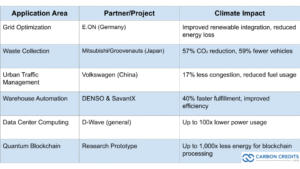
D-Wave is working with E.ON, a major utility in Europe. They aim to manage energy grids that rely more on solar and wind power. Their quantum algorithms optimize power flow, forecast energy generation, and create microgrids. This ensures local stability and efficient energy use.
Result: Reduced energy waste, improved load balancing, and more reliable integration of renewables into the grid.
-
Emission Reduction in Logistics
In Tokyo, D-Wave partnered with Mitsubishi Estate and Groovenauts to optimize waste collection routes. Using quantum computing, they reduced driving distances from 2,300 km to 1,000 km per route.
Result: 57% reduction in CO₂ emissions, 59% fewer vehicles needed, and 38% decrease in work hours.
Similar collaborations with Volkswagen have demonstrated a 17% reduction in traffic congestion through improved fleet coordination.
-
Cleaner Computing
Traditional data centers are energy-intensive. For specific optimization tasks, D-Wave’s systems use up to 100 times less energy than classical supercomputers. This improved efficiency is crucial as digital infrastructure expands globally.
-
Scope 3 Emissions and Sustainable Operations
D-Wave’s technology helps companies tackle tough Scope 3 emissions. It does this by optimizing supply chains, delivery routes, and energy use in its ecosystems.
QBTS Key Case Studies Highlighting Climate Impact
Quantum Advantage in Action
D-Wave’s latest system, Advantage2, features over 4,400 qubits and includes a new Zephyr-12 topology. It offers:
- 40% higher energy scale
- 75% lower noise levels
- 2x coherence time
- 20-way qubit connectivity
In high-precision workflows, Advantage2 has demonstrated performance that is 10,000x faster than earlier models. It uses only 12 kW of power. This makes it one of the most energy-efficient platforms for large-scale optimization tasks.
The system is accessible through Leap™, D-Wave’s cloud-based quantum platform. This allows users worldwide to use quantum capabilities without needing to own any hardware. This makes powerful quantum solutions accessible to businesses of all sizes, from logistics firms to utilities.
Fundraising and Strategic Partnerships
D‑Wave has recently strengthened both its balance sheet and global alliances:
In December 2024, it raised $175 million via at‑the‑market equity offerings. With over $160 million in cash by quarter end, the funding supports technical development and product expansion.
CEO Dr. Alan Baratz said it positions the company “to fully execute against our product and go‑to‑market strategy”.
In January 2025, D-Wave teamed up with Carahsoft. Carahsoft is a major U.S. government IT services provider. They will distribute quantum solutions to agencies like NASA and intelligence services through federal procurement channels.
In June 2025, it signed an MOU with Yonsei University and Incheon City in South Korea. This agreement aims to develop and install an Advantage2 system for both academic and commercial use.
Other partnerships include Staque (Middle East adoption), Zapata AI (hybrid quantum-generative AI), and Interpublic Group (quantum marketing optimization). These moves position D‑Wave for climate-focused impact and broader quantum adoption.
Expanding Market and Commercial Growth
D-Wave serves over 100 clients, including Mastercard, Deloitte, Siemens Healthineers, Ford, BBVA, and Lockheed Martin. In May 2025, its stock surged by 20% after launching Advantage2 on the Leap cloud platform.
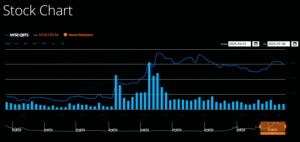
The company has raised over $400 million in funding and holds around $800 million in cash, positioning it well for continued growth. In Q1 2025, D-Wave saw its revenue rise by 509% compared to last year. This growth shows increasing commercial interest in its quantum solutions.
D-Wave is not only focused on its quantum annealing systems, but is also looking into hybrid methods that use gate-based models. This helps D-Wave stay competitive with companies like IBM and Google.
Sustainable Tech for ESG and Net-Zero Goals
D-Wave’s technology directly supports several U.N. Sustainable Development Goals:
- Goal 7: Affordable and Clean Energy
- Goal 11: Sustainable Cities and Communities
- Goal 13: Climate Action
Moreover, its quantum solutions provide measurable ESG benefits, including the following:
- 20% CO₂ reduction for logistics companies
- 17% cut in urban congestion
- 40% improved warehouse operations
Quantum Computing for a Cleaner Future
As the demand for low-carbon innovation grows, D-Wave is demonstrating that quantum computing can offer practical, immediate solutions. D-Wave’s systems support sustainable infrastructure and business operations. They help with grid optimization, emissions reduction, clean energy forecasting, and logistics planning.
By merging advanced computing with environmental responsibility, D-Wave is helping industries worldwide move closer to a net-zero future.