


New research suggests China’s farmland could become a major source of carbon removal using crushed rock. The technique, known as enhanced rock weathering (ERW), speeds up a natural process that removes carbon dioxide (CO₂) from the atmosphere.
A study published on October 10, 2026, examined the potential to spread basalt across Chinese croplands. The researchers estimated that a single year of application could remove 440 million to 790 million tonnes of CO₂ by 2100, depending on the modeled conditions.
Separately, another news report stated that sustained deployment could remove up to 350 million tonnes annually. These figures represent modeled potential, not carbon removal already being achieved at scale.
The findings point to a possible new tool for China’s climate strategy. However, large-scale deployment will depend on costs, suitable farmland, environmental safeguards, and reliable measurement of the carbon removed.
How Basalt Speeds Up Nature’s Carbon Removal Process
ERW speeds up the natural weathering of rocks. Rainwater absorbs CO₂ and reacts with minerals as rocks break down. This process can turn carbon into dissolved bicarbonate, which may flow through rivers toward the ocean.
For ERW projects, developers grind rocks such as basalt into smaller particles and spread them over farmland. The extra surface area helps the minerals react faster with water and CO₂.
The method may also improve soil conditions. Basalt contains minerals that can supply nutrients, and weathering may help reduce soil acidity in suitable fields. But the amount of rock spread on farmland does not equal the amount of carbon removed.
Projects must account for emissions from mining, grinding, transport, and application. They must also measure how much carbon stays stored rather than returning to the atmosphere.
What the China Study Found
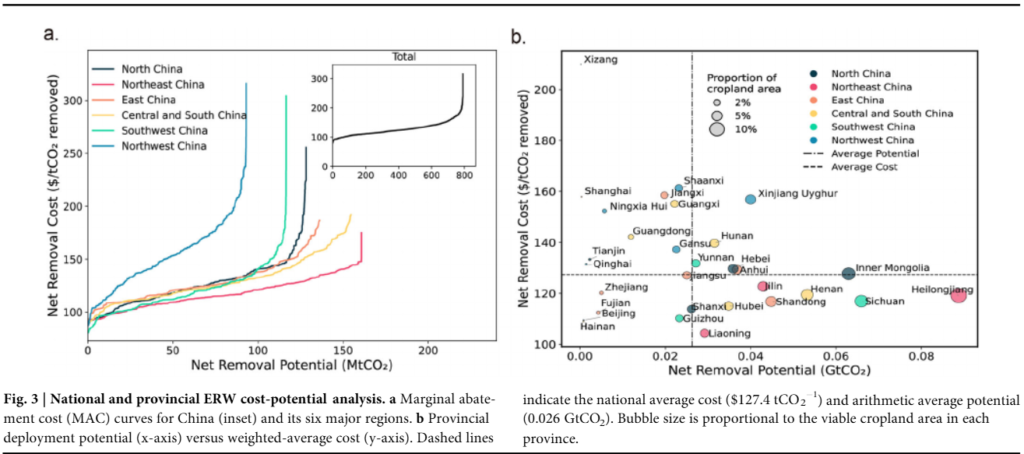
The research, by Zeyu Wang and Fei Teng of Tsinghua University and David M. Reiner of the University of Cambridge, assessed ERW potential and costs across China’s croplands. The study estimated that a single year of basalt application could remove 440 million to 790 million tonnes of CO₂ by 2100. Its modeled net lifecycle cost ranged from US127 to US226 per tonne of CO₂ removed.
The researchers also assessed ERW’s possible contribution to China’s long-term climate goals. Under their modeled scenarios, the approach could meet 5% to 30% of the country’s negative-emissions needs by 2060.
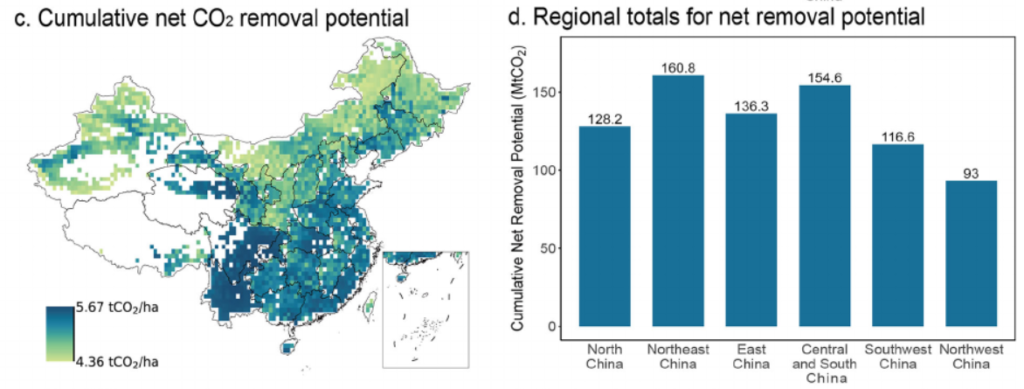
Northeast, Central-South, and East China emerged as priority areas for potential deployment. However, local conditions matter. Weathering rates depend on rainfall, temperature, soil chemistry, and rock type. The study therefore provides an initial national assessment, not a guarantee that every region can achieve the same results.
China’s Agricultural Land Offers Scale
China has a large agricultural base on which to test the technology. Its official 2025 statistical communiqué reported 119.41 million hectares of sown grain area. This is not the same as the area suitable for ERW, but it illustrates the scale of the country’s farming system.
Applying basalt to existing farmland could allow carbon removal to work alongside agricultural production. If the material improves soil quality or crop yields, those benefits could help make the process more attractive to farmers.
A 2023 study of farmland ERW in China reported an average crop-yield increase of 13.5%, with an uncertainty range of plus or minus 5.2%. It also modeled an annual national carbon removal potential of 280 million to 400 million tonnes. These are research findings, not guaranteed results for every crop or region.
Field trials will be important for establishing where basalt works best, how much to apply, and whether the agricultural benefits justify the added costs.
High Costs Could Slow Deployment
ERW requires suitable rock to be sourced, crushed, and transported to farms. Grinding rock into smaller particles uses energy, while moving heavy material over long distances can increase costs and emissions.
The new study’s estimated cost of US$127–US$226 per tonne of CO₂ removed highlights a major challenge for commercial projects. Lower-emission electricity, efficient transport, and access to suitable rock could improve the economics.
- RELATED: Microsoft Backs InPlanet’s Enhanced Rock Weathering Push to Remove 28,500 Tons of CO₂ in Brazil
Using suitable industrial by-products may also reduce the need for new mining. However, materials must be screened carefully to ensure they contain appropriate minerals and do not introduce harmful contaminants into farmland.
Carbon accounting presents another challenge. Buyers need credible evidence that projects remove additional CO₂ and that the reported removals reflect the full supply chain. Because weathering rates vary, projects also need robust monitoring to estimate how much carbon is captured and retained.
Heavy Metals and Water Quality Require Careful Monitoring
Large-scale basalt application requires safeguards for soil, crops, and water. Some rocks contain potentially harmful elements, including chromium, nickel, zinc, or cadmium. Their presence and availability depend on the material and local conditions.
A 2026 study assessing rock resources in South China identified potential materials for ERW but emphasized the need to monitor environmental risks. It highlighted Fujian as a promising location for initial field trials.
Researchers also need to track what happens after dissolved carbon leaves the soil. Some carbon may reach rivers and oceans, but the amount that remains stored depends on downstream chemical processes.
Careful selection of rock, appropriate application rates, and long-term monitoring will therefore be essential. These measures can help protect agricultural land while improving confidence in reported carbon removals.
Global ERW Market Shows Promise, But Costs Remain High
The global enhanced rock weathering market is growing as companies explore ways to remove CO₂ from the atmosphere. A September 2025 review in Nature Reviews Earth & Environment estimated that enhanced weathering could remove 0.5 billion to 2 billion tonnes of CO₂ annually by 2050. This is a technical potential estimate, not a forecast of confirmed removals.
Corporate buyers are already signing deals with ERW developers. Frontier, a buyer group that funds carbon removal projects, reports 333,000 tonnes of enhanced-weathering removals contracted, worth US$121 million, across seven companies. Its listed average purchase price is US$362 per tonne, with prices ranging from US$270 to US$500. These figures cover contracted purchases, not removals already delivered.
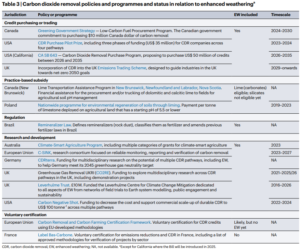
High prices and the difficulty of measuring carbon removal remain key barriers. Projects must prove how much CO₂ they remove, account for emissions from crushing and transporting rock, and monitor possible environmental risks. Lower costs and stronger measurement methods will be essential for ERW to grow from an emerging carbon-removal approach into a larger global market.
Can ERW Become a Scalable Carbon Removal Market?
China’s ERW potential adds another option to the growing range of carbon-removal approaches. The technology could interest buyers seeking measurable removals, particularly if projects can demonstrate strong monitoring and reliable net climate benefits.
However, the market opportunity remains tied to cost and proof. The headline figure of 350 million tonnes of CO₂ per year is a potential scenario, not a current supply estimate. Projects would need to show how much carbon they remove after accounting for emissions from rock processing and transport.
For China, the next steps include field testing, identifying suitable regions, improving measurement methods, and assessing environmental impacts. These efforts could help establish where ERW offers the strongest combination of carbon removal, agricultural value, and cost efficiency.
If those challenges can be addressed, enhanced rock weathering could support China’s wider climate strategy. It would still complement—not replace—direct reductions in fossil-fuel emissions.